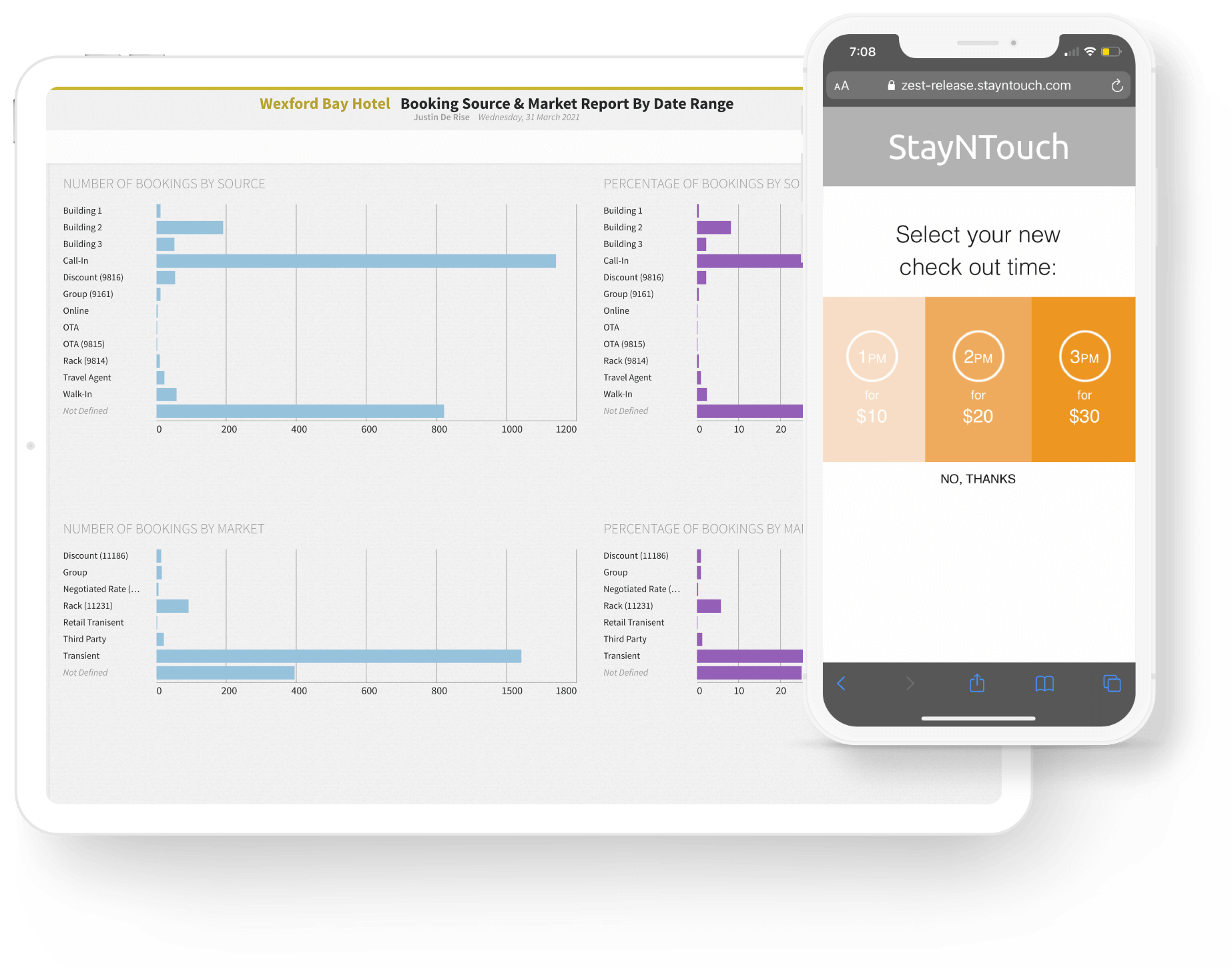
To understand the current state of hospitality technology, one must first address the foundational question: what is a PMS integration?
At its essence, PMS integration is the process of establishing a secure, real-time data bridge between the property management system and third-party applications or hardware.
This connectivity allows a unified ecosystem to emerge, where a guest’s journey—from the initial booking on a mobile app to their final room charge for a late-night snack—is tracked, analyzed, and optimized within a single data layer.
Types of Systems That Integrate with Hotel PMS
Hotel PMS can integrate with nearly any software or systems in your hotel, but most often is linked with:
- Central Reservation Systems (CRS) like SynXis, Windsurfer, TravelClick, Pegasus, and SiteMinder
- Revenue Management Systems (RMS) like IDeaS G3 and Duetto
- POS systems integrations like Toast for restaurants and Impulsify for smart vending machines and micro-markets
- Contactless tech & mobile key vendors like OpenKey, Flexipass, Salto, and Zaplox
- Customer Relationship Management (CRM) tools like Revinate
- Guest Messaging Platforms like Zingle, Canary, Birdy, and the upcoming AI-Powered Stayntouch Guest Messaging
- Payment Terminals and Gateways like Stayntouch Pay
- Accounting and back-office software like Data Plus
The Shift from Standalone Systems to Connected Ecosystems
Historically, hotel technology operated in silos. Your PMS handled reservations, your POS managed transactions, and separate systems oversaw revenue management, housekeeping, payments, and guest communication. These systems rarely communicated, forcing staff to manually transfer data between platforms.
This fragmented approach created inefficiencies, increased the risk of errors, and limited visibility into real-time performance.

A modern property management system (PMS) is no longer a standalone tool. It is the operational core of your hotel’s technology ecosystem. As guest expectations evolve and operational complexity increases, the ability of your PMS to seamlessly integrate with other systems has become a defining factor in what separates average platforms from best-in-class solutions.
The shift from on-premise, hosted solutions to cloud-native, API-first platforms has revolutionized this landscape. Cloud-native platforms are designed for continuous availability, boasting near 100% uptime and providing the flexibility required to adopt new technologies without the “rip and replace” hardware cycles common in the past. This evolution has created a competitive advantage for hotels that prioritize a connected stack with operational automations, allowing them to reduce administrative costs by 20% – 40% while simultaneously improving Revenue Per Available Room (RevPAR) through smarter pricing and distribution.
For your hotel, integrations are not a “nice to have.” They are essential to driving efficiency, enhancing guest experiences, and future-proofing your operations.
Today, best-in-class PMS platforms act as the central hub in a connected ecosystem. Through integrations, your PMS communicates seamlessly with the tools your hotel relies on, enabling automated workflows, real-time data sharing, and a more unified operation. The result is a more agile, efficient, and guest-centric hotel.
How PMS Integrations Benefit for Your Hotel
Streamlining Operations and Reducing Manual Work
Integrations eliminate the need for duplicate data entry and manual processes. Reservations, guest profiles, charges, and room statuses flow automatically between systems.

For your hotel, this means fewer errors, faster workflows, and more time for your team to focus on delivering exceptional service. Properties utilizing proper channel manager integration see overbookings drop by or more while reducing manual OTA management time by approximately
Enhancing the Guest Experience
A connected PMS enables personalized, seamless guest journeys. With integrated systems, your hotel can anticipate guest needs, tailor communications, and deliver a consistent experience across every touchpoint. This level of personalization drives satisfaction, loyalty, and repeat bookings.

For example, you could push personalized offers like spa-upgrades and discounts based on past customer activities. Or promoting a guest’s favorite snack in the lobby can convert at a higher rate compared to more generic promotions.
As AI agents are rolled out across the hospitality industry, AI hotel chatbots can also serve as the first point of contact. Stayntouch’s AI guest messaging system handles pre-arrival questions and local recommendations 24/7, which can increase direct booking conversion rates by up to 14%.
Enabling Smarter Revenue Management
Real-time integrations ensure your pricing and availability are always accurate across channels. This allows your hotel to respond dynamically to demand, optimize rates, and maximize revenue without added manual effort.
Creating a Unified View of Your Business
When your systems are integrated, your data is centralized. This gives your hotel a clear, real-time view of performance across departments, empowering faster, more informed decision-making.
Supporting Scalability and Growth
As your hotel grows, your technology needs evolve. A well-integrated PMS allows you to add new tools, services, and capabilities without disruption, ensuring your system scales alongside your business.
IoT and Smart Room Control
Smart rooms in 2026 leverage IoT (Internet of Things) to adjust temperature, lighting, and entertainment settings automatically upon check-in based on guest profiles. This is not just a comfort feature; it is a major driver of sustainability and cost reduction.
For example, occupancy sensors integrated with the PMS allow HVAC systems to power down in unoccupied rooms, reducing energy consumption by an estimated.
How Hotels Integrate Third-Party Apps with Their PMS
Modern hotels rely on dozens of software tools including booking platforms, housekeeping apps, billing systems, and more. To work seamlessly, these tools need to share information with the hotel PMS quickly, reliably, and, in some cases, without human input or action.
There are three main ways they do this:
- APIs are the most common method. One system sends a request, another responds with data like texting a question and getting a reply. Fast, flexible, and widely supported.
- Webhooks take things a step further by removing the need to ask at all. The moment something happens (a guest checks in, a booking is cancelled), the system automatically pushes that update to wherever it needs to go instantly.
- AI Agents, once triggered to play their part in an automated workflow, act on pre-provided datasets and instructions. For example, they can manage guest interactions when messaged by a user for most purposes. If they can’t answer the user, they can forward messages that require a human touch to a hotel staff member.
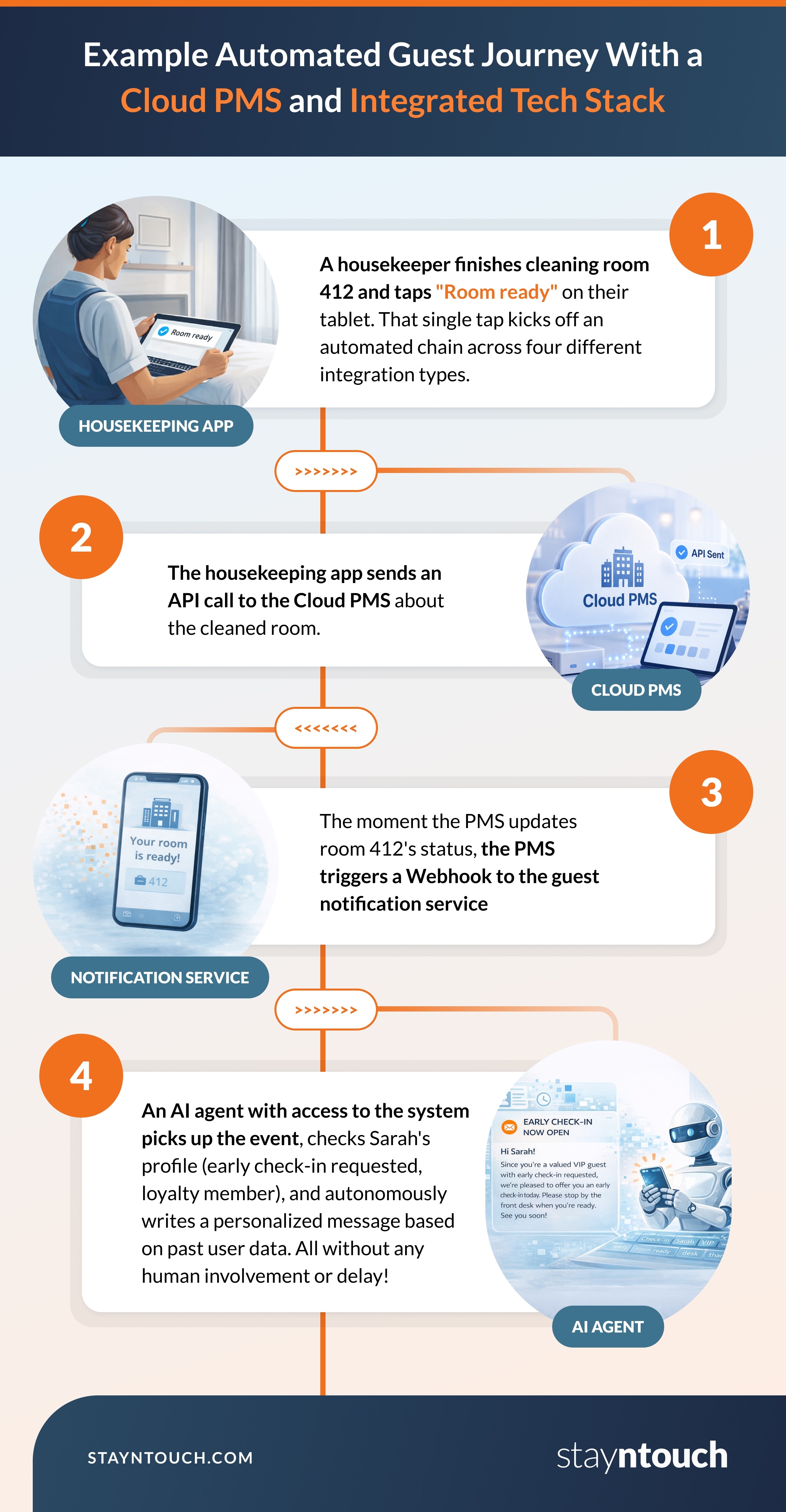
Example automated guest journey with a cloud PMS and integrated tech stack
- A housekeeper finishes cleaning room 412 and taps “Room ready” on their tablet. That single tap kicks off an automated chain across four different integration types.
- The housekeeping app sends an API call to the PMS about the cleaned room.
- The moment the PMS updates room 412’s status, the PMS triggers a Webhook to the guest notification service
- An AI agent with access to the system picks up the event, checks Sarah’s profile (early check-in requested, loyalty member), and autonomously writes a personalized message based on past user data. All without any human involvement or delay!
Without an integrated tech stack, this whole chain would be manual. The housekeeper would radio or call the front desk to say the room is ready. A staff member would manually update the PMS. Someone would then look up the guest’s details, find their number, and either call or manually text them. Each handoff could lead to a potential delay or mistake: rooms getting missed, guests waiting in the lobby not knowing their room is ready, and staff spending time on coordination rather than service. During busy check-in periods this compounds quickly.
What to Look for in a PMS Integration Strategy
Not all integrations are created equal. To truly unlock the value of a connected ecosystem, your PMS must be built on a modern, flexible, and high-performance integration framework that supports reliability, speed, and long-term scalability.
- Cloud-Native Architecture with Near 100% Uptime
A cloud-native PMS is the foundation of a strong integration strategy. Unlike legacy systems, cloud-native platforms are designed for continuous availability, ensuring your integrations are always active and performing reliably.
For your hotel, this means no downtime disruptions, consistent data flow between systems, and the confidence that your operations and guest services are always running smoothly.
- Open APIs for Unlimited Flexibility
Open APIs give your hotel the freedom to connect with best-in-class solutions across your technology stack. Instead of being restricted to a closed ecosystem, you can choose the tools that best align with your operational goals.
This flexibility is critical as your needs evolve, allowing your hotel to adopt new technologies, integrate specialized solutions, and remain competitive without being locked into a single vendor’s limitations.
- Real-Time Performance with Webhooks
Speed matters when it comes to integrations. Webhooks enable real-time data exchange between systems, ensuring updates happen instantly rather than through delayed, batch-based processes.
For your hotel, this translates to more accurate availability, immediate updates to guest profiles and folios, and faster, more responsive operations across every department.
- Large Integration Library with No Additional Costs
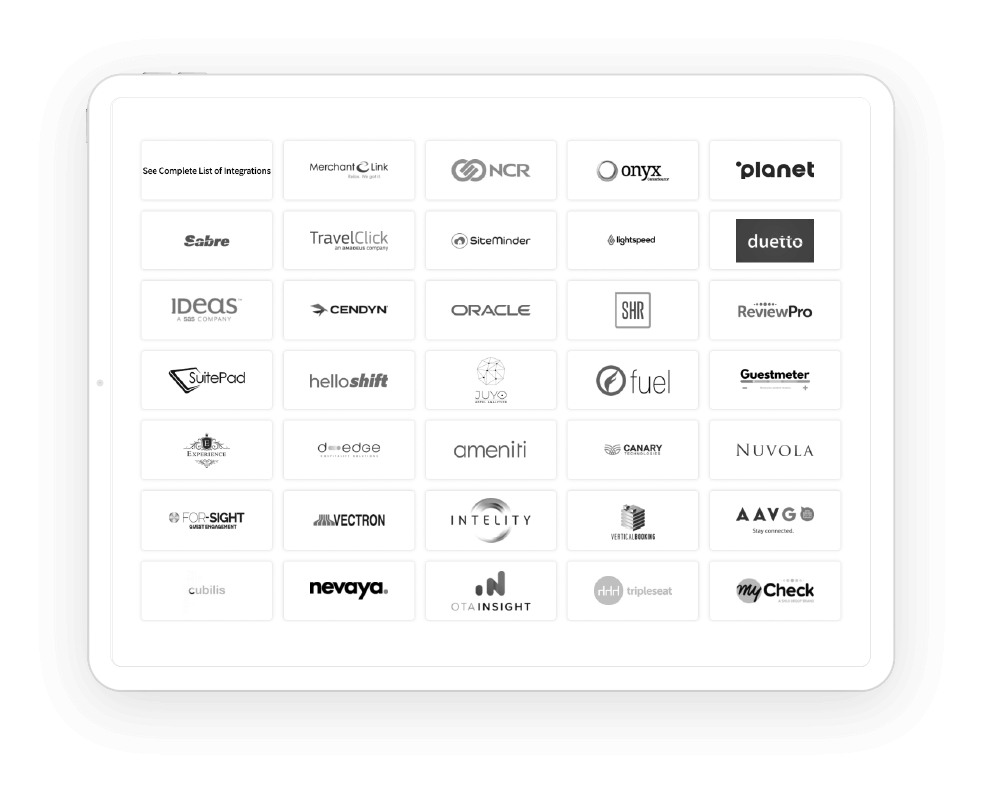
A best-in-class PMS should offer an extensive library of pre-built integrations, making it easy to connect with the systems your hotel already uses.
Equally important, these integrations should not come with hidden fees. A platform that includes integrations as part of its core offering reduces complexity, lowers total cost of ownership, and accelerates time to value.
Stayntouch’s PMS was named “Hotel PMS of the Year” for its 1,400+ integrations to other best-in-class hotel software. Check out our flexible, open-APIs and integrations to build your ideal tech stack.
2025 TravelTech Breakthrough Awards
- Expert Configuration and Implementation Support
Even the best integrations require proper setup. A strong PMS provider will offer expert configuration and onboarding support to ensure your integrations are implemented correctly and optimized for your workflows.
This hands-on approach minimizes disruption during deployment and ensures your hotel gets the full benefit of its technology investment from day one.
- A Strategic Partner with Exceptional Support
Integrations are not a one-time project. They are an ongoing part of your hotel’s operations. That is why it is essential to work with a PMS provider that acts as a true strategic partner.
Look for a team that offers proactive guidance, responsive support, and continuous optimization as your needs evolve. This partnership ensures your integration ecosystem remains aligned with your business goals over time.
The Pitfalls of All-in-One Marketplaces
While all-in-one app marketplaces may appear convenient, they often come with trade-offs. These ecosystems can limit flexibility, forcing your hotel to rely on a restricted set of tools that may not fully meet your operational or strategic needs.
As your hotel grows, these limitations become more pronounced. You may find it difficult to adopt new technologies, integrate specialized solutions, or adapt to changing market demands.
That is why growing hotel groups increasingly favor a best-in-class approach. By selecting purpose-built systems and connecting them through a robust PMS, your hotel gains the flexibility to innovate, scale, and stay competitive without being constrained by a closed ecosystem.
The Competitive Advantage of a Connected PMS
In today’s hospitality landscape, disconnected systems create friction for both your staff and your guests. A fully integrated PMS eliminates that friction, enabling your hotel to operate more efficiently and deliver a higher level of service.

The benefits are clear:
- Streamlined operations and reduced manual workload
- More personalized and consistent guest experiences
- Smarter, data-driven decision-making
- Greater flexibility to adapt and grow
Integrations transform your PMS into more than just a system. They make it the foundation of your hotel’s success.
Final Thoughts
The importance of integrations in a best-in-class PMS cannot be overstated. They are the backbone of modern hotel operations, enabling your systems to work together seamlessly and your team to perform at its best.
For your hotel, the right integration strategy unlocks efficiency, enhances every guest interaction, and positions your business for long-term growth.
In a world where connectivity drives performance, a truly integrated PMS is not just better. It is essential.
Contact us today to book a Stayntouch PMS demo and see how your current hotel tech stack would connect!