The best cloud-based hotel PMS runs on any device, automates what a lean team can’t cover, and scales without integration fees eating into your margins. Cloud-native is now the default; what separates the 2026 leaders is how much operational weight they lift off your staff and how cleanly they grow with you. This guide ranks nine strong platforms by fit, with Stayntouch out front for mobile-first, automation-heavy operations across independent, boutique, and multi-property hotels.
Your PMS is the one system your whole operation runs through, touching reservations, housekeeping, billing, and reporting alike, so choosing it is among the highest-stakes technology decisions an operator makes. In 2026, that decision increasingly lands in the cloud, with options ranging from simple all-in-one tools for a single B&B to enterprise platforms supporting thousands of rooms.
This analysis breaks down what a cloud PMS is, what to look for this year, and how the nine strongest platforms stack up, so you can match the right system to your property’s size, type, and growth plans.
What’s a Cloud-Based PMS?
A cloud-based hotel PMS runs on the vendor’s remote servers and is device-agnostic, so your team can manage reservations, rates, housekeeping, and billing from any device, anywhere. The vendor handles updates, security, and uptime behind the scenes, and the system scales without new hardware as you grow. A traditional on-premise PMS works the opposite way, tying the software and your data to physical servers at the property, along with the local hardware, manual updates, and on-site IT that keeps them running. See the main types of hotel PMS to compare the models.
The decision between cloud-based PMS vs traditional PMS comes down to flexibility and total cost of ownership, and for most operators, it favors cloud, though on-premises still holds a few advantages worth weighing.
| Pros of a Cloud-Based PMS | Pros of a Traditional (On-Premise) PMS |
| Accessible from any device, anywhere, through a web browser | Runs independently of internet connectivity |
| Automatic updates and security patches, no manual installs | One-time license rather than a recurring subscription |
| Predictable subscription pricing and a lower upfront investment | Full on-site control over where data is stored |
| Scales across new rooms and properties without added hardware | Deep customization for properties with dedicated IT teams |
| Faster integrations through open APIs, often with no added fees | Data stays on-site for strict compliance needs |
What to Look For in a Cloud PMS in 2026
The strongest cloud-based hotel PMS platforms in 2026 share the same core traits:
- Cloud-native design. The vendor handles upkeep, security, and uptime, so you skip on-site servers and an IT team, and updates roll out automatically across every property.
- Device flexibility. Your team works in any browser, anywhere on the property, and guests check themselves in on their own phones, with no app to download.
- Open APIs. You assemble the exact tech stack you want without paying a toll on every connection, as long as integrations, certifications, and support come at no extra charge. See how hotel PMS integrations work in practice.
- Automation. Repetitive front-desk and back-office work runs itself, so tight staffing never drags service down.
- Fast onboarding. New hires are productive within their first shift, helping maintain stable service amid the constant turnover that defines hospitality.
- Built-in upselling. In-the-moment upselling surfaces the right upgrade or add-on during mobile check-in, boosting revenue without your team having to implement an awkward desk-side pitch.
The 9 Best Cloud Hotel Property Management Software (PMS)
The nine platforms below are the strongest cloud-based hotel PMS options on the market. The best fit depends on your property type, size, and growth trajectory, so weigh each against your own operation before deciding.
Stayntouch
Stayntouch is a fully cloud-native PMS built on a single principle: place the burden of complexity on computers, not people. Guests register from any browser through a web-based check-in that needs no app, and behind the desk, the system runs itself, triggering contactless check-in the moment a room is ready, collecting deposits on routed bills, posting night-audit charges, and pushing housekeeping tasks to staff devices in real time. The payoff is a front-desk team freed to focus on the guest.
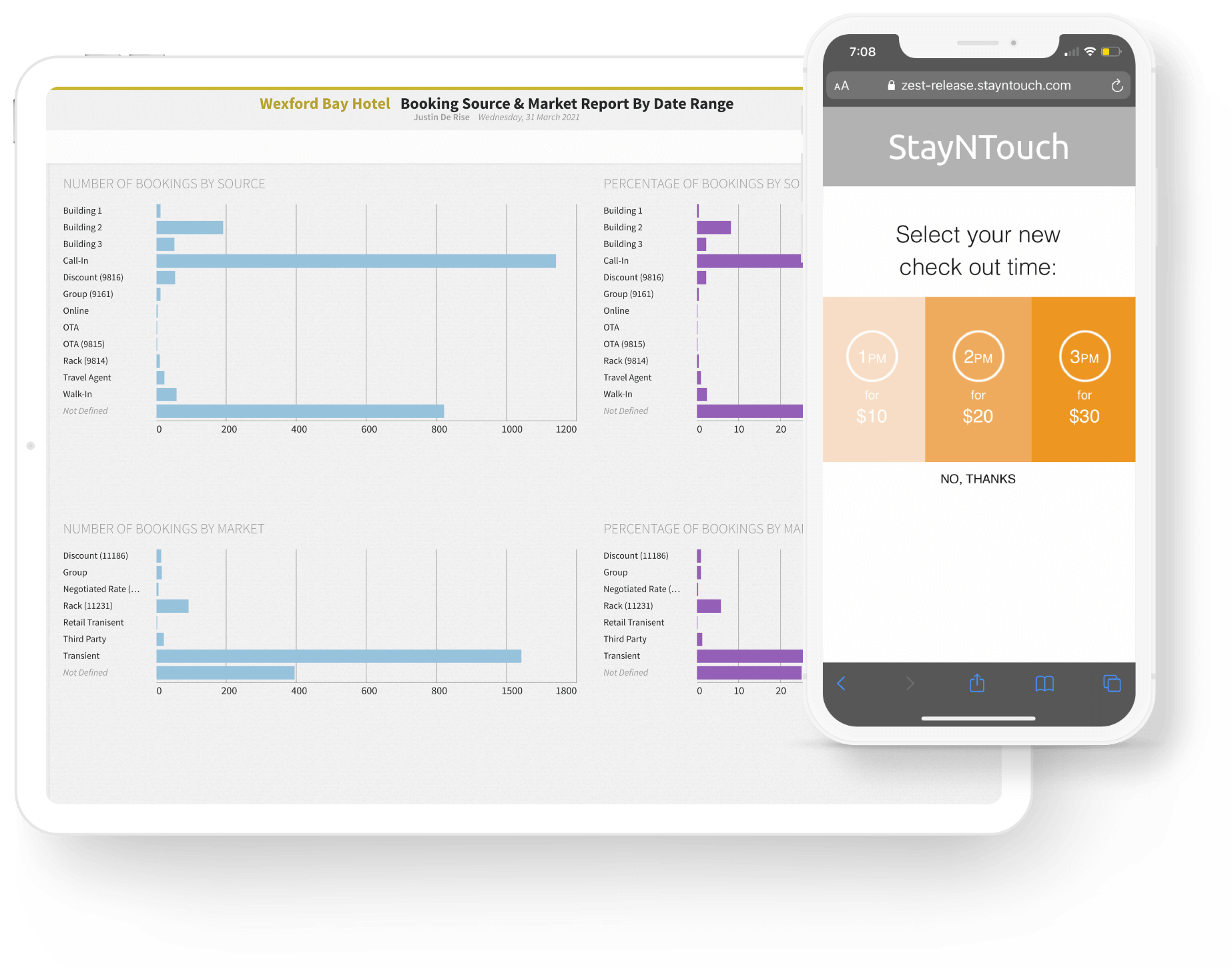
It also turns the PMS into a revenue engine by surfacing targeted offers for upgrades, early check-ins, late checkouts, and add-ons during mobile check-in, with lobby kiosks adding a second upsell moment upon arrival. Paired with real-time portfolio-wide reporting, 96% customer retention, and 100% uptime, Stayntouch sets the standard for cloud PMS performance.
Pros:
- 100% mobile parity, full PMS functionality on any device, anywhere on the property
- Rapid onboarding, with hotels live and teams trained in as little as two days
- Automated housekeeping that lifts productivity by up to 25% with mobile task lists and instant room status
- Automated, attribute-based upselling that increases ancillary revenue by up to 18%
- 1,400+ free integrations through the open Connect API architecture
- Automated check-in kiosks that get guests checked in in under a minute
Cons:
- Higher cost-per-feature ratio for all-in-one use cases at properties under 50 rooms
Best suited for: Independent and boutique hotels, as well as enterprise brands and mid-sized chains operating multiple properties.
Little Hotelier
Powered by SiteMinder, Little Hotelier is purpose-built for the smallest accommodation providers, owner-operators who want one simple system for bookings, rates, payments, and distribution. It bundles a PMS, channel manager, booking engine, website builder, and payments into a single color-coded calendar, and its real strength is reach: through SiteMinder’s network, small properties stay visible across hundreds of booking channels and capture direct bookings without manual updates. It performs well within its scope, as long as that scope stays small.
Pros:
- High-converting booking engine paired with SiteMinder’s global distribution network
- Ultra-simple color-coded calendar interface, learnable in under an hour
- No lock-in contract and a 30-day free trial, with month-to-month billing
Cons:
- Does not scale meaningfully beyond 30 rooms; growing properties typically migrate to a larger platform
- Lacks detailed housekeeping workflows and corporate or group billing capabilities
Best Suited For: Micro-properties, B&Bs, and guesthouses, typically under 30rooms.
Oracle OPERA Cloud
Oracle OPERA Cloud is the enterprise standard for large, complex hospitality operations, powering a significant share of the world’s major branded chains, casino hotels, and luxury resorts. Its strength is functional depth: extensive configuration, robust group and block management, and integrated sales and event management for banqueting and conferencing at scale. For a global brand that needs one system spanning thousands of rooms, centralized loyalty, and complex revenue routing, few platforms match its range, and that power is more than smaller properties need.
Pros:
- Massive configuration depth and enterprise-grade controls for complex global portfolios
- Integrated sales and event management for group, catering, and conference business in one system
- Meets the fiscal, legal, and compliance requirements that large brands and public operators demand across 200+ countries
Cons:
- High total cost that is difficult to justify for independent and mid-market properties
- Long implementation timelines; complex deployments commonly take several months to over a year
- Interface carries legacy-style workflow complexity that can slow down day-to-day use
Best suited for: Large global chains, casino hotels, and luxury resorts that need deep enterprise functionality across many properties.
RoomRaccoon
RoomRaccoon pulls the PMS, booking engine, channel manager, payments, and housekeeping into one place, then layers automation across the guest journey: online check-in and check-out, a digital ID and passport scanner that auto-fills guest details, automated guest emails and invoicing, and virtual card handling that reconciles OTA payments in a single view. The trade-off is its tightly integrated design. Because the value comes from everything working as one closed system, operators with complex workflows or heavy third-party integration needs may find it more constraining than the open, modular platforms larger operations tend to favor.
Pros:
- AI-driven dynamic pricing via RaccoonRev Plus that adjusts rates to demand, competitor rates, events, weather, and historical trends
- Built-in upselling through RaccoonUpsell that displays upgrade and add-on offers at booking and check-in
- All-in-one platform (PMS, booking engine, channel manager, housekeeping) that reduces vendor overhead
Cons:
- Less workflow flexibility than fully modular platforms, which can constrain properties with unusual operational needs
- Smaller integration marketplace, with support primarily Europe-centric
Best suited for: Boutique and independent hotels that want automated pricing and upselling built natively into their PMS.
Hotelogix
Hotelogix serves 12,000+ hotels across 100+ countries, delivering all-in-one cloud PMS functionality at pricing accessible to growing operators. Its draw for budget-conscious hotels and regional chains is multi-property capability without enterprise overhead: a Central Reservation Office lets head-office agents view rates and availability across every property from one login and take bookings on their behalf, a capability competitors often reserve for higher tiers. But the interface feels dated compared to newer cloud-native entrants, and some routine tasks require more clicks than they should, a drawback that compounds during busy shifts.
Pros:
- Strong all-in-one functionality at pricing that undercuts most enterprise alternatives
- Native Central Reservation Office for managing multiple properties from one central system
- Functional mobile app for managers and staff away from the front desk
Cons:
- Interface lacks the modern aesthetic polish of newer cloud-native platforms
- Some daily workflows require more clicks than necessary, adding friction for frontline staff
Best suited for: Growing regional operators and budget-conscious small to mid-sized hotels that need multi-property capability without the enterprise price tag.
Apaleo
Apaleo is the first hotel platform built entirely on the MACH architecture (microservices, API-first, cloud-native, headless), designed for hotel groups with developer resources and a clear tech stack vision. Every function is exposed through open APIs, and its store offers 200+ pre-integrated apps with no setup, license, maintenance, or per-integration fees, on a transparent per-room subscription. That openness is the whole proposition, and also the catch: Apaleo deliberately ships no native booking engine, channel manager, or revenue management, so the full operational stack comes from third-party apps that each need selecting, onboarding, and managing. Teams without developer resources will struggle to leverage it.
Pros:
- Fully open MACH architecture (microservices, API-first, cloud-native, headless) with complete API access
- 250+ apps and integrations in the Apaleo Store, with zero setup, license, maintenance, or integration fees
- Transparent per-room subscription (around €9/room per month) with no hidden costs
Cons:
- High technical dependency, since the open model requires developer resources to fully leverage
- Core capabilities like revenue management and channel management come from third-party apps, adding integration overhead
Best suited for: Tech-forward hotel groups and developers who want to build an open, best-of-breed stack without integration fees or vendor lock-in.
ZUZU Hospitality
ZUZU Hospitality pairs its PMS with hands-on revenue management rather than operating as a pure software vendor. Dedicated specialists manage pricing, distribution, and channel strategy on a property’s behalf, backed by regional market data most independent operators cannot access alone, while the cloud PMS handles reservations, housekeeping, and front desk in one dashboard. For an independent owner in Southeast Asia or India focused on running the property, that done-for-you model is a genuine differentiator against larger chains. The constraint is geography: ZUZU’s data, expertise, and support are calibrated specifically to those markets, making it a poor fit for properties elsewhere.
Pros:
- Done-for-you revenue management with dedicated human specialists, delivering chain-level pricing and distribution expertise without building a team
- Zero setup fees, built specifically for Southeast Asian and Indian market dynamics
- All-in-one cloud PMS bundled with expert-managed distribution strategy
Cons:
- Geographically focused on Asia-Pacific, with limited relevance for properties outside the region
- Revenue-share commission model means costs scale with the revenue generated
Best suited for: Independent hotels in Southeast Asia and India that want expert-led revenue management without building an in-house team.
roommaster
roommaster, formerly InnQuest and now rebranded, is a cloud platform built for independent properties with more than 30 years in hospitality software. Its main 2026 addition is roommaster Concierge, an AI voice agent that answers guest calls 24/7 in any language and books directly into the PMS, capturing after-hours inquiries that would otherwise go to voicemail. Its age shows in places: the interface feels dated compared to newer cloud-native systems, and the reporting tools can fall short when operators need deeper historical or group-level analytics.
Pros:
- Unified operations calendar across bookings, front desk, and housekeeping in one view
- Native POS connectivity, so transactions and folios stay in sync without a separate billing system
- roommaster Concierge AI voice agent answers every call 24/7 and books directly into the PMS
Cons:
- Room layout views can feel cluttered and difficult to scan when assigning rooms under high volume
- Automatic session timeouts can interrupt mid-task workflows
Best suited for: Independent hotels, motels, and lodges that want an all-in-one cloud system with built-in AI-powered guest communication.
RMS Cloud
RMS Cloud is geared towards multi-property groups, resorts, and outdoor hospitality operators such as holiday parks and campgrounds. Its differentiators are financial: advanced owner and trust accounting for mixed portfolios of trust and non-trust entities, robust multi-site inventory controls, and portfolio-level reporting that complex operations depend on. For a group managing varied property types from one system, that financial infrastructure is hard to match. But the cost is usability: the interface lags newer cloud-native entrants, and frontline teams typically need substantial training before they are fully productive.
Pros:
- Advanced back-office and trust accounting for managed and multi-owner property structures
- Robust multi-site inventory controls and portfolio-level reporting across varied property types
Cons:
- Interface feels dated compared to newer cloud-native platforms
- Steep learning curve; frontline staff require significant onboarding before they are productive
Best suited for: Multi-property groups, resorts, and outdoor-hospitality operators that need deep back-office accounting and centralized portfolio control.
FAQs
What Are the Best Cloud PMS for Limited-Service Hotels in 2026?
Limited-service hotels should prioritize lean operations automation, strong channel distribution, and minimal training time. Confirm the integration list before signing, since a brittle channel manager, payment, or guest-messaging connection causes the most pain; ask which are native, certified, or custom. And weigh ease of use over feature breadth: a system staff learns in a shift beats one that takes a week.
- Stayntouch: A consumer-grade interface, AI messaging, and self-service kiosks that absorb front-desk volume, with 1,400+ integrations to connect your core tools.
- WebRezPro: A well-established all-in-one for small and mid-sized independents, with strong distribution and reliable support.
- Little Hotelier: The simplest entry point for the smallest properties, learnable in under an hour.
What Cloud Hotel PMS Has Advanced Reporting Dashboards?
In 2026, the baseline is real-time reporting, with occupancy, ADR, RevPAR, pickup, and pace all updating in seconds. Look for three things: a drag-and-drop dashboard builder, a portfolio view that drills down to individual reservations, and open export or API access so your BI tool can pull data automatically. The best platforms also add AI summaries that explain why a number moved.
- Stayntouch: A Multi-Property Chain Dashboard with full drill-down, a scheduled custom-export builder, and open Connect APIs for direct BI integration.
- mycloud PMS: Real-time reporting for small and mid-sized properties that need live visibility without enterprise complexity.
- Apaleo: Full open-API access to granular real-time data for operators building custom BI environments.
What Cloud Hotel PMS Has Deep Scalability for Growing Hotels?
True scalability means adding properties within a single instance, with no separate system to stand up. Confirm that moving from an entry plan to enterprise carries your data, configurations, and integrations forward without re-implementation, and that multi-currency, multi-tax, and multi-language are native from day one. Confirm, too, that certified connectors exist for the RMS, CRM, BI, loyalty, and IoT tools you’ll need at maturity.
- Stayntouch: Multi-property without silos, with synced global profiles, portfolio-wide reporting, single sign-on, and native multi-currency and multilingual support.
- Oracle Hospitality OPERA Cloud: The global standard for the largest, most complex portfolios, scaling to thousands of rooms across international brands.
- Agilysys PMS: Enterprise-ready multi-property control for resorts and casinos with complex operational and financial needs.
See Why Hoteliers Choose Stayntouch as Their Cloud PMS
Every platform here earns its place for some property type. What sets Stayntouch apart is its command of the things hoteliers do every shift: a mobile-first interface that lets staff step out from behind the front desk and serve guests anywhere on property, kiosks and self-check-in that move guests through arrival in under a minute, and 1,400+ integrations that keep your stack connected as you scale from one property to many.
One hotelier put the difference plainly: with their old system, staff “could never raise their heads to look the guest in the eye” for all the screens they had to click through; Stayntouch took that same process down to far fewer steps.
See it in practice. Read Stayntouch customer stories from hoteliers across property types, watch how Cobblestone Hotels, a 139-property group, runs portfolio-wide operations on Stayntouch, or how Sage Hospitality’s Catbird Hotel elevated its independent boutique guest experience.