Summary: A hotel property management system (PMS) is the software that runs a hotel’s day-to-day operations, including reservations, check-in and check-out, housekeeping, billing, and rate management, all in one place.
If you’re new to the term “hotel PMS”, this guide breaks down:
- What a PMS in the hotel industry does
- What a modern hotel PMS should do, including:
- Streamlining operations
- Enabling remote access
- Supporting revenue growth
- Powering guest-facing technology
- How Stayntouch’s cloud-native PMS enables each function, from automated housekeeping tasks to integrations with the rest of a hotel’s tech stack
What Is a PMS in the Hotel Industry?
A property management system, or PMS, is the software hotels use to manage reservations, guests, rooms, and daily operations from a single platform. It’s often described as the “central nervous system” of a hotel property because nearly every department, from the front desk to housekeeping to accounting, uses it over the course of a guest’s stay.
Originally, hotel PMS software tracked reservations and guest folios. Today, a modern hotel PMS is expected to do more:
- Managing rates and availability
- Processing payments
- Coordinating housekeeping
- Handling group bookings
- Connecting to a hotel’s broader technology stack, including channel managers, booking engines, point-of-sale (POS) systems, and revenue management tools
A PMS captures and centralizes the data a hotel runs on, such as guest profiles, purchase history, room rates, and housekeeping status, all in one system of record.
What Does a Hotel PMS Include?
At minimum, a hotel PMS should include reservation and front desk management, guest profile, and customer relationship management (CRM) data, housekeeping and maintenance tracking, billing and financial reporting, and rate and revenue management. Most properties also expect it to handle group bookings and allotments, and to connect via APIs to the rest of their tech stack.
According to a 2026 study by HotelTechReport, the following trends have emerged over the last decade:
- 89% of hoteliers say their PMS saves their team between two and ten hours per week.
- 91% of those surveyed said their PMS has a direct impact on their revenue growth through upsells, rate optimization, and direct booking.
- 60% of hoteliers want built-in payment processing and housekeeping tools.
- 44% of hoteliers want CRM and guest-marketing integrations.
While these numbers are promising, 26% of those surveyed cite staff training as the biggest barrier to switching PMS vendors, with another 24% pointing to the data migration process as their top concern.
What Should a Hotel PMS Do?
Choosing the right hotel PMS for your property is not a decision you should make lightly. It’s an investment that requires you to think carefully about what you need. With that in mind, here are four things your hotel PMS should be doing, so that when it comes time to invest or upgrade, you know you’re making the right choice.
1. Streamline Operations
Hotels can, and do, run multiple systems across multiple departments to manage day-to-day operations. For maximum efficiency, your PMS needs to streamline critical functions into one system. Additionally, many of these systems need to communicate with one another.
With a cloud-based PMS, hotel staff don’t need to worry about whether a system is being mismanaged, which can negatively impact guest service and revenue. They can access, update, and track all the relevant information related to daily functions of the property and its guests, across all departments and locations, through a single platform. For example, front office staff can easily assign specific room-cleaning tasks to housekeeping, and both can track room status updates.
Additionally, there’s no more logging in and out of multiple systems or keeping paper files. By leveraging the cloud, hotels can manage their most critical tasks in one place, stay organized, save time, and keep their focus on guests rather than behind the desk.
2. Allow Remote Access on Multiple Devices
As today’s hoteliers are constantly managing on the go, a mobile or tablet-based PMS solution has become a necessity. Traditionally, a hotel PMS was installed on an on-site computer. That meant that staff movement was restricted based on the physical location of the PMS, which was typically the front desk.
Cloud-based PMS solutions let you manage your property anytime, from anywhere. Running in a browser, staff can remotely and securely log in for live access to everything they need, from bookings to check-ins, housekeeping reports, accounting, and billing. Staff can process orders, reservations, and payments. They can also check guests in and out from anywhere. This puts information at your employees’ fingertips and lets them serve guests wherever they are.
3. Support Revenue Streams
Hoteliers know that the execution of day-to-day operational tasks significantly impacts both guest service and revenue. Your PMS needs to maximize efficiency and support revenue growth across departments and locations.
One of the most valuable features of a cloud PMS is its ability to integrate multiple programs and consolidate guest stay information and preference data all in one place. By joining processes and centralizing information, a cloud PMS provides live, actionable analytics about a hotel and its guests. You can then use this data to optimize your services and make key decisions, promote personalized offers, and push upgrades and upsells to the right guest at the right time.
4. Be Guest-Facing
Guest-facing technology is now a must-have feature. Guest satisfaction remains one of the strongest drivers of repeat business and revenue. For today’s travelers, technology is critical.
Guests want to be able to check in on their own, which means your PMS needs to give guests control over their booking and stay, with the process as automated as possible. A cloud-based PMS with self-service capabilities provides a secure channel of communication between the hotel and its guests. It allows you to offer services like:
- Self check-in
- Booking changes
- Room service ordering
- Bill preview and secure payment
- Keyless entry
- Check-out
This gives guests more control over their stay while freeing your staff to focus on serving guests.
How Stayntouch Meets the Requirements of a Modern Hotel PMS
Stayntouch was built around the idea that a PMS shouldn’t be a glorified cash register in the back office. Instead, it’s a guest-centric PMS that’s a profit center built on four pillars: ease of operations, ease of access, ease of profitability, and ease of scale and connectivity. Here’s how these pillars translate into the functionality of a modern PMS.
Reservation and Front Desk Management
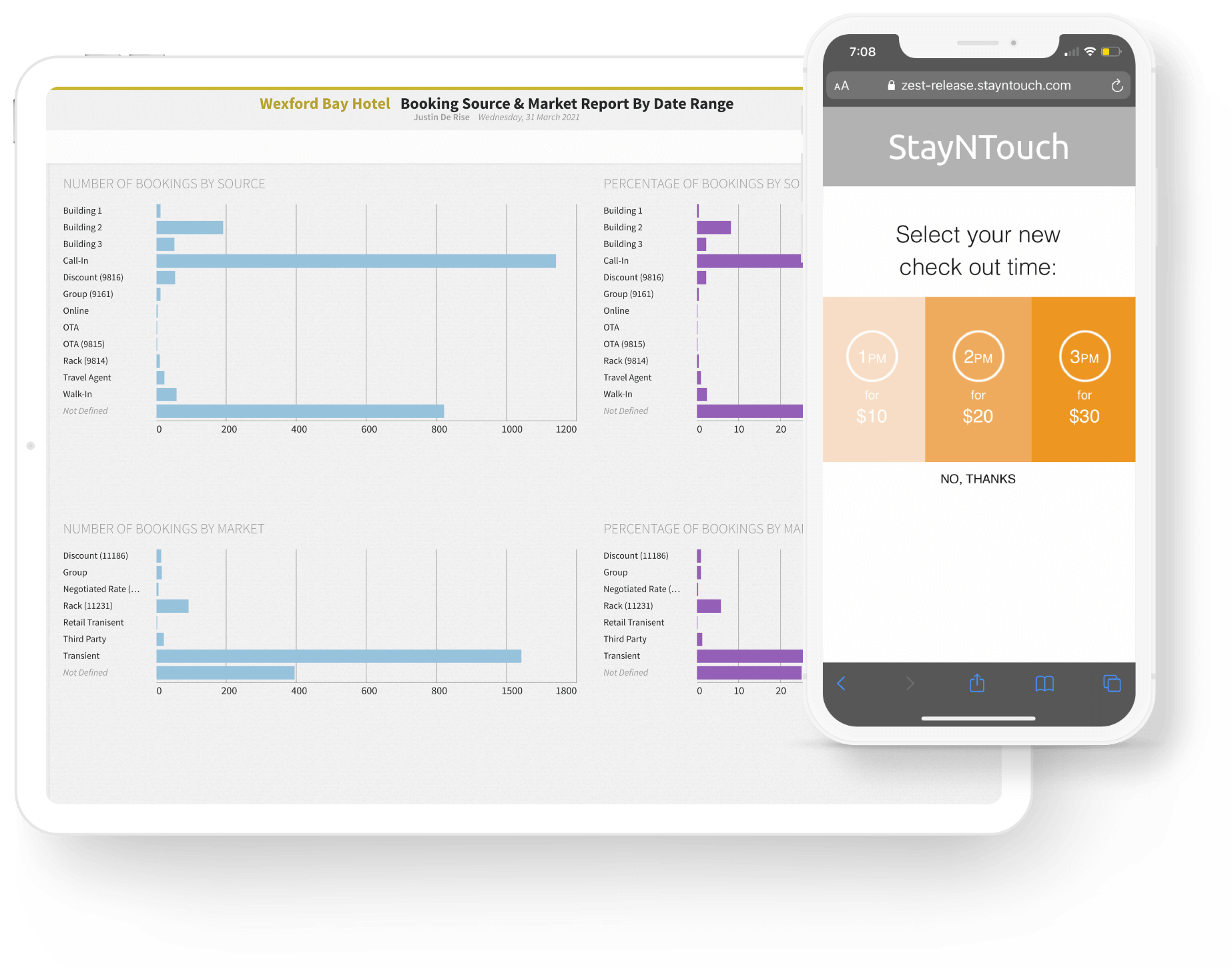
Stayntouch manages the full guest lifecycle, from arrival to departure. It supports front desk check-in to bulk check-ins for groups and fully contactless self-service via Zest Web (Mobile) and Zest Station (kiosk). An interactive room diary and “Auto Assign” feature instantly allocate rooms while skipping conflicting bookings. Additionally, “Party” functionality links reservations for groups traveling together.
Guest Profile and Data Management
The platform works as a built-in CRM, storing guest history, loyalty memberships, and specific preferences in a centralized profile. Staff can merge duplicate profiles into a single record without losing historical notes.
Housekeeping and Maintenance
Stayntouch automatically generates housekeeping tasks based on length of stay and configurable rules. Housekeepers track progress on a mobile tablet, tapping to start and stop cleaning, which instantly updates room status for the front desk. This prevents a room from reverting to dirty if a guest checks out after it was already cleaned.
Financial Control and Accounting
The system automatically extracts virtual credit cards from OTAs and routes charges to a hidden secondary bill, supports split billing across multiple guests, and includes a full accounts receivable module with dynamic tax rules that adjust by room type, season, or length of stay.
Revenue Management and Distribution
A native Rate Strategy tool automatically adjusts room rates based on current occupancy. The system pushes monetized early check-ins, late checkouts, and upgrades directly to a guest’s phone or a kiosk. As the anchor of a hotel’s distribution stack, Stayntouch connects via open API to booking engines, channel managers, central reservation systems like Sabre by SynXis and SiteMinder, and revenue management systems like IDeaS and Duetto.
Multi-Property and Enterprise Scale
For hotel groups, a Multi-Property Chain Dashboard lets executives manage 100 or more properties from a single login and view aggregated portfolio analytics. Chain administrators can build rate codes, cancellation policies, and housekeeping templates once and push them to every subscribed property to keep brand standards consistent.
Cloud Architecture and Ecosystem Connectivity
Unlike legacy, on-premise systems, Stayntouch is hosted on Amazon AWS and delivers automatic updates roughly every three weeks without hotel IT staff managing servers or patches. Its open-API architecture supports more than 1,100 direct and indirect integrations, with live data exchange via webhooks connecting the PMS to POS systems, Internet of Things (IoT) sensors, and door lock encoders. This makes it the central hub that you want your PMS system to be.
Book a demo to see how Stayntouch can help streamline your daily operations today.
Frequently Asked Questions About Hotel PMS
What does PMS stand for in the hotel industry?
PMS stands for property management system. In the hotel industry, it refers to the core software platform used to manage reservations, guest profiles, room assignments, housekeeping, billing, and rate management from a single system.
What is the main function of a hotel PMS?
A hotel PMS centralizes the operational data a property runs on, such as reservations, guest profiles, room status, and financial transactions. Staff across departments can access accurate live information instead of using separate systems or manual processes. It makes sure the front desk, housekeeping, and accounting are working from the same data.
Is a cloud-based PMS different from a traditional hotel PMS?
Yes. A traditional, on-premise PMS runs on a physical server at the hotel, which limits staff to working from a specific spot and requires the hotel to maintain its own hardware and IT support. A cloud-based PMS runs on remote servers accessed through the internet, letting staff manage the property from anywhere, while the vendor oversees maintenance, security, and software updates.
A hotel property management system (PMS) is the central point of hotel operations. It has become an