TL;DR: Hotel inventory covers far more than rooms. It includes rate plans, packages, meeting space, F&B, retail, and the supplies staff use to service a stay. A hotel inventory management system tracks all of it in real time, syncs it across every booking channel, and applies rules, like sell limits, dynamic pricing, and automated upselling, so hotels can sell more of what they have without overbooking or underselling it. We break down what hotel inventory actually is, the methods and software that manage it, how distribution works, and how hotels move unsold inventory without a public discount.
What Is Inventory in the Hotel Industry?
Ask a general manager and a revenue manager what “hotel inventory” means, and you might get two different answers. The GM is thinking about rooms, linens, and the minibar. The revenue manager is thinking about rate plans, sell limits, and channel allocations. Both are right.
Hotel inventory is any asset with a finite, perishable supply that the property sells or consumes to generate revenue.
That includes:
- Room inventory: Every room type, from standard king to suite, plus the rate plans, packages, and restrictions attached to each one.
- Meeting and event space: Conference rooms, ballrooms, and banquet space are often sold alongside room blocks.
- Food and beverage: Restaurant covers, banquet menus, and minibar stock levels.
- Retail and ancillary inventory: Spa slots, parking, and add-on experiences sold at booking, during self check-in, or during the stay.
- Operational supplies: Linens, toiletries, and consumables managed through procurement that keep rooms sellable but don’t generate revenue directly.
Unlike a retailer holding stock for next season, a hotel’s inventory expires daily. That’s what makes hotel inventory management a revenue discipline and an operational necessity.
What Is the Purpose of a Hotel Inventory Management System?
A hotel inventory management system exists to answer one question continuously: what do we have left to sell, at what price, and on which channels? Without a hotel inventory management software or system in place, those answers live in spreadsheets, phone calls to the front desk, and manual updates to each OTA extranet.
The purpose of the system is to:
- Keep room counts, rates, and restrictions accurate across every channel at the same time.
- Apply business rules automatically, like closing a discounted rate once demand hits a threshold, without a person having to catch or update it.
- Give revenue managers one place to see occupancy, ADR, and RevPAR trends and adjust strategy from any device.
- Prevent the two costly failure modes: overbooking a sold-out night and leaving inventory unsold because it wasn’t visible where guests were looking.
Hotel Inventory Management Methods That Move Revenue
The hospitality industry is a fiercely competitive space and inventory management plays a critical part in overall hotel success. Here are eight ways to streamline inventory management to maximize revenue opportunities.
1. Dynamic pricing and rate optimization
Static rates fail to earn max profit during high-demand days or events and over-price rooms during slow seasons. Tools like Stayntouch Rate Strategy acts as a native, lightweight revenue management tool that automatically adjusts rate amounts or applies restrictions across up to ten customizable occupancy thresholds. It can target discounted “based on” rates specifically, closing them out as demand rises while the core parent rate stays open at full price.
Any revenue management system (RMS) used should give revenue managers one console to set and review pricing and restrictions, including closed dates, minimum and maximum length of stay, and stay-through requirements, across date ranges and room types.
2. Strategic sell limits and overbooking control
Sell limits let hoteliers configure planned overbooking or underbooking at both the room-type and house level. That way a property can oversell its lower-tier rooms and upgrade those guests on arrival, capturing more bookings without turning away revenue.
On the other side of that risk, property management systems (or PMS-integrated software) should handle zero-inventory sync to protect against a costly overbooking mistake. It pushes a signal to every connected channel manager the moment house availability reaches zero, closing distribution before a channel accepts one reservation too many.
Inventory status matters just as much as inventory count. Marking a damaged or seasonal room as Out of Inventory removes it from the property’s active room count entirely, so occupancy and RevPAR calculations reflect what’s actually sellable rather than counting a room that was never available to book. That’s different from Out of Order, which keeps the room in the count but flags it as temporarily unavailable.
3. Automated ancillary upselling
Room inventory isn’t the only revenue lever. Software like Upsell Pro dynamically prices specific attributes–like a high floor, an ocean view, or premium bedding–and presents those upgrades to guests automatically during mobile or kiosk check-in. Because the system enforces maximum length-of-stay rules on upgrade room types, premium inventory doesn’t get undersold on long bookings. Integrations with dedicated upselling platforms extend that further, sharing availability so guests can bid on upgrades or receive personalized offers by text, email, or WhatsApp before they even arrive.

4. Group allotment optimization
Group business creates its own inventory puzzle: blocks that sell out too early and blocks that never pick up. PMS with hotel groups and allotment capabilities let a group reservation automatically borrow unallocated rooms from general house inventory once its block sells out, capturing additional group pickup without a manual override. On the other end, unpicked-up group rooms that hit their cutoff date go back into the inventory automatically during the end-of-day process. That way, the unpicked blocks go back on sale to transient guests at the best available rate.
Every hotel that wants tighter control over how these rules apply eventually asks what a modern PMS can automate on its own. That’s worth exploring directly: see how Stayntouch’s Revenue Management tools work together.
5. Integrate your channel manager with your PMS and RMS
Integrated systems are now necessary to improve the overall performance of your property. A hotel’s channel manager (CRS) solution should interface, seamlessly connect, and share data, in a real-time manner with both the PMS and revenue management systems.
With an integrated system comes real-time inventory management, making it easier for hotels to manage room bookings, rates, and distribution of inventory across multiple channels and properties in a single click. Channels that are not updated properly encounter reservation errors, overbooking and missed booking opportunities. Integration ensures that room rates and inventory availability update simultaneously and accurately across all booking channels and provides operators with the flexibility needed to optimize inventory for maximum occupancy and revenue.
6. Make data-based decisions
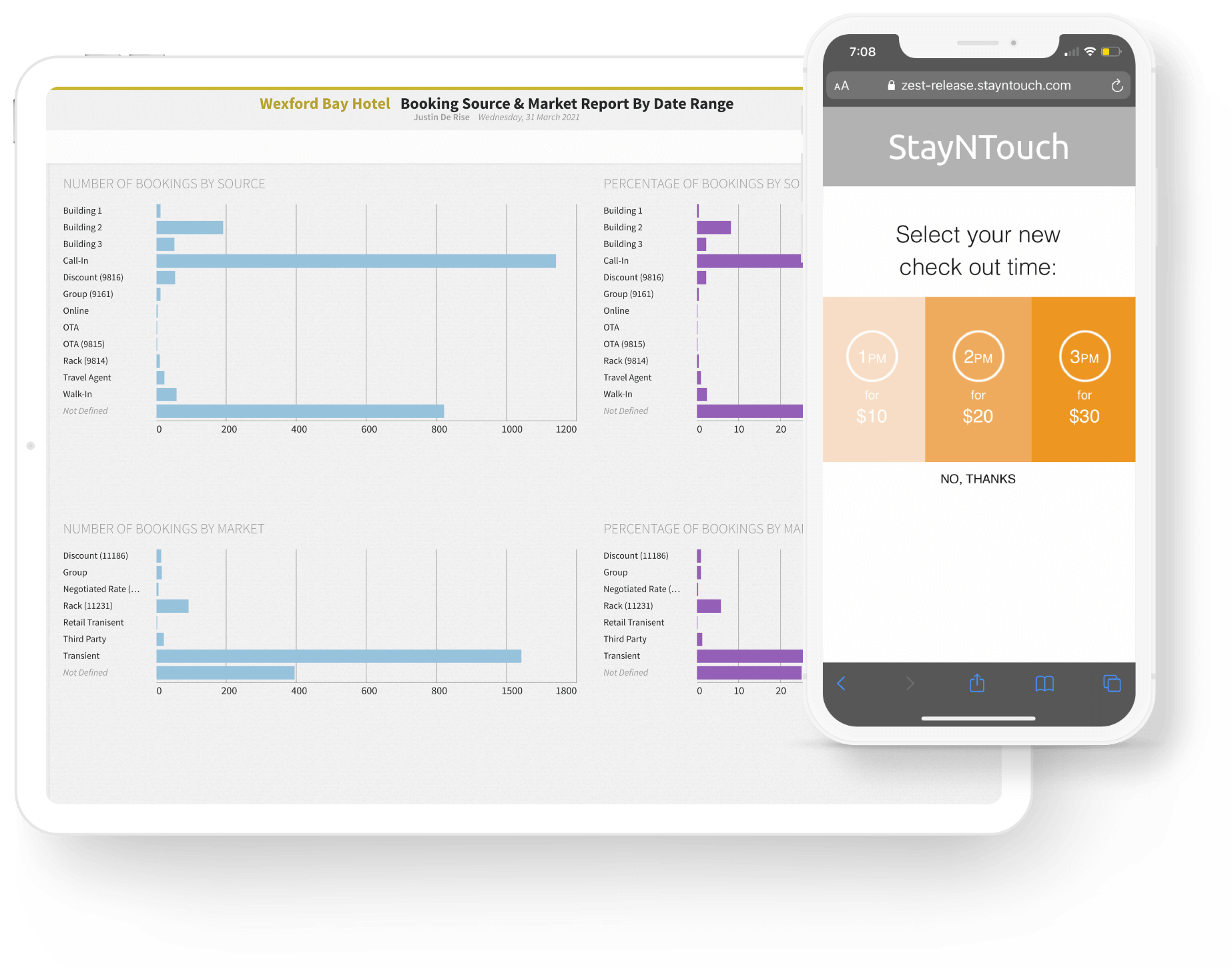
When it comes to rate setting and inventory allocation decisions, data, not instinct, should drive marketing moves. With seamless integration, hoteliers can monitor performance metrics such as RevPAR, ADR, occupancy, booking source etc. GMs and RMs can not only determine their best-performing channels and price points that are best fit for their target market, but also gauge the impact of their decisions.
Similarly, hoteliers can combine and analyze various data sets simultaneously such as customer segmentation, seasonality, special events, booking trends, competition rate setting, and more. This allows hoteliers to forecast demand and create appropriate pricing and promotional strategies aimed at different customer segments.
Armed with the relevant data and utilized effectively, owners and managers can then make more timely, informed and sophisticated rate and distribution decisions, maximizing revenue opportunities and hotel performance.
7. Leveraging mobile technology
Real-time visibility is important in making timely informed decisions. With a cloud-based mobile PMS managers’ can view live performance, monitor operations, access key reports etc. remotely, on the go, anytime, anywhere–even if they are not physically on site. Likewise, revenue managers can access the PMS and make strategic decisions about rates and inventory and can react to hotel and market conditions in real time and make inventory adjustments. Information that can be accessed instantly from almost anywhere helps to further streamline inventory management; employees are better informed, can make more accurate, faster decisions, deliver the right inventory to the right people at the right time, maximizing revenue opportunities.
8. Push your book direct channels
Driving direct bookings avoids the common OAT fees that come with third-party booking channels: the commission paid by the hoteliers (anywhere from 15-25% of top-line revenue in commissions), the strong online presence OTAs have (supported by unbelievable marketing budgets), along with the consumers belief that’s been trained to believe that the best prices can be found on third-party sites.
With the right technology in place, maximizing return on your inventory and increasing the hotel’s revenue is much more achievable. By leveraging the power of a cloud-based property management system and other strategies you will not only be able to collect the right data and analyze it in a way that is meaningful but also use it to make smarter and potentially more profitable decisions.
- s that surface unpublished discounts to specific app users let a hotel sell distressed inventory without posting a lower rate on its own website or standard OTA listing.
- Closed user group and member rates: Rates gated behind a loyalty login or a corporate or negotiated account never appear in public search results, so they don’t undercut the hotel’s advertised price.
- Package bundling: Wrapping a room with an amenity, like breakfast, parking, or a spa credit, adds perceived value without lowering the headline room rate.
- Length-of-stay and last-minute restrictions: Offering a lower rate only when tied to a minimum stay or a booking window inside 24 to 48 hours limits who sees the discount and prevents it from resetting guest expectations for full-price stays.
A channel manager that supports granular rate mapping is what makes this workable at scale. Setting different rate codes for different channels, rather than one blanket public rate, is how hotels protect rate integrity while still filling rooms that would otherwise go empty. This also prevents rate parity issues that can come with publicly discounting the same room across channels.
How to Track Hotel Inventory in Real Time
Tracking inventory manually means someone checking multiple systems and reconciling numbers by hand, and it’s a method that breaks down the moment a hotel runs more than a handful of distribution channels.
Effective real-time inventory tracking depends on three things working together:
- A single source of truth: The PMS should be the system of record for room status, availability, and restrictions, with every other system, from the channel manager to the RMS, reading from and writing back to it rather than keeping a separate count.
- Live rather than end-of-day reporting: Dashboards that update as reservations, cancellations, and room status changes happen let managers see today’s actual sellable inventory instead of yesterday’s snapshot.
- Two-way system connections: Stayntouch connects through open REST APIs with revenue management system integrations including IDeaS G3, Duetto, Pace, RoomPriceGenie, Wheelhouse, and others. These RMS can pull live booking pace and inventory data, then write optimized prices and restrictions directly back into the PMS without a manual export and reimport.
Put Your Inventory to Work
Hotel inventory management stops being a spreadsheet exercise the moment a property treats every room, rate, and add-on as revenue in motion rather than a fixed count. The hotels getting this right aren’t necessarily selling more rooms, but they are selling the right room, at the right price, on the right channel automatically.
See how Stayntouch’s cloud PMS handles rate strategy, sell limits, and distribution sync in one connected system.
Frequently Asked Questions
What is inventory in the hotel industry?
Hotel inventory is any asset a property sells or uses to generate revenue, including rooms and rate plans, meeting and event space, food and beverage, retail and spa slots, and the operational supplies (like linens and minibar stock) that support a guest’s stay.
What is the purpose of a hotel inventory management system?
A hotel inventory management system keeps room counts, rates, and restrictions accurate across every sales channel at once. It can apply pricing and availability rules automatically and gives revenue managers a single, real-time view of what’s left to sell. This helps the property avoid both overbooking and unsold inventory.
What is hotel inventory distribution?
Hotel inventory distribution is the process of making rates and availability visible and bookable across every channel a hotel sells through, including a hotel’s own website, OTAs, the GDS, and wholesale channels. A channel manager keeps availability synced across all of them in real time.
How do hotels sell unsold inventory without public discounting?
Hotels move distressed inventory through channels that stay invisible to the general public. Options include opaque or mobile-only booking apps, closed user group and loyalty rates, value-added packages, and length-of-stay restrictions, all of which avoid posting a lower rate on the hotel’s standard public listing.
How can a hotel manage inventory across multiple channels without overbooking?
The core requirement is real-time, two-way sync between the PMS and every connected channel, so a booking on one channel instantly reduces availability everywhere else. Features like zero-inventory sync add a second layer of protection by automatically closing all channels the moment house availability hits zero.
What metrics should a hotel booking system track to optimize inventory distribution?
At minimum, occupancy, ADR, and RevPAR by channel, booking pace and lead time, cancellation rate, and channel-level conversion. Tracking these hotel KPIs by channel, not just in aggregate, shows which distribution sources are actually profitable once commission is factored in.
How do I track hotel inventory in real time?
Use a PMS as the single source of truth for room status and availability, connect it two-way to a channel manager and any revenue management system through open APIs, and rely on live dashboards rather than end-of-day reports so inventory reflects what’s sellable right now.