
Written by: Kelly Campbell, Vice President of Marketing, Stayntouch
Key Takeaways
- A mobile PMS API is the interface that lets external systems read and write hotel data for mobile check-in, digital keys, housekeeping, and guest messaging.
- Evaluating API openness means checking six dimensions: documentation quality, sandbox availability, authentication methods, endpoint coverage, webhook support, and integration costs.
- OAuth 2.0 with scoped access is the preferred authentication method, and webhooks deliver real-time updates that polling cannot match.
- Stayntouch Connect APIs stand out with 1,400+ endpoints, OAuth 2.0 scoped authentication, self-service sandbox, event-driven webhooks, and no per-interface fees.
- Ready to evaluate an open PMS API for your next integration? Request a developer walkthrough to discuss your project.
How to Evaluate PMS API Openness
An “open API” is documented, accessible without special permission, and free of per-interface fees. Many vendors use the term, but not all meet these criteria. The six dimensions below give you a practical evaluation framework.
- Documentation quality: Endpoints, parameters, and request and response examples should be clearly documented. Strong documentation lets a developer make a first API call without contacting the vendor.
- Sandbox availability: A sandbox is an isolated test environment where developers can experiment with API calls and webhooks without affecting live hotel data. Self-service, free sandbox access is the standard to look for.
- Authentication methods: OAuth 2.0 provides scoped, revocable access without sharing master credentials. API keys are simpler to implement but less granular. Both are common. OAuth 2.0 is preferred for production integrations that handle sensitive data.
- Endpoint coverage: The API should support the full operational surface: reservations, room status, guest profiles, billing, and housekeeping. Narrow coverage forces workarounds.
- Webhook support: Webhooks push data the moment an event occurs. Polling, which repeatedly requests data at intervals, creates lag and unnecessary load. Real-time integrations depend on webhooks.
- Integration costs: Per-interface fees on some legacy enterprise platforms can reach high four figures per connection, which turns every technology decision into a budget negotiation. Free API certification and no per-interface fees set a clear benchmark.
Genuine openness on all six dimensions prevents vendor lock-in and enables a best-in-class tech stack where the hotel retains control over which tools to use.
Talk to our integration team to discuss your requirements and see how Stayntouch’s open API approach fits your project.
How Major PMS Vendors Approach API Documentation
This section shows how the six-dimension framework appears in real documentation portals from four major PMS vendors. Focus on authentication, sandbox access, and how easily a developer can start testing.
Mews Connector API Documentation Overview
The Mews Developer Portal documents the Mews Connector API. Authentication uses ClientToken and AccessToken supplied as parameters in the request body instead of OAuth 2.0. Mews is widely recognized for its open API and comprehensive documentation, and it offers a shared demo environment that developers can use for testing without a live property.
Where to Find OPERA PMS API Documentation
Oracle provides the Oracle Hospitality Integration Platform (OHIP), a unified API layer across Oracle hospitality products, including OPERA Cloud. Documentation is available at Oracle Hospitality Documentation, with open-source API specifications also published on GitHub. Authentication for Oracle OPERA and OHIP APIs uses OAuth 2.0 client credentials (ClientId and ClientSecret) to obtain an OAuth token and requires an application key passed in the x-app-key header of every request.
Cloudbeds API Documentation for Mobile Check-In
The Cloudbeds API portal covers RESTful APIs for reservations, rates, and availability. Authentication uses API keys.
Stayntouch Connect APIs: Open, Webhook-Enhanced, and Free
The Stayntouch for Developers portal documents the Connect APIs across 1,400+ endpoints. Authentication uses OAuth 2.0 with scoped access, so each integration sees only the data it needs. A door lock application, for example, can see a room number and checkout date but cannot access payment details or home address data.
Stayntouch provides sandbox environments for safe testing before go-live, webhook testing tools, and documentation that covers a broad event surface.
- Reservation
- RoomStatus
- EndOfDay
- Guest
- Account
- Group
- Inventory
- ReservationRevenue
- RoomStatusService
Granular reservation events cover the full lifecycle: creation, editing, cancellation, pre-check-in, check-in availability, check-in success and failure, checkout, room assignment, and room moves. This breadth lets connected systems react to exactly the events they care about.
Stayntouch charges no per-interface fees and provides free API certification. Users still pay each third-party platform its own platform fee, while Stayntouch charges nothing for the integration itself. This commercial model encourages building the right stack instead of constraining it.
PMS API Comparison: Openness at a Glance
The table below compares the four vendors across three of the six evaluation dimensions: authentication, sandbox, and integration cost. Use it to see at a glance where each platform stands.
| Vendor | Authentication | Sandbox | Integration Cost |
|---|---|---|---|
| Mews | ClientToken and AccessToken | Shared demo environment available | Contact vendor |
| Oracle OPERA / OHIP | OAuth 2.0 client credentials and application key | Available via OHIP developer program | Contact vendor |
| Cloudbeds | API keys | Contact vendor | Contact vendor |
| Stayntouch | OAuth 2.0 (scoped) | Available, self-service | No per-interface fees; free API certification |
Documentation quality and endpoint coverage vary across these platforms and require hands-on evaluation in each sandbox. A comparison table captures structure, but a developer still needs to make actual API calls against the endpoints that matter for a specific project.
Authentication and Security Best Practices
Most PMS API integrations rely on two primary authentication methods.
- API keys: A token that identifies the calling application. This approach is easy to implement but less granular, because a single key typically grants broad access instead of scoped permissions.
- OAuth 2.0: An authorization framework that gives applications limited, revocable access without sharing master credentials. It works like a digital valet key. It works for one application, covers only what that application needs, and can be revoked instantly without changing the master password.
Scoped access is the security principle that matters most in practice. Each integration should see only the data it needs to function. A door lock application requires a room number and checkout date, but it has no legitimate need for payment card data or a guest’s home address. Scoping limits the blast radius of any single compromised integration.
Three compliance frameworks apply to any hotel PMS integration that handles payment or personal data.
- PCI DSS (Payment Card Industry Data Security Standard): Governs how payment card data is stored, transmitted, and processed. Level 1 is the most stringent tier.
- GDPR (General Data Protection Regulation): European law that governs how personal data is collected, stored, and deleted. It applies to any system that handles data from EU residents.
- SOC 2 (System and Organization Controls 2): An independent audit of a vendor’s security controls. Type 1 assesses controls at a point in time.
Stayntouch’s security architecture applies these principles at the integration layer. It uses OAuth 2.0 with scoped access, PCI DSS Level 1 for payments via Stayntouch Pay, SOC 2 Type 1, GDPR compliance, ISO 27001 and 27018, and AWS Private VPC infrastructure. The security program includes quarterly patching, daily vulnerability scanning, and annual penetration testing.
Webhooks vs. Polling: Real-Time Integration Patterns
A webhook is a connection that pushes data the moment an event happens. A polling mechanism is the alternative, where a system repeatedly requests data at set intervals, such as every 30 seconds or every minute, to check whether anything has changed.
Polling creates lag. A guest who checks in at 3:00 p.m. may not appear as checked in to a connected door lock or messaging system until the next polling cycle runs. For mobile check-in and housekeeping workflows, that lag is operationally unacceptable.

Webhooks eliminate this lag. When a guest checks in, the event fires immediately. The door lock system receives the room assignment and checkout date, the guest messaging platform sends a welcome message, and housekeeping receives any relevant status update, all without staff intervention and without waiting for the next poll.
Stayntouch’s Connect APIs are event-driven by design. Connected systems subscribe to events and receive data the moment something happens across Reservation, RoomStatus, EndOfDay, Guest, and other webhook objects.
Common Mobile PMS Integration Use Cases
These use cases show why webhook support and scoped authentication matter in practice. Each scenario depends on real-time data and secure access to specific guest information.

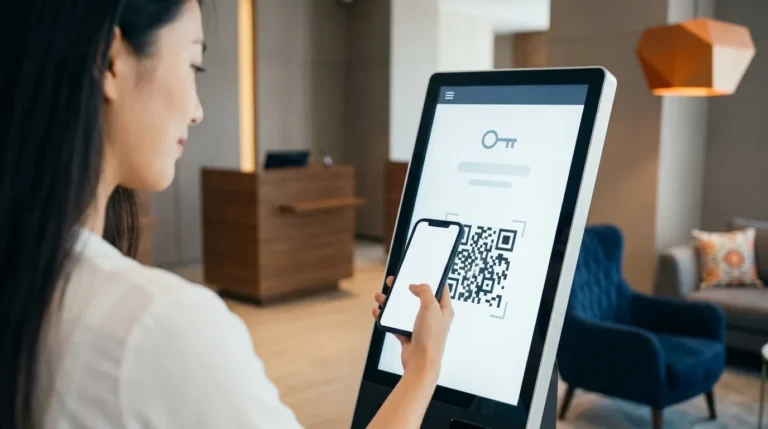
- Mobile check-in: Guests complete registration and payment from their phone before arrival. They bypass the front desk and proceed directly to their room.
- Housekeeping status updates: Room status changes such as dirty, clean, and inspected propagate instantly to the front desk, so arriving guests receive rooms the moment they are ready.
- Digital keys: Door lock systems receive check-in and checkout events via webhook, which enables keyless entry without staff involvement.
- Guest messaging: Two-way communication platforms sync with live reservation data, which enables automated pre-arrival outreach, real-time service requests, and upsell delivery.
How to Get Started with a PMS API: A Step-by-Step Guide
- Identify your integration needs. Define the data flows and events that matter for your project, such as reservations, room status, guest profiles, billing, or a combination.
- Evaluate vendors based on API openness. Use the six-dimension framework of documentation quality, sandbox availability, authentication methods, endpoint coverage, webhook support, and integration costs.
- Sign up for a sandbox environment. Test without affecting live hotel data. Favor vendors that offer free, self-service sandbox access.
- Review authentication documentation. Understand the OAuth 2.0 authorization flow or API key management process before writing a line of code.
- Make your first API call. Retrieve a reservation or room status record to confirm connectivity and response structure.
- Test webhooks. Verify event delivery, payload structure, and latency for the events that matter to your use case.
- Plan for go-live. Confirm certification requirements, integration costs, and any vendor-specific approval processes before committing to a timeline.
As step 7 suggests, certification and cost are decisive. Vendors that offer free API certification and no per-interface fees keep the tech stack an operational decision, while those that charge per connection turn every improvement into a capital negotiation.
Schedule a developer consultation. Stayntouch can typically arrange a technical conversation within a week.
How to Choose a PMS Based on API Openness
The right PMS for a mobile integration project uses a genuinely open, well-documented API. Marketing claims about openness are easy to make. The documentation portal, sandbox availability, and integration cost structure tell the real story.
A practical decision framework covers three core questions.
- Does it fit your existing tech stack? A PMS with extensive documented integrations and open APIs connects to the revenue management system (RMS), customer relationship management (CRM), point-of-sale (POS), and door lock systems you already run or plan to run. A closed platform would force you to replace those systems.
- Does it support real-time data? If your mobile check-in, digital key, or guest messaging use case requires instant updates, webhook support becomes essential. Polling-based architectures introduce lag that degrades the guest experience.
- What is the total integration cost? Per-interface fees compound across a tech stack. A platform that charges nothing for integrations, while each third-party platform charges its own fee, produces a very different total cost of ownership than one that charges per connection.
Stayntouch is a strong option for hotels that want a mobile integration project on an open foundation. As mentioned earlier, the Connect APIs cover a broad endpoint surface, use OAuth 2.0 with scoped access, support an event-driven webhook architecture, provide sandbox environments and webhook testing tools, and carry no per-interface fees or API certification costs. The Stayntouch integrations ecosystem spans 18 categories, from door locks and POS to CRM, RMS, and central reservation systems, so the PMS connects to the stack the hotel actually wants.
According to the 2026 Hotel Technology Outlook, produced by the NYU SPS Jonathan M. Tisch Center of Hospitality with Stayntouch and IDeaS Revenue Solutions (November 2025, 300+ hotel professionals), 38% of respondents cited integration as a top pain point, and 30% of all-in-one users intend to move to best-in-class solutions, against 14% moving the other way. API openness is a strategic choice, not just a technical preference.
Frequently Asked Questions
Does Oracle OPERA have a public API?
Yes. Oracle provides the Oracle Hospitality Integration Platform (OHIP), a unified API layer for OPERA Cloud and other Oracle hospitality products. Documentation is available at the Oracle Hospitality Documentation portal, with open-source API specifications also published on GitHub. Authentication for Oracle OPERA and OHIP APIs uses OAuth 2.0 client credentials (ClientId and ClientSecret) to obtain an OAuth token and requires an application key passed in the x-app-key header of every request. Developers can access the OHIP developer program for sandbox testing.
What is the difference between a webhook and polling in a PMS API?
Polling requires a connected system to repeatedly request data at set intervals, such as every 30 seconds or every minute, to check whether anything has changed. This approach creates lag between when an event occurs and when the connected system learns about it, and it generates unnecessary load on both systems. A webhook pushes data the instant an event occurs, such as a reservation creation, a check-in, or a room status change, which enables real-time updates for mobile check-in, digital keys, and housekeeping workflows. For any integration where timing matters, webhooks provide the right architecture.
How much does a PMS integration cost?
Costs vary significantly by vendor. Some legacy enterprise platforms charge substantial per-integration fees, which turns every technology decision into a budget negotiation. Stayntouch charges nothing for the integration itself. You pay each third-party platform its own platform fee, and Stayntouch adds no per-interface charge on top. API certification is also free. Always confirm per-interface fees and API certification costs before committing to a platform, because these costs compound across a full tech stack.
What is a sandbox environment in PMS API documentation?
A sandbox is a safe, isolated test environment where developers can experiment with API calls and webhooks without affecting live hotel data. It allows a team to verify endpoint behavior, test authentication flows, and confirm webhook payload structure before connecting to a production property. Favor vendors that offer free, self-service sandbox access. Some require a formal application or vendor approval before granting test environment access, which adds friction to the evaluation process.
What webhook events does a hotel PMS API typically support?
Webhook coverage varies by vendor. A well-documented, event-driven PMS API should support the full operational surface of a hotel stay. Stayntouch Connect APIs cover the same webhook objects and reservation events described in the “Stayntouch Connect APIs” section above, which gives connected systems the breadth they need to react to specific events without receiving irrelevant data.
Conclusion: Start With the Documentation
Finding mobile PMS API documentation should not require hours of digging through marketing pages. This guide aggregates the official portals for Mews, Oracle OPERA and OHIP, Cloudbeds, and Stayntouch, explains OAuth 2.0 and API key authentication in plain language, distinguishes webhooks from polling, and provides a six-dimension framework for evaluating API openness before you commit to a platform.
For hotels building a mobile check-in, digital key, or guest messaging integration, the evaluation criteria are clear: documented endpoints, sandbox access, webhook support, scoped authentication, and no per-interface fees. Stayntouch delivers all five with event-driven Connect APIs, free API certification, and a commercial model that treats connectivity as included infrastructure rather than a revenue line.
Ready to evaluate a PMS with a genuinely open API? Start the conversation about your integration project.
Read Next
Turn a more connected stack into a better stay.
See how Stayntouch can support the operating moments that matter most to your hotel team.