
Written by: Kelly Campbell, Vice President of Marketing, Stayntouch
Key Takeaways for 2026 PMS Decisions
- U.S. hotel labor costs rose 12.8% in 2025 while turnover reached ~70%, so rapid PMS training now directly controls recurring onboarding expenses.
- Guests expect multiple check-in options, and a best-in-class PMS supports mobile, kiosk, and staff-assisted paths at the same time.
- Four evaluation dimensions, operational depth, training speed, integration flexibility, and support reliability, keep PMS decisions focused on measurable operating outcomes.
- Best-in-class PMS platforms deliver 70% satisfaction versus 55% for all-in-one systems, with 30% of all-in-one users planning to switch in the next 12–24 months.
- See how Stayntouch scores on all four dimensions and accelerates your 2026 PMS evaluation
Executive Summary: Four Dimensions for Evaluating Any PMS
Every PMS evaluation reduces to four core questions, and answering them before vendor demos keeps the process grounded in operating outcomes instead of feature overload.
- Operational depth. The system must cover reservations, front desk, housekeeping, billing, reporting, and multi-property management with enough detail to run a real hotel. Shallow coverage forces manual workarounds and erodes productivity.
- Training and adoption speed. In an industry with the turnover rates noted above, new hires must become productive quickly. A system that takes months to learn behaves like a recurring cost, not a one-time investment.
- Integration flexibility and cost. The PMS should connect to the RMS, CRM, POS, and CRS the hotel actually wants, at a predictable price per connection. Legacy enterprise integrations can cost up to $10,000 each, turning every technology choice into a budget negotiation.
- Support and reliability. When something breaks at 2 a.m. on a Saturday, hotels need a clear answer on who responds and how quickly. Tiered support that favors contract size leaves smaller properties exposed.
The sections below apply these four dimensions to each major PMS feature category, using measurable outcomes drawn from Stayntouch customer data.
See how Stayntouch performs on these four dimensions for your property
Reservation and Inventory Management as PMS Foundation
Reservation and inventory management form the operational core of any PMS and support every other module. This layer controls which rooms are available, at what rate, through which channels, and under what restrictions. These restrictions include sell limits, stay controls such as minimum length of stay or closed-to-arrival dates, and allotments for partners or groups.
A system that handles these details with precision prevents overbooking, protects rate integrity, and gives revenue teams reliable control without constant manual overrides.
| Feature | Measurable Hotel Outcome |
|---|---|
| Real-time two-way sync with channel manager and internet booking engine (IBE) | Eliminates double bookings, availability updates instantly across all channels |
| Flexible rate structures including day-use and hourly rates | Captures demand segments that conventional nightly-rate systems miss |
| Automated rate adjustments via Rate Strategy module | Rule-based rate movement responds to occupancy without manual oversight, with training completed in 20 minutes and activation occurring instantly (according to Stayntouch customer data) |
| Sell limits and stay restrictions managed centrally | Protects against overselling and enforces pricing strategy at the room-type level |
| Group block management with rooming list CSV upload | Manages groups from 10-room blocks to 500-person conferences without spreadsheet workarounds |
Front Desk Operations and Guest Mobility Options
The front desk is where labor cost and guest experience intersect most visibly, so the PMS must free staff from a fixed workstation. A workstation-bound system keeps staff behind a monitor while guests queue, which increases frustration on both sides. A mobile-first PMS lets staff greet guests anywhere on property and match service style to guest preference.
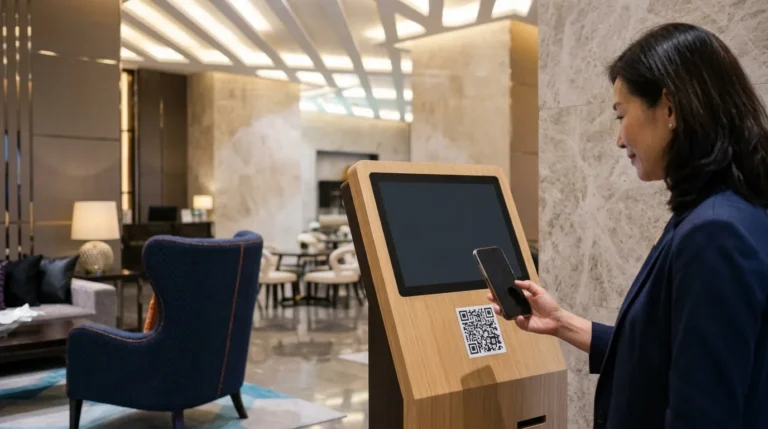
Stayntouch supports three simultaneous check-in paths: fully mobile in 30 seconds from the guest’s phone, self-service at a kiosk with an integrated credit card reader and key encoder, and staff-assisted check-in anywhere on property via tablet. The guest chooses the path, and the hotel supports all three at once.
| Feature | Measurable Hotel Outcome |
|---|---|
| Mobile check-in completing in 30 seconds | 54% reduction in staff-assisted check-in, according to Stayntouch customer data |
| Kiosk check-in with ID scanning and digital key issuance | Guest satisfaction scores rise by up to 20 points, according to Stayntouch customer data |
| Color-coded room diary with drag-and-drop room assignment | Front desk teams manage arrivals, departures, and room moves from a single view without screen switching |
| Full front desk staff training in 2 hours | New hires become productive on their first shift, so turnover no longer causes long productivity gaps |
| Automated upsells in mobile and kiosk check-in flows | Room upgrades, early check-in, and amenity add-ons convert at the moment of highest guest intent |
Housekeeping and Real-Time Task Management
Housekeeping is usually the largest labor line in a hotel and sits between departing and arriving guests. A room cannot be assigned to an arriving guest until housekeeping has cleaned and inspected it, so stale information slows both operations and revenue.
When room status travels on paper or by radio, the front desk works from information that is minutes or hours old. Mobile housekeeping management closes that gap, because room status updates propagate instantly, tasks are assigned by floor or section, and managers can staff against tomorrow’s expected departures instead of reacting on the day.
| Feature | Measurable Hotel Outcome |
|---|---|
| Real-time room status updates from mobile devices | 25% increase in housekeeping productivity, according to Stayntouch customer data |
| Automated task assignment by floor or section | Managers assign work once, and the system distributes it without manual coordination |
| Forward task scheduling based on expected departures | Staffing aligns to tomorrow’s workload instead of only reacting to today’s demand |
| Fast-posting of minibar charges from the room | Revenue is captured at the point of consumption rather than lost at checkout |
| Housekeeping and front desk working from one live view | Guests who paid for early check-in receive a room the moment it is inspected, turning an operational signal into revenue |
Billing, Payments, and Night Audit Accuracy
Revenue often leaks through missed charges, manual billing errors, and inconsistent tax application, so the PMS must close these gaps. Hotels take payment at the front desk, restaurants and bars, the spa, the lobby shop, and a guest’s phone, and every charge needs to land on the correct guest folio before departure.
Anything not posted in time disappears from revenue, and occupancy tax and local taxes must apply instantly and correctly across jurisdictions. Misapplied tax creates guest disputes and regulatory risk, which both consume staff time.
| Feature | Measurable Hotel Outcome |
|---|---|
| Automated charge posting from POS, spa, mobile, and Grab & Go Kiosk to guest folio | Up to 42% improvement in accounting efficiency, according to Stayntouch customer data |
| Automated night audit and end-of-day close | Faster end-of-day with fewer errors and no overnight manual reconciliation |
| Jurisdiction-aware occupancy and local tax application | Tax-exempt handling, OTA auto-charge rules, and commission tracking managed without manual intervention |
| Digital Registration Cards capturing signed terms and conditions | Documented records reduce chargebacks and convert OTA bookers into direct relationships |
| Stayntouch Pay: PCI DSS Level 1 processing with funds settled in two business days | One transparent monthly bill and cash-flow certainty the hotel can plan against |
Reporting and Analytics for Daily Decisions
Manual report assembly consumes staff time that should go toward decisions, so reporting must arrive ready for action. Interactive analytics dashboards that allow direct action on the underlying data remove the export-and-re-enter cycle entirely.
Scheduled, automated report delivery ensures that stakeholders receive the data they need without sending requests or chasing files.
| Feature | Measurable Hotel Outcome |
|---|---|
| Automated report delivery by email, SFTP, or cloud drive | Portfolio-wide visibility without manual assembly, so managers act on data rather than producing it |
| Manager Daily Report with month-to-date and year-to-date comparison | RevPAR, ADR, occupancy, arrivals, and departures visible from any device |
| Fully customizable report content, sequence, and format | Finance teams receive the exact output their accounting systems require, in the format they need |
| Interactive dashboards with direct action on underlying data | Rate changes and housekeeping schedules execute from within the report, eliminating the round-trip to another screen |
Integrations and Ecosystem Strategy
A PMS that profits from integrations has a built-in incentive to limit them, which restricts the hotel’s technology choices. Stayntouch charges nothing for integrations, with 1,400+ connections available at no additional cost, unlimited connections, and free API certification.
Each third-party platform charges its own platform fee, while Stayntouch does not add integration charges. Two connection architectures cover the full technology stack: direct cloud-to-cloud connections using webhooks for modern applications, and bridge integrations via COMTROL and Omniboost for legacy door locks, PBX telephone systems, and specialized accounting software.
| Feature | Measurable Hotel Outcome |
|---|---|
| 1,400+ integrations at no extra cost from Stayntouch | Improving the tech stack becomes an operational decision rather than a capital one |
| Named RMS partners: IDeaS, Duetto, FLYR, Lighthouse, PriceLabs | Hotels keep their preferred revenue management platform without forced substitution |
| Named POS partners: Toast, Oracle Micros, Lightspeed, Shiji Infrasys | Restaurant and bar charges post automatically to the guest folio with no manual entry |
| Named CRM partners: Salesforce, Revinate, Cendyn, Amadeus TravelClick | Guest profiles sync outward automatically, so marketing and loyalty programs run on the hotel’s preferred platform |
| OAuth-scoped integration access | A door lock application sees a room number and checkout date but not payment details, so a breach in one application cannot expose the full database |
Multi-Property and Profile Management at Portfolio Scale
A PMS built for a single hotel creates compounding administrative work as a portfolio grows, so multi-property capability becomes critical. Multi-property management treats the portfolio as the unit of operation, with configuration written once centrally and pushed to every property.
Guest, company, and travel agent profiles are shared globally, so a returning guest at a sister property arrives with history and preferences already known. New properties open on a template instead of a blank system, which shortens deployment.
| Feature | Measurable Hotel Outcome |
|---|---|
| Multi-property dashboard showing occupancy, available rooms, and best available rate (BAR) across all properties | 70% more efficient portfolio management, according to Stayntouch customer data |
| Centrally pushed configuration templates for rate types, policies, and permissions | Brand standards hold across 100+ properties without manual policing |
| Shared guest, company, and travel agent profiles with aggregated ADR and total stays | Loyal guests are never treated as strangers at a sister property |
| Single sign-on (SSO) across the portfolio | Corporate teams manage global configuration from one login without property-by-property access management |
| 139 properties deployed in 90 days for a single management company | Implementation scales without proportional headcount growth |
Discuss how Stayntouch scales across your portfolio
Types of PMS in Hotels
Hotel operators evaluating a PMS in 2026 encounter two primary architectural categories, and knowing the difference prevents a choice that feels right on a demo but creates friction later.
Best-in-class PMS. This model uses a specialized platform whose engineering team focuses entirely on the PMS and its immediate guest-facing surround, including arrival, payment, distribution, and communication. Because development effort does not spread across revenue management, CRM, POS, and CRS, the core PMS receives continuous, deep investment. The hotel connects the specialist tools it prefers through open integrations, with no vendor deciding which platforms are permitted. The 2026 Hotel Technology Outlook, produced by the NYU SPS Jonathan M. Tisch Center of Hospitality with Stayntouch and IDeaS (November 2025, 300+ hotel professionals), found that 30% of all-in-one users intend to move to best-in-class solutions, against 14% moving the other way, more than double the rate. The satisfaction gap noted earlier reflects these deeper operational differences.
All-in-one PMS. This model uses a platform whose vendor spreads engineering effort across the PMS, RMS, CRM, POS, and CRS at the same time. For a smaller property, this approach can serve as a practical starting point because everything arrives in one contract. Pressure appears as the business grows, because added properties and new markets require more specialization than the platform can usually support. The same NYU study found that all-in-one users report check-in delays at 46% versus 23% for best-in-class users, booking errors at 57% versus 45%, and missed guest preferences at 51% versus 41%.
The distinction does not hinge on legacy versus modern, because both categories include cloud-native platforms. The difference is architectural, with a walled garden that decides which tools a hotel may use versus an open ecosystem that lets the hotel decide.
Core PMS Features in Operator Language
A property management system is the core software a hotel runs on and the system front desk and housekeeping staff touch every hour of every shift. Its essential features, in operator language, are:
- Reservation management: Creating, modifying, and canceling bookings, while managing room inventory, sell limits, and stay restrictions across all channels simultaneously
- Front desk operations: Check-in and checkout workflows, room assignment, guest folio management, and cashier functions from a single view
- Guest mobility: Mobile check-in from the guest’s device, self-service kiosk check-in, and staff-assisted check-in anywhere on property via tablet
- Housekeeping management: Real-time room status, mobile task assignment by floor or section, and forward scheduling based on expected departures
- Billing and payments: Automated charge posting from every revenue center, night audit, occupancy and local tax application, accounts receivable management, and integrated payment processing
- Rate and revenue tools: Central rate and restriction management, automated rate adjustments, and flexible inventory models including day-use and hourly rates
- Reporting and analytics: Customizable dashboards, scheduled automated report delivery, and portfolio-wide visibility across occupancy, ADR, and RevPAR
- Integrations: Open API connections to RMS, CRM, POS, CRS, door locks, accounting software, and distribution channels
- Multi-property management: Centralized configuration, shared guest profiles, and portfolio-level reporting from a single login
- Security and compliance: PCI DSS payment security, GDPR data protection, and jurisdiction-aware tax handling across operating markets
PMS Readiness Checklist: Ten Objective Comparison Criteria
Apply this checklist across any vendor before making a final evaluation decision.
- Training time to front desk productivity. Measure how long a new hire needs before they can check in a guest without supervision, and track this in hours, not days.
- Full platform training duration. Confirm how long it takes to train across all modules, including front desk, housekeeping, night audit, finance, and revenue tools, because this figure drives total onboarding cost.
- Integration cost and depth. Identify whether the vendor charges per integration, per interface, or per API certification, and confirm what the hotel pays when it wants to add a new tool next year. Beyond cost, verify whether connections exchange real-time data via webhooks or rely on batch syncs that create gaps between systems, because a free integration that updates once per hour may cost more in operational friction than a paid real-time connection.
- Uptime record and upgrade model. Check whether the system is cloud-native with no downtime for product releases or whether it requires scheduled maintenance windows that affect operations.
- Guest check-in paths. Confirm that the system supports mobile, kiosk, and staff-assisted check-in simultaneously instead of forcing a single path.
- Support availability and response time. Verify that support operates 24/7/365 for every customer regardless of contract size, with a guaranteed response time and hospitality specialists rather than a general helpdesk.
- Data migration support. Ask whether the vendor provides tooling to migrate legacy guest profiles, group reservations, and deposit totals, and clarify what happens when the legacy export is messy or incomplete.
- Multi-property capability. Confirm that configuration can be pushed centrally to all properties and that guest profiles can be shared across the portfolio without manual duplication.
- Compliance coverage. Determine whether the vendor maintains product compliance across the hotel’s operating jurisdictions in advance or expects the hotel team to identify and flag local requirements.
- Scalability over time. Assess how the PMS handles growth in room count, new markets, and added brands, and whether performance and support remain consistent as the portfolio expands.
Frequently Asked Questions
How long does it take to train staff on a new PMS?
Training time varies significantly by platform and role, so hotels should compare concrete timelines. With Stayntouch, front desk staff complete full front desk training in 2 hours, and full platform training across all modules, including housekeeping, night audit, finance, and revenue tools, takes 2 days. The Rate Strategy module trains in 20 minutes and activates instantly.
Legacy enterprise platforms typically require around three months for a basic working grasp and six to nine months to master, which becomes a recurring cost in a high-turnover industry. Stayntouch Academy provides self-paced eLearning with role-based learning paths, test environments, certifications, and progress tracking, so new hires can onboard without scheduling a trainer.
Does Stayntouch charge for integrations?
Stayntouch does not charge for integrations, and 1,400+ connections are available at no additional cost, with unlimited connections and free API certification. There are no per-interface fees and no charges for adding new integrations as the hotel’s technology stack evolves.
As explained in the Integrations section, this no-charge integration policy means hotels pay only the third-party platform fees. This approach removes financial barriers to connecting the tools that best fit the operation.
How long does PMS deployment take, and what does data migration involve?
A single property typically deploys in about one month, while a full portfolio configures and deploys in 30 to 45 days. In one documented case, Stayntouch deployed 139 properties in 90 days for a single management company.
Auto-Configuration reduces property setup from around 30 hours of manual work to 4–5 hours using standardized templates with a pre-submission audit. The Dataloader module migrates legacy guest profiles, group reservations, company and travel agent profiles, and deposit totals in as little as 1–2 hours. When a legacy export is messy or incomplete, Stayntouch provides data cleanup support through an internal Colab-based file clean-up and validation process rather than rejecting the file.
Manual data entry remains available as a fallback when automated migration is not feasible, and certain fields, such as group blocks, are always created manually regardless of export quality. Non-standard data such as group rooming lists or revenue budgets can be uploaded as CSV files.
What compliance and security certifications does Stayntouch hold?
Stayntouch Pay is certified to PCI DSS Level 1, the most stringent tier of the card industry’s security standard, with point-to-point encryption and card tokenization so raw card numbers never reside in the PMS. The platform holds SOC 2 Type 1, is GDPR-compliant, and runs on AWS Private VPC infrastructure with ISO 27001/27018 certification.
Integration access is scoped using OAuth, so each connected application sees only the data it needs. The security program includes quarterly system-wide patching, daily vulnerability scanning, and annual penetration testing. Stayntouch maintains product compliance in 66 countries across 6 regions, with jurisdictional diligence completed in advance on the hotel’s behalf rather than left to the operator to research.
What support does Stayntouch provide after go-live?
Support operates 24/7/365 for every customer with no service tiers, regardless of property size or contract value, and response is guaranteed in under one hour. Hospitality and product specialists deliver support, so requests reach people who know both the system and the industry.
Follow-the-sun staffing across multiple time zones ensures that a request always reaches someone currently on shift. A dedicated customer success team is assigned to every property, and all support is included at no extra cost. Stayntouch holds Hotel Tech Report’s highest tier Global Customer Support Certification (Level 4 GCSC) across pre-emptive support, reactive support, coaching, and customer validation.
Is Stayntouch suitable for a hotel with fewer than 75 rooms?
Stayntouch works with hotels of all sizes, and the preferred sweet spot is 75 rooms and above, particularly independent properties, boutique brands, multi-property groups, and management companies. Smaller independent hotels are well supported, and many Stayntouch customers operate fewer rooms.
Operational fit matters more than room count, because Stayntouch is built for properties that want deep PMS functionality, open integrations, and a mobile-first guest experience. The platform scales from a single property to portfolios of 100+ hotels managed from one login, and the same 2-hour front desk training, 24/7 support, and 1,400+ integrations apply regardless of property size.
Conclusion: Turning PMS Choice into Operational Gains
The four pressures defining hotel operations in 2026, rising labor costs, high turnover, guest demand for choice, and integration complexity, all converge on the PMS. A system that takes months to learn, charges for every new connection, and locks the hotel into a vendor’s preferred tools amplifies those pressures instead of easing them.
Stayntouch is a best-in-class, cloud-native PMS built for independent hotels, boutique brands, and multi-property groups that expect more from their core system. Front desk staff train in 2 hours, and the full platform trains in 2 days. More than 1,400 integrations connect at no extra cost from Stayntouch, and three-way check-in delivers the staff-assisted check-in reduction shown in the Front Desk section. Housekeeping productivity improves measurably through real-time status updates, and accounting efficiency improves substantially through automated charge posting.
Support operates 24/7/365, delivered by hospitality specialists rather than a chatbot, and every customer receives the same level of service with no tiers. The 2026 Hotel Technology Outlook found that 51% of hotel professionals plan to replace or upgrade their technology stack within the next 12–24 months. If your property is among them, this evaluation framework gives you criteria to base that decision on outcomes rather than feature lists.
Book a demo and experience a best-in-class PMS in operation
Read Next
Turn a more connected stack into a better stay.
See how Stayntouch can support the operating moments that matter most to your hotel team.