Written by: Kelly Campbell, Vice President of Marketing, Stayntouch
Key Takeaways for Hotel Decision Makers
- Cloud hotel software is a subscription-based PMS hosted remotely, removing on-site hardware, manual upgrades, and scheduled downtime while scaling from single properties to 100+ property portfolios.
- High U.S. hospitality turnover near 70% makes fast training essential; Stayntouch trains front desk staff in 2 hours and the full platform in 2 days versus 3–9 months for legacy systems.
- Best-in-class cloud PMS platforms like Stayntouch deliver open APIs, 1,400+ free integrations, and 100% uptime, and they outperform all-in-one suites in satisfaction and operational efficiency.
- Three-way check-in (mobile 30-second, hybrid pre-check-in, staff-assisted) and mobile housekeeping deliver measurable gains: 54% fewer staff-assisted check-ins and 25% higher housekeeping productivity.
- Contact Stayntouch to see how the right cloud hotel software can reduce operating friction and support profitable growth.
Market Pressure and Why PMS Decisions Matter Now
Hotels face rising costs and staffing volatility, and the property management system sits at the center of these pressures.
In the United States, hotel wage cost per occupied room rose 12.8% in 2025, from $42.82 to $48.32, while labor cost per hour rose 8.0%, against U.S. consumer price inflation of 2.7% over the same period. The U.S. quit rate in accommodation and food services reached 4.3% in March 2026, close to double the 2.2% private-sector average, and industry estimates place annual U.S. hospitality turnover near 70%, compared with 12–15% in most other sectors. These are U.S.-specific figures; labor dynamics differ materially in other markets.
High turnover resets the training clock constantly. A system that takes months to learn becomes a permanent operating cost rather than a one-time onboarding expense. Vibeke Raddum, former president of First Hotels, put it plainly when selecting a PMS: “Like many hotel companies, we experience high turnover and thus the system needs the capability to train new employees easily.”
The technology market is responding to these pressures. Cloud deployment accounted for 75.4% of the total hospitality PMS market share in 2025. The overall hospitality PMS market is projected to grow at a 7.05% CAGR from 2026–2031 according to Mordor Intelligence. Grand View Research values the global hotel and hospitality management software market at USD 4.2 billion in 2025 and projects it to reach USD 7.0 billion by 2033.

The 2026 Hotel Technology Outlook: Best-in-Class vs. All-in-One Systems (NYU SPS Jonathan M. Tisch Center of Hospitality with Stayntouch and IDeaS Revenue Solutions, November 2025, 300+ hotel professionals) found that 51% of respondents plan to replace or upgrade their technology stack within the next 12–24 months. Cost pressure and staffing realities are driving this shift.
Review Stayntouch in a live session and see how a modern PMS responds to these market pressures.
How PMS Platforms Evolved to Cloud-Native Best-in-Class
Hotel property management systems have passed through three distinct generations.
The first generation was on-premise: software installed on local servers, maintained by in-house IT teams, upgraded through scheduled downtime, and integrated with other systems through proprietary connections that could cost as much as $10,000 per interface. Legacy platforms in this category typically require around three months for a new hire to reach a basic working grasp and six to nine months to master fully.
The second generation was the all-in-one suite, with a single vendor supplying PMS, revenue management system (RMS), customer relationship management (CRM), point-of-sale (POS), and central reservation system (CRS) under one contract. The appeal was consolidation: one login, one bill, one support number. The trade-off was architectural. The vendor’s engineering team spread its development effort across separate disciplines such as pricing science, marketing automation, restaurant operations, and distribution infrastructure, and could not match the depth of specialists in any of them. The hotel also lost the ability to choose better tools in individual categories.
The third generation, and the direction the market is moving, is the best-in-class cloud-native PMS. This platform goes deep on the property management system and its guest-facing surround, integrates openly with specialist platforms in every adjacent category, and charges nothing for those connections. Open APIs and API-first, composable PMS architectures let organizations integrate best-of-breed modules without data silos, reduce vendor lock-in, and accelerate experimentation with niche solutions, according to Mordor Intelligence’s 2026 market report.
The 2026 Hotel Technology Outlook quantifies this shift: 30% of all-in-one users intend to move to best-in-class solutions, against 14% moving the other way.
See the architectural difference in a live platform walkthrough.
Stayntouch Platform Architecture and Integration Model
Stayntouch is built mobile-first from the ground up, not adapted for mobile after the fact. The platform runs natively on phones and tablets, so staff are not tied to a front desk and can access a full guest profile or complete a check-in from anywhere on property.

The integration architecture rests on two foundations. Direct cloud-to-cloud connections use open APIs (application programming interfaces, the standardized connections two software systems use to exchange data) and webhooks (connections that push data the moment something happens, rather than requiring another system to keep asking). When a guest checks in, the door lock system and guest messaging platform are notified instantly. For older hardware such as legacy door locks, PBX telephone systems, and specialized accounting software, Stayntouch uses bridge integrations via COMTROL and Omniboost, so existing equipment does not have to be replaced.
Across both paths, Stayntouch connects to 1,400+ integrations at no additional cost. Stayntouch charges nothing for the integration itself, while each third-party platform carries its own platform fee. This commercial model is a deliberate structural choice. A PMS that profits from integrations has an incentive to limit them; Stayntouch does not.
Named integration partners span every category a hotel needs:
- Revenue management: IDeaS, Duetto, FLYR Hospitality, Lighthouse, PriceLabs
- Point of sale: Toast, Oracle Micros and Simphony, Lightspeed, Shiji Infrasys
- CRM and guest data: Salesforce, Revinate, Cendyn, Amadeus TravelClick
- Access and door locks: Salto, ASSA ABLOY Hospitality, VingCard, dormakaba
- Central reservation systems: Sabre SynXis, Amadeus TravelClick iHotelier, SHR Windsurfer
- Accounting: Sage Intacct, QuickBooks Online, Xero, M3, DATEV
The platform is hosted on AWS with 100% system uptime sustained over the past two years and an average system response time of 256ms. Product releases require no downtime and generally have no impact on staff usage or the guest experience.
How Architecture Enables Daily Operations
This architectural foundation of mobile-first design, open APIs, and cloud-native infrastructure enables the operational workflows that define daily hotel operations.
Three-way check-in is the operational centerpiece. Guests choose their preferred path: fully mobile check-in completed in 30 seconds from their own phone, hybrid pre-check-in where guests register in advance and staff handle keys and payment, or staff-assisted check-in where a team member greets the guest anywhere on property using a tablet. All three paths run simultaneously. According to Stayntouch customer data, this approach reduces staff-assisted check-in by 54%.
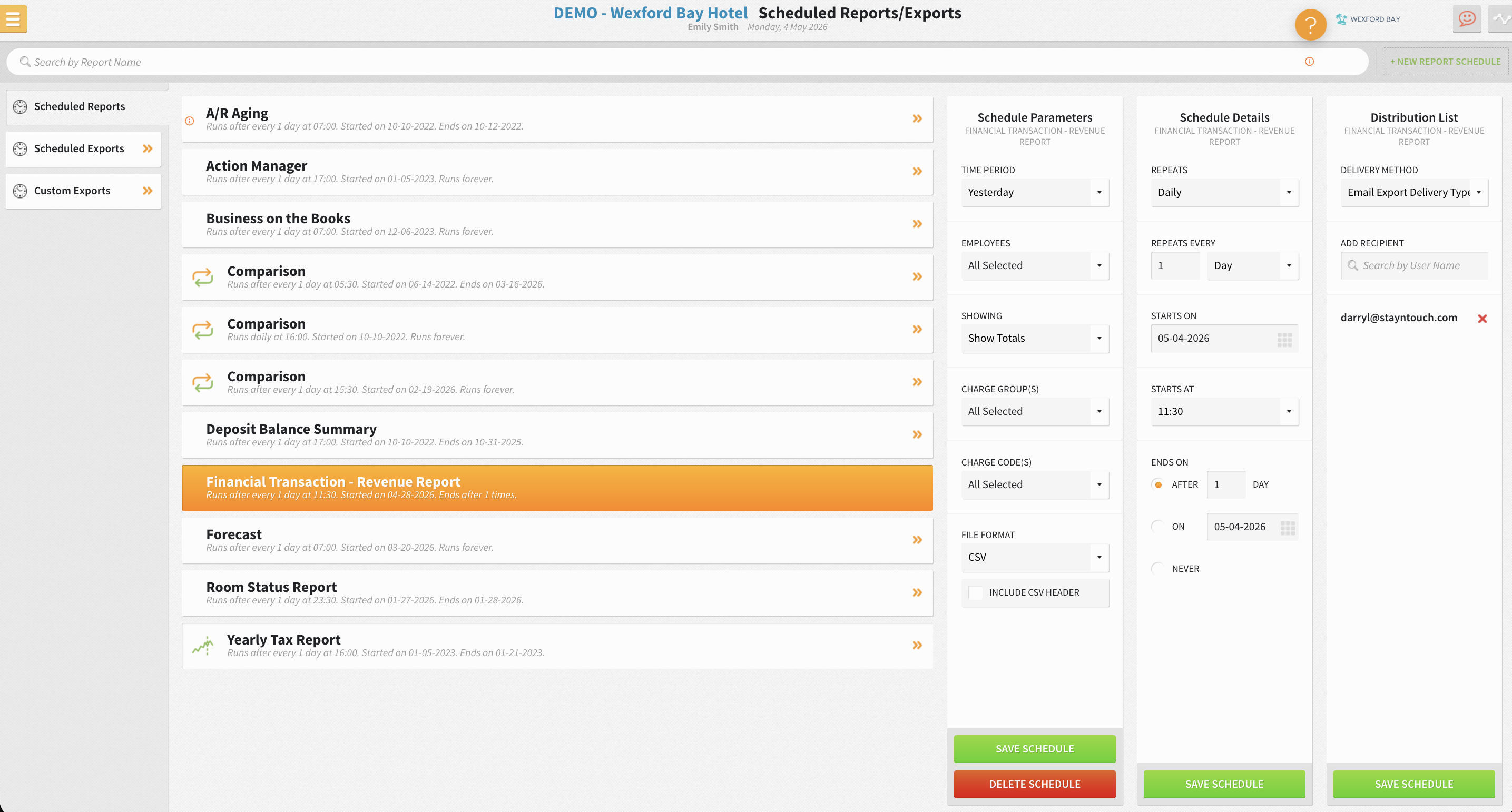
Mobile housekeeping keeps front desk and housekeeping working from one live view. Housekeepers update room status from the room itself, and the front desk sees a room become available the moment it is inspected. According to Stayntouch customer data, this drives a 25% increase in housekeeping productivity. Tasks can be assigned forward in time, so managers staff tomorrow against tomorrow’s expected departures rather than reacting on the day.

Night audit, the end-of-day process that closes out transactions, posts room charges and taxes, and rolls the system into the next business day, runs automatically. Charges post from every revenue center, including front desk, restaurant, bar, spa, and kiosk, directly to the guest folio as they happen, with occupancy tax and local taxes applied instantly.
Support operates 24/7/365 with no service tiers, a guaranteed response under one hour, and follow-the-sun staffing, with teams across multiple time zones so a request always reaches someone currently on shift. Every customer receives the same level of support regardless of property size, included at no extra cost. Hospitality specialists, not a chatbot, deliver support.
Who Stayntouch Serves and Where It Fits Best
Stayntouch is built for independent hotels, boutique brands, and multi-property groups. The platform scales from a single property to portfolios of 100+ properties managed from one login, with no upper limit on property size. The largest single property on the platform has 730 rooms, and the largest group manages 7,000+ rooms.
The 2026 Hotel Technology Outlook found that 68% of hotels with 101–250+ rooms already run best-in-class systems, while 54% of hotels with 100 rooms or fewer run all-in-one platforms. The data reflects a pattern that Stayntouch’s own framing captures well. An all-in-one can genuinely suit a smaller property because everything arrives in one box. Pressure appears as the business grows. As a hotel adds properties, enters new markets, and needs to personalize, it starts wanting to specialize, and specialization is exactly what a closed suite prevents.
Property types well served by Stayntouch include:
- City hotels in primary and secondary markets, which are larger, tech-capable, and able to run an integrated stack
- Boutique properties, which seek comprehensive operational modules that support a distinctive, personalized stay
- Apartment-style and extended-stay hotels, which rely on automation, open APIs, and flexible rate structures including day-use and hourly inventory
- Mid-sized independent chains, which need centralized operations and portfolio-wide reporting without sacrificing property-level flexibility
Schedule a property-type fit assessment with the Stayntouch team.
Implementation, Training, and Organizational Fit
Switching a property management system often creates hesitation, yet specific tools reduce the risk materially.
Auto-Configuration cuts property setup from approximately 30 hours of manual work to 4–5 hours using standardized templates with a pre-submission audit that catches errors before deployment. Property shells are active within five business days.
The Dataloader module migrates legacy guest profiles, group reservations, company and travel agent profiles, and deposit totals in as little as 1–2 hours. When a legacy export is messy, which is common because data quality often reflects the system being replaced, Stayntouch’s team uses an internal Colab-based cleanup and validation process to reformat and validate the file rather than rejecting it. Manual data entry remains available as a fallback when automated migration is not feasible. Certain fields, such as group blocks, are always created manually regardless of export quality. Non-standard data such as group rooming lists or revenue budgets can be uploaded as CSV files.
The training advantage mentioned earlier translates into deployment speed. Front desk staff reach working proficiency in a single shift, and full platform mastery in two days. Stayntouch Academy provides self-paced eLearning with role-based learning paths, test environments, certifications, and progress tracking, so new hires can onboard without scheduling a trainer.
A single property typically deploys in approximately one month. A full portfolio configures and deploys in 30 to 45 days. In one documented customer case, Stayntouch deployed 139 properties across 29 U.S. states in 90 days for a single management company.
Competitive Positioning in the Cloud PMS Landscape
Cloud PMS for Properties with 75 or More Rooms
Properties at 75 rooms and above have outgrown the simplicity argument for all-in-one platforms. They need a PMS that integrates with a specialist revenue management system, connects to the point-of-sale they already run, and scales to additional properties without rebuilding from scratch. Independent properties represent a substantial portion of the hospitality PMS market and continue to show strong growth, outpacing chain-affiliated properties, which signals that the independent segment is actively investing in purpose-built technology.
Cloud PMS for Boutique Hotels
Boutique hotels need a platform that supports a distinctive guest experience without forcing a standardized workflow. Mobile check-in, digital registration cards, guest messaging with real-time translation, and kiosk check-in all serve guests who expect a personalized arrival. A luxury boutique property in Virginia delivered 26 digital keys to 24 guests in its first weekend after switching to contactless check-in with Stayntouch, with the General Manager describing the integration as “99% seamless.”
Hotel Management Software with a No-Fee Integration Model
Integration cost often becomes the hidden variable in total cost of ownership. Legacy enterprise platforms can charge as much as $10,000 for a single new integration, turning every technology decision into a budget negotiation. The integration model described earlier, with zero per-connection fees across the full 1,400+ partner ecosystem, removes that barrier. The 2026 Hotel Technology Outlook found that 38% of respondents cite integration as a top pain point, which reflects what closed ecosystems cost in practice.
Mobile-First Cloud PMS for On-Property Flexibility
A mobile-first PMS is not a desktop system with a mobile app bolted on. Stayntouch was designed from the outset to run on phones and tablets, so the full platform, including reservations, check-in, housekeeping, and reporting, is available from any device. Staff can greet guests anywhere on property rather than from behind a monitor. Cloud PMS platforms enable real-time coordination between housekeeping and front desk, reducing check-in delays and improving daily operations efficiency, and this benefit compounds at properties with 75 or more rooms and high daily turnover.
PMS Training Time Comparison
| Platform Category | Time to Basic Working Grasp | Time to Full Platform Proficiency |
|---|---|---|
| Legacy on-premise PMS | ~3 months (front desk) | 6–9 months (full platform) |
| Stayntouch cloud PMS | 2 hours (front desk only) | 2 days (full platform, all modules) |
Legacy training figures reflect Stayntouch’s internal competitive research on a specific legacy vendor category and are first-party claims, not independently verified. Stayntouch figures are from Stayntouch customer data.
Request a side-by-side platform comparison tailored to your requirements.
Evidence, Results, and Third-Party Validation
The 2026 Hotel Technology Outlook (NYU SPS Jonathan M. Tisch Center of Hospitality with Stayntouch and IDeaS, November 2025, 300+ hotel professionals) documents a clear satisfaction gap between platform architectures:
- PMS satisfaction: 70% among best-in-class users versus 55% among all-in-one users
- Revenue management satisfaction: 59% best-in-class versus 51% all-in-one
- Among all-in-one users who intend to switch, only 34% are satisfied with training and support
- Check-in delays: reported by 46% of all-in-one users versus 23% of best-in-class users
- Booking errors: 57% all-in-one versus 45% best-in-class
- Missed guest preferences: 51% all-in-one versus 41% best-in-class
Stayntouch’s own customer data adds operational specificity:
- 97% customer retention rate
- 100% system uptime sustained over the past two years
- 54% reduction in staff-assisted check-in
- 25% increase in housekeeping productivity
- 70% faster portfolio management from a single multi-property dashboard
- Up to 42% improvement in accounting efficiency
On Hotel Tech Report, Stayntouch holds a 4.7/5 rating across 378 reviews with an HT Score of 91 and a 94% recommendation rating from 249 hotels. The platform earned the TravelTech Breakthrough “Hotel PMS Company of the Year” award in 2026.
See the evidence in action with a tailored Stayntouch walkthrough.
How to Evaluate Cloud Hotel Software in Practice
When evaluating cloud hotel software, focus on a connected set of criteria that reflect daily operations and long-term cost.
Start with the factors that drive recurring expenses. Training time determines how quickly new hires become productive, and with hospitality turnover near 70%, this is a permanent expense, not a one-time cost. Integration costs compound over time, because a platform that charges per connection can add tens of thousands of dollars to your three-to-five-year total cost of ownership.
Once you understand those cost drivers, examine the operational foundation. Uptime and reliability show whether the platform can support daily operations without interruption, and support structure reveals how quickly issues will be resolved and whether hospitality specialists handle your requests.
Implementation risk comes next. Data migration tools, handling of messy legacy data, and realistic deployment timelines determine how disruptive the switch will be. Vendor lock-in, compliance coverage across jurisdictions, security certifications, and scalability from one hotel to 100+ properties round out the evaluation framework.
Frequently Asked Questions
What is the difference between a best-in-class cloud PMS and an all-in-one hotel software suite?
A best-in-class cloud property management system focuses its entire development effort on the PMS and its guest-facing surround, including check-in, checkout, reservations, housekeeping, billing, and reporting, and integrates openly with specialist platforms for revenue management, CRM, POS, and distribution. An all-in-one suite bundles all of those categories under one vendor contract. The trade-off is depth, because the all-in-one vendor’s engineering team spreads its effort across separate disciplines and the hotel loses the ability to choose better tools in individual categories. As documented in the 2026 Hotel Technology Outlook, best-in-class users report higher satisfaction and show a stronger intention to move away from all-in-one platforms.
How long does it take to train staff on a cloud PMS like Stayntouch?
Full front desk staff training on Stayntouch PMS takes 2 hours, and training across the full platform, covering all modules, takes 2 days. The Rate Strategy module, which automates rule-based rate adjustments inside the PMS, trains in 20 minutes. These figures matter most in the context of hospitality turnover, where a system that takes months to learn becomes a permanent operating cost. Stayntouch Academy provides self-paced eLearning with role-based learning paths, test environments, certifications, and progress tracking, so new hires can onboard without scheduling a trainer. Several Stayntouch customers report a secondary benefit, because the system is easy to learn and they can hire for guest-facing ability rather than technical aptitude.
Are integrations really free with Stayntouch, and what does that mean in practice?
Stayntouch charges nothing for the integration itself across its partner ecosystem. Each third-party platform, such as a revenue management system, a point-of-sale, or a door lock system, carries its own platform fee, which the hotel pays directly to that vendor. Stayntouch adds no per-interface fee, no API certification charge, and no connection limit. This commercial choice removes the incentive to restrict integrations. In practice, a hotel can connect IDeaS, Toast, Salto, Revinate, and Sabre SynXis without a budget negotiation for each one, while legacy enterprise platforms may charge as much as $10,000 for a single new integration.
How does Stayntouch support multi-property hotel groups?
Stayntouch manages portfolios of 100+ properties from a single login through its multi-property dashboard. Corporate teams push rate types, deposit and cancellation policies, charge codes, user permissions, housekeeping task lists, and maintenance reasons centrally to every property in the group. Guest, company, and travel agent profiles are shared globally across the portfolio, so a returning guest at a sister property arrives with their history and preferences already known. New properties open on a pre-built configuration template rather than a blank system. According to Stayntouch customer data, multi-property management runs 70% more efficiently from the dashboard than property-by-property administration, and one management company deployed 139 properties across 29 U.S. states in 90 days.
What are the risks of switching a PMS, and how does Stayntouch reduce them?
The three main risks in a PMS switch are data loss during migration, extended downtime during cutover, and a long productivity gap while staff learn the new system. Stayntouch addresses each directly. The Dataloader module migrates legacy guest profiles, group reservations, company and travel agent profiles, and deposit totals in as little as 1–2 hours, with Colab-based cleanup and validation for messy exports. Manual data entry is available as a fallback, and non-standard data such as group rooming lists can be uploaded as CSV files. Auto-Configuration cuts property setup from approximately 30 hours of manual work to 4–5 hours. The platform is cloud-native on AWS with a documented record of 100% system uptime over the past two years, so there is no cutover downtime. The training timeline, measured in hours and days rather than months, keeps the productivity gap to a minimum.
Conclusion: A Practical Framework for 2026 PMS Decisions
The decision framework for cloud hotel software in 2026 centers on three tests. The platform must go deep enough on the PMS to serve a 75-room independent or a 100-property portfolio without compromise. It must connect openly to the specialist tools the hotel actually wants, including revenue management, CRM, POS, and distribution, without charging for each connection or restricting the choice. It must also train fast enough that high turnover stops being a technology problem.
The 2026 Hotel Technology Outlook shows the market moving toward best-in-class platforms that deliver deeper PMS functionality, higher satisfaction, fewer operational errors, and the freedom to build the tech stack the hotel actually needs. Cloud deployment now accounts for the majority of the hospitality PMS market, and independent hotels and boutique groups are driving that shift, which aligns directly with the segment Stayntouch serves.
Stayntouch supports three-way check-in, delivers mobile housekeeping with measurable productivity gains, connects to a broad integration ecosystem without per-connection fees, and maintains a strong record on uptime, retention, and recommendation. It deploys portfolios quickly and includes 24/7/365 support for every customer from day one.
See what a modern cloud hotel PMS looks like in practice with a Stayntouch demo.
Read Next
Turn a more connected stack into a better stay.
See how Stayntouch can support the operating moments that matter most to your hotel team.