

Written by: Kelly Campbell, Vice President of Marketing, Stayntouch
Key Takeaways
-
Payment processing errors at the front desk can cost independent hotels hundreds of dollars per shift through mishandled authorizations, declined cards, and chargebacks that average $450 each.
-
High turnover rates near 70% in hospitality make rapid, repeatable training essential, while legacy PMS platforms require months to learn and best-in-class systems build full competence in hours.
-
An eight-step workflow from reservation intake through checkout settlement, paired with PCI DSS v4.0.1 rules and fraud red-flag training, gives every new hire a repeatable sequence that protects revenue.
-
Hands-on terminal practice with tokenization, P2P encryption, and Stayntouch Pay prepares staff to process chip, contactless, VCC, and incidental-hold transactions confidently before their first live shift.
-
Stayntouch PMS and Stayntouch Academy cut payment training time to just 2 hours; contact us to see how the platform turns high-turnover challenges into a competitive advantage.
The Cost of Slow Payment Training in High-Turnover Hotels
High turnover makes payment training a constant expense for hotels. Industry estimates put annual U.S. hospitality turnover near 70%, compared with 12–15% in most other sectors.
Every departure resets the payment training clock. When a property management system (PMS) takes weeks to learn, onboarding becomes a recurring operating cost instead of a one-time investment.
Legacy platforms, including on-premise installs and partially cloud-based hybrids, typically take around three months for a new hire to gain a basic working grasp and six to nine months to master. That learning curve turns every resignation into a months-long productivity gap. A best-in-class PMS built for independent hotels eliminates that gap by reducing payment processing to a clear, repeatable workflow that new hires can master in hours.
8-Step Payment Processing Workflow for Front Desk Teams
This eight-step workflow covers every payment touchpoint from reservation to checkout. Train staff to follow each step in sequence on every arrival.
-
Reservation intake and payment capture. Collect a valid credit or debit card at booking. Send a secure payment link instead of accepting card details by phone or email. Confirm that the cardholder name matches the guest name, and flag third-party payer arrangements for manager review before arrival.
-
Pre-arrival authorization. Run a card authorization 24 to 48 hours before arrival. This temporary hold confirms the card is valid and has sufficient funds. A declined pre-authorization is easier to resolve before the guest stands at the desk.
-
Check-in identity verification. Match the guest’s government-issued ID to the name on the reservation and the payment card. Treat any mismatch as a fraud signal, not a minor inconvenience. Document the ID type checked and the authorization result in the folio, which serves as the guest’s running bill for the stay.
-
Incidental hold placement. Place an incidental hold in addition to the room rate. This temporary block on funds covers potential charges such as room service, minibar, or damages. Explain the hold amount and release timeline at check-in to prevent checkout disputes. Debit cards pull funds directly from the guest’s bank account, so explain that difference clearly.
-
OTA and virtual credit card (VCC) handling. For bookings from OTAs such as Booking.com or Expedia, confirm whether the stay is prepaid, VCC-funded, or hotel-collect before processing any payment. Treat VCCs as single-use card numbers tied to one reservation amount. Charge them only after confirming the activation date, exact amount, and CVV. A charge attempted before the activation date or for the wrong amount will fail.
-
Mid-stay charge posting. Ensure that charges from food and beverage (F&B), spa, and retail post to the guest folio in real time. In a well-configured PMS, this posting occurs automatically. Staff should verify that all revenue centers have posted before the night audit, which closes transactions, posts room charges and taxes, and rolls the system into the next business day.
-
Jurisdiction-aware tax application. Apply occupancy tax and any additional local assessments automatically at the correct rate for the property’s jurisdiction. Occupancy tax is a per-night tax on the room rate set by city, county, or state. For tax-exempt guests, such as government travelers or extended stays beyond the local threshold, retain documented exemption certificates in the folio. Misapplied taxes create guest disputes and compliance risk.
-
Checkout settlement and folio review. Present the itemized folio to the guest before settlement. Confirm that the authorization hold has converted to a final charge or has been released. Process the final payment, provide a receipt with the property name and contact information, and retain all signed documentation for at least 12 months to support any future chargeback dispute.
Hands-On Terminal Training with Stayntouch Pay
Front desk teams need both workflow knowledge and terminal practice. Without hands-on experience, even well-trained staff hesitate at the desk.

Every new hire should complete structured terminal exercises before their first live shift. This practice builds confidence with real-world scenarios instead of abstract theory.
Stayntouch Pay, the integrated payment facilitation layer within Stayntouch PMS, handles processing, acquiring, and settlement in a single system. This unified approach replaces the usual chain of separate gateway, processor, and acquirer vendors that often leaves hotels without a clear point of accountability when a payment fails.
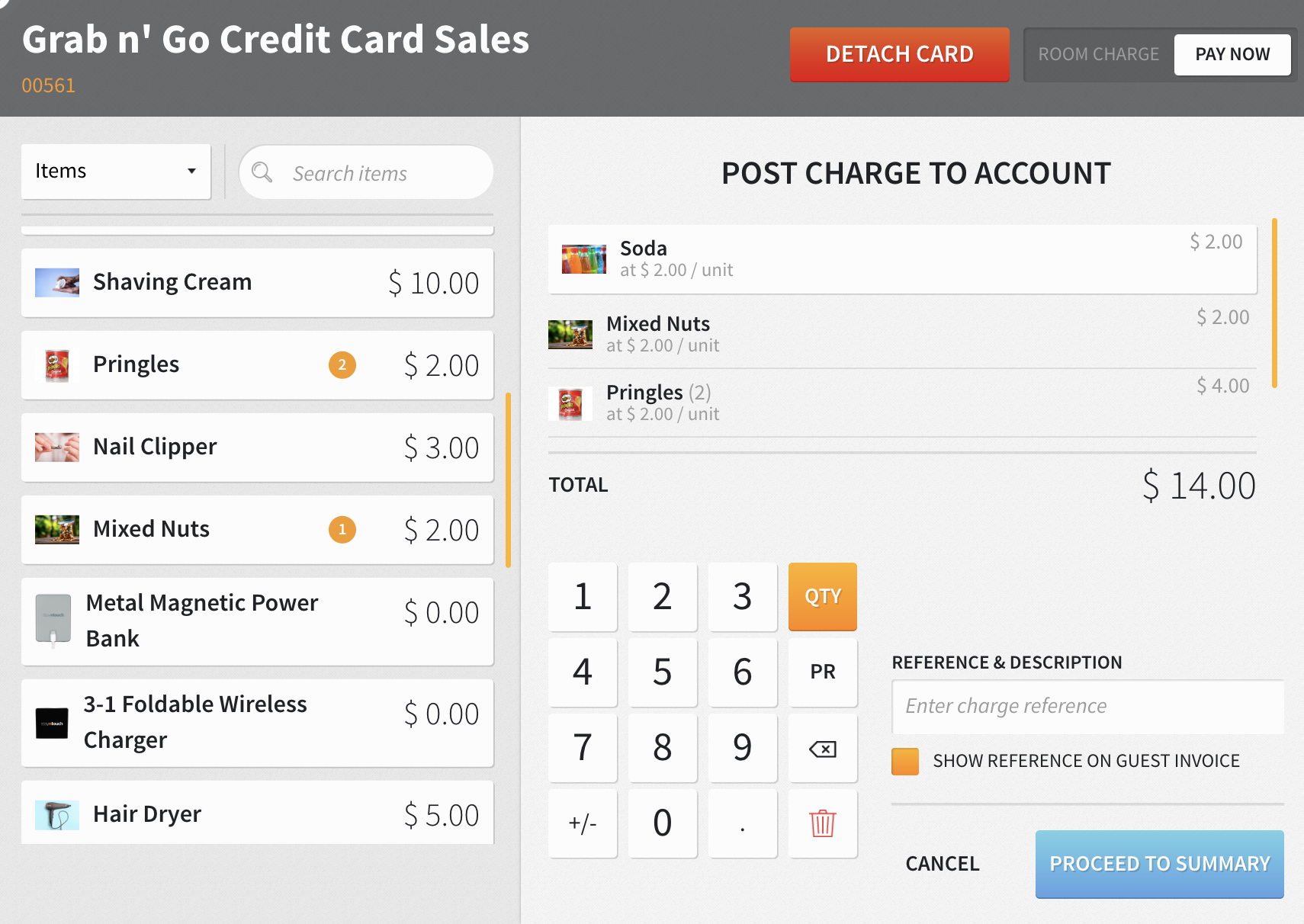
Two security mechanisms protect every transaction. Tokenization replaces the real card number with a meaningless substitute value the moment the card is entered, so actual card data never resides in the PMS. Point-to-point (P2P) encryption scrambles card data from entry until it reaches the processor, so attackers cannot read it in transit. Together these controls support PCI DSS Level 1 certification, which is the most stringent tier of the card industry’s security standard.
Terminal practice exercises should progress from basic card-present transactions to more complex scenarios. Start with processing a standard chip-and-PIN authorization and confirming the approval code in the PMS folio. Move next to contactless tap-to-pay transactions, where staff explain to guests that each tap uses a unique token and no card data is stored.
Once card-present flows feel comfortable, introduce card-not-present scenarios. Have staff generate a one-click payment link via Stayntouch Pay for a remote reservation or house account. Then practice processing a VCC charge using MOTO configuration while verifying the activation date and exact amount before submission.
Finally, cover operational safeguards. Practice placing and releasing an incidental hold and confirming the hold status in the reservation record. Then rehearse handling a declined transaction by pausing the process, checking the folio for prior attempts, and following the escalation path without repeated authorization attempts.
Funds settle two business days after transaction through Stayntouch Pay. This predictable timing provides cash-flow certainty that slower settlement cycles, which can leave money in transit for up to six days, cannot match.
PCI DSS Level 1 Security Rules for Hotel Teams
PCI DSS v4.0.1, the card industry’s security standard and the only assessable version after v3.2.1 retired in March 2024, sets clear training obligations for every hotel that stores, processes, or transmits cardholder data. Front desk staff, reservations agents, cashiers, and finance employees all fall within scope.
The key requirements for hotel training programs are:
-
Requirement 12.6.1: A formal, documented security awareness program must exist. A generic online course alone does not satisfy this requirement. The program must include role-specific content and evidence of completion.
-
Requirement 12.6.3: Training is required upon hire and at least once every 12 months, measured individually from each employee’s training date. New hires must complete training before receiving access to cardholder data.
-
Requirements 12.6.3.1 and 12.6.3.2: Enforceable since March 31, 2025, annual training must explicitly cover phishing, social engineering, and acceptable use of end-user technologies such as payment terminals and personal devices.
-
Requirement 12.6.2: The security awareness program must be reviewed and updated at least annually, and the hotel must retain documentation of that review for assessors.
Hotels must retain four compliance artifacts per employee. These include a completion record with date, the course version, a signed or electronic acknowledgment, and program-level documentation of the annual review. Training content must be tailored to each role’s specific risks rather than relying on a single generic module.
Stayntouch Pay holds PCI DSS Level 1 certification, with tokenization and P2P encryption handling the technical controls. The hotel remains responsible for the awareness program, which must be documented, role-specific, and renewed annually.
Realistic Payment Scenarios and Escalation Paths
Front desk staff perform best when they have practiced real scenarios, not just ideal flows. Edge cases often create the greatest revenue leakage and compliance exposure.
The following scenarios cover the situations most likely to cause problems and show how to respond.
|
Scenario |
Immediate Action |
Escalation Trigger |
|---|---|---|
|
Card declined at check-in |
Pause key issuance. Ask the guest to contact their bank or offer an alternative card. Document the decline in the folio. |
Two or more declines on different cards, or a guest request for an exception to the deposit policy. |
|
VCC charge fails |
Verify activation date, exact amount, and CVV against the OTA extranet. Confirm MOTO configuration with the payment team. |
Card expired or cancelled due to a booking modification, which requires contacting the OTA for a replacement VCC. |
|
OTA prepaid vs. hotel-collect confusion |
Check the OTA dashboard before processing any payment. Confirm the billing model before the guest reaches the desk. |
Conflicting instructions between the PMS and OTA extranet, which means do not charge until the situation is confirmed. |
|
Chargeback or friendly-fraud dispute |
Pull the signed registration card, folio, authorization records, and check-in timestamp. Submit representment documentation within the card network deadline. |
Missing documentation, which requires immediate escalation to the finance manager. |
Friendly fraud, where legitimate cardholders dispute charges they actually made, accounts for a substantial share of hotel chargebacks. Documentation provides the strongest defense. Signed terms captured at check-in, itemized folios, and timestamped authorization records all matter.
Stayntouch Digital Registration Cards capture signed terms and conditions digitally and store them in a retrievable record. This documentation reduces disputes before they become chargebacks.
Fraud Red Flags and When to Pause a Transaction
Fraud at the front desk usually appears as a pattern rather than a single signal. Train staff to recognize combinations of red flags instead of reacting to isolated incidents.
These observable red flags warrant a pause and supervisor notification:
-
Name on the payment card does not match the government-issued ID or reservation.
-
Same-day or next-day booking for premium inventory, especially multiple rooms on one card.
-
Multiple declined cards followed by a successful authorization on a third card.
-
Guest resists or delays identity verification.
-
Cardholder is not present and the guest cannot provide a verified cardholder authorization form.
-
Request for an immediate cash refund on a recently charged card.
-
Booking details such as email, phone, or billing address are generic, disposable, or unverifiable.
-
OTA prepaid booking where the guest insists on paying again at the desk.
Use this one-page escalation protocol for any red-flag situation:
-
Pause key issuance.
-
Confirm identity by comparing booking data, government ID, payment method, and registration card.
-
Restate policy using neutral, non-accusatory language.
-
Request approved alternatives such as a second accepted ID, a verified cardholder authorization form, or an alternative payment method.
-
Call a supervisor when two or more warning signs are present.
-
Record only observable facts, including the document type checked, authorization result, policy explained, supervisor contacted, and guest response.
-
Involve security or law enforcement only when threats, trespass, or illegal activity occur.
Fraudulent chargeback claims often succeed when hotels cannot provide evidence. The escalation protocol exists to generate that documentation in real time.
Pass/Fail Certification Checklist for New Hires
Supervisors should certify each new hire before that associate processes live transactions independently. Any failed item triggers targeted retraining on that specific step before the associate returns to the desk.
|
Observable Skill |
Pass Criteria |
Re-Training Trigger |
|---|---|---|
|
ID and card name verification |
Checks ID against reservation and card name on every arrival without prompting. |
Skips verification or accepts a mismatch without escalation. |
|
Incidental hold placement |
Places the correct hold amount, communicates it to the guest, and documents it in the folio. |
Uses an incorrect amount, fails to inform the guest, or omits the folio entry. |
|
Declined card handling |
Pauses key issuance, follows the escalation protocol, and documents the outcome. |
Issues a key before resolution or makes repeated authorization attempts. |
|
VCC charge processing |
Verifies activation date, exact amount, and CVV before charging. |
Charges before the activation date or enters an incorrect amount. |
|
Fraud red flag recognition |
Identifies two or more red flags and calls a supervisor before proceeding. |
Continues with check-in despite multiple warning signs. |
|
Folio documentation |
Records all charges, holds, and authorization results before the end of the shift. |
Leaves missing entries that appear during night audit. |
|
PCI DSS acceptable use |
Never accepts or transmits card details by email or phone and always uses a secure payment link. |
Accepts a card number verbally or in writing outside a secure channel. |
Printable One-Page Desk Reference SOP
Post this checklist at every front desk workstation. It supports trained staff under pressure but does not replace full training.
ARRIVAL
-
Verify that the ID matches both the reservation name and the card name.
-
Confirm the OTA billing model, whether prepaid, VCC, or hotel-collect, before processing payment.
-
Place the incidental hold and explain the amount and release timeline to the guest.
-
Issue the key only after the authorization confirms.
DURING STAY
-
Confirm that F&B, spa, and retail charges are posting to the folio automatically.
-
Flag any unposted charges before night audit.
-
Process VCC charges on or after the activation date and for the exact amount only.
CHECKOUT
-
Present the itemized folio to the guest before settlement.
-
Confirm that the hold has converted to a final charge or has been released.
-
Provide a receipt with the property name and contact information.
-
Retain signed documentation for at least 12 months.
RED FLAGS — STOP AND CALL SUPERVISOR
-
ID and card name do not match.
-
Two or more declined cards.
-
Guest resists ID verification.
-
Same-day booking with multiple rooms on one card.
-
Request for a cash refund on a recently charged card.
NEVER accept card details by phone or email. Always use a secure payment link.
Why Stayntouch Delivers 2-Hour Payment Training
Legacy platforms impose a multi-month learning curve that slows every new hire. On some enterprise systems, the check-in process alone runs to eight steps before a guest receives a key, and the associate keeps their eyes on the screen throughout.
All-in-one platforms, where a single vendor spreads development effort across property management, revenue management, point-of-sale, and customer relationship management, often produce a PMS that feels shallow and difficult to navigate. Among all-in-one users who intend to switch platforms, only 34% are satisfied with training and support, according to the 2026 Hotel Technology Outlook produced by the NYU SPS Jonathan M. Tisch Center of Hospitality with Stayntouch and IDeaS.
Stayntouch PMS trains front desk staff completely in 2 hours. The interface uses select-and-click and drag-and-drop interaction, supported by a color-coded room diary that shows live status across the property. According to Stayntouch customer data, this design reduces staff-assisted check-in by 54% and allows hotels to hire for guest-facing ability instead of technical aptitude.
Stayntouch Academy adds self-paced eLearning with role-based learning paths, test environments, certifications, and progress tracking. New hires can onboard without scheduling a trainer, and managers can verify completion before granting access to live payment data. The full platform, across all modules, trains in 2 days.
Stayntouch connects to more than 1,400 integrations at no extra cost. Users pay each third-party platform its own platform fee, while Stayntouch charges nothing for the integration itself. Payment, door locks, revenue management, and accounting systems connect without per-interface fees that can reach $10,000 on legacy platforms.
“Before Stayntouch, we dealt with a legacy platform that was very restrictive in its usability, learnability, and integrations. With Stayntouch PMS, we can train new staff in just hours, and it has been extremely easy for our staff to learn and operate the platform.”
— Jeff Johnsen, General Manager, The Waterfront Inn
Contact us to request a demo and see the 2-hour training workflow in action.
Conclusion: Turning Payment Training into an Advantage
High turnover resets the training clock constantly. A payment training program that depends on weeks of system familiarization becomes a permanent operating cost that grows with every resignation and every undocumented chargeback.
The eight-step workflow in this guide, from reservation intake through jurisdiction-aware tax application to checkout settlement, gives every new hire a repeatable sequence that protects revenue and meets PCI DSS v4.0.1 requirements. The one-page SOP keeps that sequence visible at the desk, and the pass/fail certification table ensures no associate processes live transactions before they are ready.
The system behind the training matters as much as the training itself. Stayntouch PMS helps front desk staff reach full competence in 2 hours. Stayntouch Pay manages tokenization, P2P encryption, and PCI DSS Level 1 compliance at the infrastructure level, and Digital Registration Cards capture the signed documentation that wins chargeback disputes before they are filed.
Frequently Asked Questions
What does PCI DSS training require for hotel front desk staff?
PCI DSS v4.0.1, the card industry’s security standard, requires every hotel that stores, processes, or transmits cardholder data to maintain a formal, documented security awareness program. Front desk staff, reservations agents, cashiers, and finance employees all fall within scope. Training must be completed before a new hire receives access to cardholder data and must be repeated at least once every 12 months, measured individually from each employee’s training date.
Since March 31, 2025, annual training must explicitly cover phishing, social engineering, and acceptable use of payment terminals and personal devices. Hotels must retain a completion record with date, course version, signed acknowledgment, and documentation of the annual program review for each employee. A generic online course alone does not satisfy the requirement, because the program must include role-specific content and evidence of completion for each person.
How should front desk staff handle a virtual credit card from an OTA?
Virtual credit cards (VCCs) issued by online travel agencies such as Booking.com or Expedia are single-use card numbers tied to one specific reservation amount. The OTA does not push funds automatically, so the hotel must initiate the charge after receiving the card details via email or extranet.
Before processing, staff should verify the activation date, confirm that the charge amount matches the card limit exactly, and confirm the CVV. VCCs are typically configured for MOTO processing without 3D Secure. If the charge fails, common causes include an incorrect amount, a charge attempted before the activation date, or a card cancelled due to a booking modification. In that case, staff should contact the OTA for a replacement card rather than retrying the original.
Teams should always confirm whether a booking is prepaid, VCC-funded, or hotel-collect before the guest reaches the desk. OTA dashboard verification before arrival prevents the most common errors.
What documentation does a hotel need to win a chargeback dispute?
The most effective chargeback defense is a complete digital paper trail assembled at check-in, not after the dispute arrives. Hotels should retain a signed registration card capturing the guest’s agreement to the property’s terms and conditions, the itemized folio showing all charges with timestamps, the authorization record confirming the card was present and approved, a copy of the government-issued ID checked at arrival, and any email or SMS correspondence confirming the booking and cancellation policy.
Stayntouch Digital Registration Cards capture signed terms digitally and store them in the PMS, which makes retrieval straightforward when a dispute is filed. Friendly fraud, where legitimate cardholders dispute charges they actually made, is a leading cause of hotel chargebacks. Documentation that links the cardholder to the transaction and the stay provides the primary defense.
How does Stayntouch PMS reduce payment training time compared with legacy systems?
Legacy property management systems impose a three-to-nine-month learning curve that slows new hires and extends onboarding. Some enterprise platforms even stretch the check-in process to eight steps before a guest receives a key.
Stayntouch PMS trains front desk staff completely in 2 hours by using an interface built around select-and-click and drag-and-drop interaction instead of nested menus. Stayntouch Academy adds self-paced eLearning with role-based learning paths, test environments, certifications, and progress tracking, so new hires can complete training without scheduling a trainer. For hotels with high turnover, this approach means a new associate can be productive on their first shift instead of spending weeks reaching basic competence. The full Stayntouch platform, across all modules, trains in 2 days.
What are the most important fraud red flags for hotel front desk staff?
Fraud at the front desk usually appears as a combination of signals rather than a single obvious indicator. The highest-priority red flags include a name mismatch between the payment card and the guest's government-issued ID, same-day or next-day bookings for premium inventory with multiple rooms on one card, and two or more declined cards followed by a successful authorization on a third.
Additional red flags include a guest who resists or delays identity verification, a request for a cash refund on a card charged within the same stay, and booking details such as email address, phone number, or billing address that are generic or unverifiable. When two or more of these signals appear together, staff should pause key issuance, call a supervisor, and document only observable facts, including the document type checked, authorization result, policy explained, and guest response. The escalation protocol should remain the same every time and should apply consistently, regardless of how the guest reacts to the initial pause.
Read Next
Turn a more connected stack into a better stay.
See how Stayntouch can support the operating moments that matter most to your hotel team.