
Written by: Kelly Campbell, Vice President of Marketing, Stayntouch
Key Takeaways
-
High staff turnover in hospitality creates recurring training costs, and legacy PMS systems magnify those costs by taking months to reach basic competence.
-
Modern cloud PMS platforms with intuitive interfaces can cut front desk training time from months to about 2 hours for core daily tasks.
-
A focused 2-hour training outline that covers login, reservations, check-in, housekeeping, night audit, and guest communication prepares new hires for day-one productivity.
-
Effective training methods include sandbox environments, role-based eLearning, microlearning, scenario-based practice, and progress tracking with certifications.
-
Stayntouch delivers the fast training timeline shown in the comparison below; contact us to see how quickly your team can be up and running.
Core Daily PMS Tasks Every Front Desk Staff Must Master
Competence starts with a clear definition of the tasks a front desk agent must handle on day one. Front desk staff interact with the PMS across every stage of the guest cycle, from pre-arrival through post-departure. The tasks that must be mastered on day one fall into eight categories:

-
Reservations. Creating, modifying, and canceling bookings, verifying availability, and handling walk-ins and group blocks.
-
Check-in. Verifying guest identity and reservation details, assigning rooms, issuing keys or digital access, and collecting payment or deposits.
-
Checkout. Reviewing the guest folio, resolving disputed charges, processing final payment, and closing the stay in the system.
-
Room assignment. Reading the room diary, managing out-of-order (OOO) and out-of-service (OOS) rooms, and coordinating real-time status with housekeeping.
-
Payments and billing. Posting charges from food and beverage (F&B), spa, and other revenue centers to the correct folio, processing cash, card, and direct-bill transactions, and handling tax-exempt stays.
-
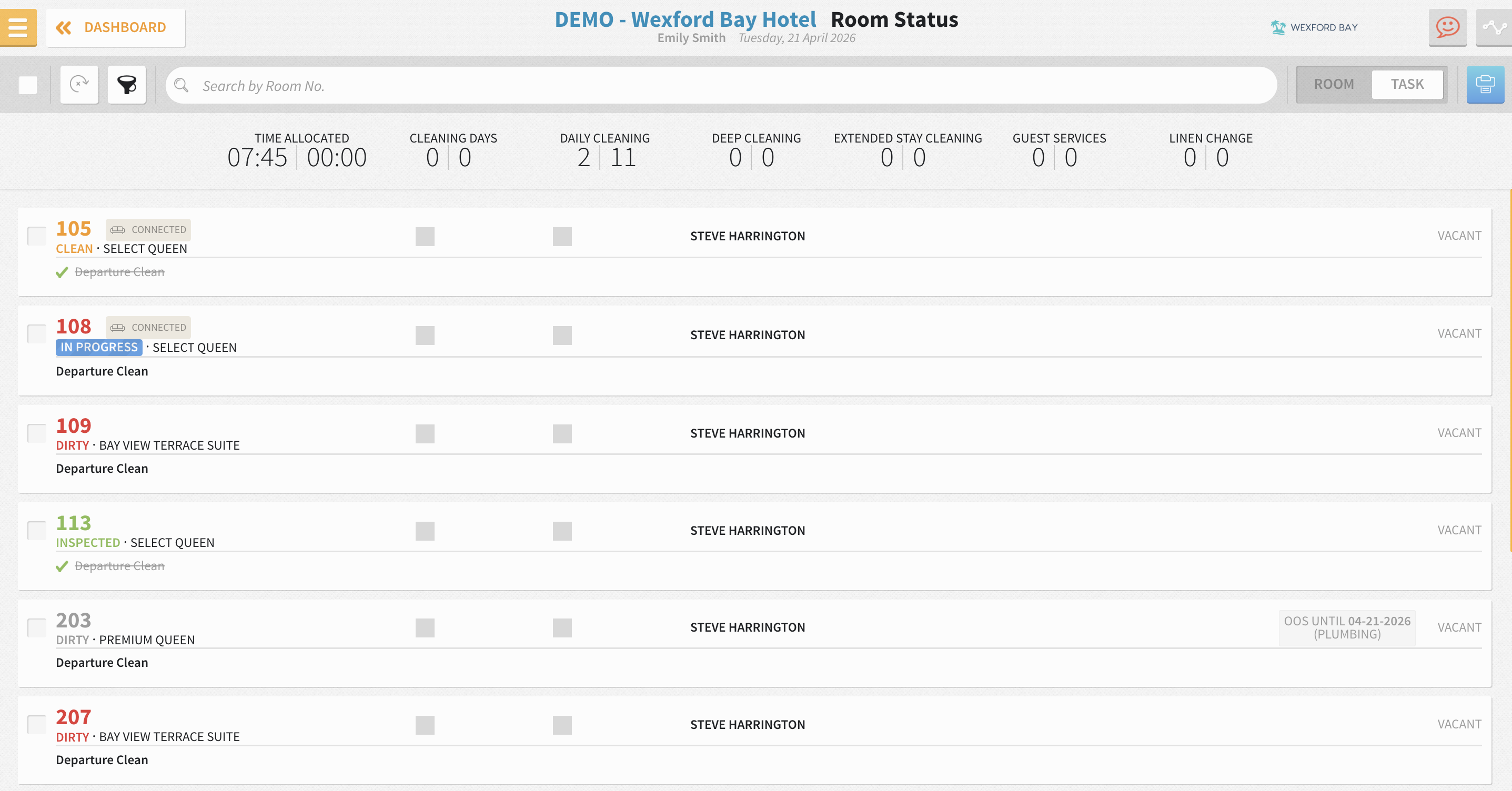
Housekeeping status updates. Communicating room readiness in real time so arriving guests are never sent to an unserviced room.
-
Night audit basics. Understanding the end-of-day process that closes out transactions, posts room charges and taxes, and rolls the system into the next business day, even if a dedicated night auditor runs it.
-
Guest communication. Logging requests, complaints, and preferences, escalating issues to the right department, and following up before checkout.
A hotel PMS integrates all of these functions into a single platform, and the interface design of that platform determines how quickly a new hire becomes productive. That design difference creates a dramatic gap in training timelines across the industry.
Why Legacy Systems Take Months While Modern Cloud PMS Trains in Hours
The gap in training time between legacy and modern systems is not marginal; it is categorical.
|
PMS Category |
Time to Basic Front Desk Competence |
Full Platform Training |
|---|---|---|
|
Legacy on-premise or hybrid systems |
Higher training effort due to complex customizations, typically around 3 months to a basic working grasp |
6–9 months to master |
|
Modern cloud PMS (general) |
Moderate training due to intuitive interfaces |
Varies by vendor |
|
Stayntouch PMS |
2 hours (front desk staff), according to Stayntouch customer data |
2 days (full platform, all modules), according to Stayntouch customer data |
Legacy platforms carry three structural disadvantages that extend training timelines. Their interfaces were designed around server-based workflows, not the way hotel staff actually move through a shift. A system with 200 features is worthless if a receptionist needs a manual to complete a check-in. Functions are often buried in nested menus that do not match real front desk sequences. Each upgrade typically requires extended downtime, which disrupts operations and forces retraining on changed interfaces.
The training cost grows with turnover. At a 55% annual turnover rate on a 75-person property, a hotel replaces approximately 41 workers per year.
Front Desk PMS Training Program: 2-Hour Outline
This 2-hour outline fits any modern cloud PMS with an intuitive interface. It assumes access to a sandbox or test environment, which mirrors the live system so staff can practice without affecting real guests or data. Each step includes the main actions, key inputs, stakeholders involved, approximate timing, and any integration or compliance notes.
-
System login and navigation (15 minutes). Actions: log in with individual credentials, orient to the main dashboard, locate the room diary, and identify the primary navigation menu. Inputs: staff credentials, property configuration. Stakeholders: training coordinator. Integration note: if the property uses single sign-on (SSO, one login granting access across multiple systems), confirm credentials work across connected platforms. Compliance note: each staff member must have an individual login, because shared credentials create audit gaps.
-
Reservations and room assignment (20 minutes). Actions: search existing reservations by name and confirmation number, create a new individual reservation, modify dates and room type, apply a rate, and block a room. Inputs: guest name, arrival and departure dates, room type, rate code. Stakeholders: front desk agent, revenue manager. Integration note: confirm that availability shown reflects live channel inventory to prevent overbooking. Compliance note: verify that deposit and cancellation policies attach automatically to each reservation.
-
Check-in and payment (20 minutes). Actions: retrieve an arriving reservation, verify guest identity, assign a room, post a deposit or pre-authorization, issue a key or activate a digital key, and confirm the folio. Inputs: reservation record, payment method, room status. Stakeholders: front desk agent, housekeeping for room readiness confirmation. Integration note: if the property uses a door lock system, confirm the key encodes correctly. Compliance note: card data must be tokenized, so raw card numbers are never stored in the PMS.
-
Housekeeping status updates (15 minutes). Actions: read current room status codes, update a room status manually, and identify which rooms are ready for early arrivals. Inputs: housekeeping team updates, room diary. Stakeholders: front desk agent, housekeeping supervisor. Integration note: on systems with mobile housekeeping, status updates propagate instantly, so confirm the front desk view refreshes in real time. According to Stayntouch customer data, real-time housekeeping sync produces a 25% increase in housekeeping productivity.
-
Night audit basics (15 minutes). Actions: review the end-of-day sequence, including posting room charges and taxes, reconciling departmental accounts, and rolling the system to the next business day. Inputs: daily transaction summary, rate and tax configuration. Stakeholders: night auditor, finance team. Compliance note: occupancy tax must apply automatically, because manual tax entry creates liability. Staff do not need to run the night audit independently after 2 hours of training. They need to understand what it does and when to escalate discrepancies.
-
Guest communication tools (15 minutes). Actions: log a guest request or complaint, add a note to a guest profile, send a message through the PMS communication module, and locate the escalation path for unresolved issues. Inputs: guest profile, request type, department routing. Stakeholders: front desk agent, relevant department head. Integration note: if the property uses a dedicated guest messaging platform, confirm that messages sent through it are visible in the PMS guest record.
-
Troubleshooting common issues (20 minutes). Actions: practice three high-frequency scenarios in the sandbox, including a guest whose reservation cannot be found, a payment that declines at checkout, and a room that shows occupied when it should be vacant. Inputs: test reservation records, simulated payment responses. Stakeholders: training coordinator, support team. Note: staff should know the support escalation path before going live. A PMS with a guaranteed sub-one-hour support response reduces the risk of a new hire being stranded during a busy check-in period.
Total structured time is approximately 2 hours. Staff who complete this outline in a sandbox environment are ready to handle the core front desk workflow on their first live shift, with a supervisor available for edge cases.
See what a best-in-class PMS actually feels like. Book a demo and watch the 2-hour training outline run on a live system.
Training Methods That Build Lasting PMS Skills
The outline above only works when supported by the right delivery methods. A sandbox training environment that mirrors the live PMS allows staff to practice workflows and make errors without affecting guests or real operations, and this setup is the single highest-impact investment a property can make in onboarding speed.
Five methods consistently accelerate front desk PMS competence:
-
Simulated environments. The Watch-Try-Do model progresses users from observing a correctly completed workflow, to practicing with guided support, to completing the task independently, which builds procedural memory before live system use.
-
Role-based eLearning. Self-paced modules organized by job function, such as front desk, housekeeping, night audit, and finance, let new hires focus on what they will actually do. This approach avoids time spent on modules irrelevant to their role. Stayntouch Academy provides this structure, with course certifications and progress tracking.
-
Microlearning. Five-to-ten-minute burst lessons via mobile applications during natural shift lulls break complex procedures into segments that improve retention by keeping cognitive load manageable.
-
Scenario-based practice. Connecting PMS functions to real guest problems, such as a returning guest with a late checkout request and a dietary note on file, improves retention over feature-by-feature instruction.
-
Certifications and progress tracking. Role-specific certification milestones serve as proficiency tests for core front desk processes and give managers documented evidence of competence rather than a time estimate.
How to Measure Training Success
Training is complete when a staff member can perform core tasks independently under guest-facing pressure, not when a scheduled training period ends. Use the following checklist and metrics to confirm readiness.

Day-one competency checklist:
-
Can log in independently and navigate to the room diary without assistance.
-
Can retrieve a reservation by guest name and confirmation number.
-
Can complete a check-in, post a payment, and issue a key in under three minutes.
-
Can update a room status and identify rooms ready for early arrivals.
-
Can log a guest request and route it to the correct department.
-
Knows the escalation path for payment failures and reservation discrepancies.
Operational metrics to track at 30 days:
-
Average check-in time per guest, with a target under 3 minutes for staff-assisted check-in.
-
Billing error rate, measured as disputed charges per 100 checkouts.
-
Support escalations initiated by new hires, with a declining trend expected by week two.
-
Guest satisfaction scores during the new hire’s shifts compared with the property average.
Employees who experience strong onboarding are 69% more likely to remain with the organization for three years and achieve approximately 50% greater new-hire productivity. Measuring training outcomes supports retention and revenue, not just HR reporting.
To cut your onboarding timeline from months to hours, book a demo and see Stayntouch Academy in action.
Choosing PMS Software Based on Training Time
Training time reflects interface design more than staff capability. If the check-in process is not obvious without reading a manual, staff will struggle under high-pressure guest-facing conditions. Evaluate any PMS against these criteria before signing a contract.
-
Time to competence. Ask the vendor how long it takes a new front desk hire with no prior PMS experience to complete a check-in independently. Request a reference from a property with comparable turnover rates. This baseline metric sets your recurring onboarding cost.
-
Self-paced learning modules. Once you know the time-to-competence target, confirm that the vendor provides training infrastructure that can hit it consistently. A system that requires a scheduled trainer for every new hire scales poorly in a high-turnover environment. Role-based eLearning with certifications and progress tracking removes that dependency.
-
Sandbox access. Training infrastructure only works when staff can practice safely. Evaluate PMS ease of use by timing core tasks such as check-in and checkout during a trial, and involve actual front desk staff in the assessment, not just managers.
-
Support response time. When a new hire encounters an edge case on their first live shift, support response time determines whether the situation resolves smoothly or becomes a guest complaint. A guaranteed sub-one-hour response, available 24/7/365 with no service tiers, is the standard to require.
-
Integration flexibility. A PMS that charges for each new integration, and legacy enterprise systems can charge as much as $10,000 per connection, turns every technology decision into a budget negotiation. Note that while Stayntouch charges nothing for the integration itself, each third-party platform carries its own platform fee.
Stayntouch delivers the training timeline shown in the comparison above, with Stayntouch Academy providing the self-paced eLearning, test environments, certifications, and progress tracking that make that timeline repeatable regardless of how often the training clock resets. As Hotel Belle Epoque’s director noted after switching, because the system is easy to learn, the property can now hire for the ability to engage with guests rather than for technical aptitude.
That hiring shift matters. Up to 22% of all hospitality turnover occurs in the first 45 days. A PMS that trains in hours rather than months reduces onboarding cost and widens the hiring pool to candidates who are excellent with guests, regardless of their prior software experience.
Frequently Asked Questions
How long does it actually take to learn hotel PMS software?
The answer depends entirely on the system. Legacy on-premise platforms typically require around three months for a new hire to reach basic working competence, and six to nine months to master the full platform. Modern cloud-based systems vary, but Stayntouch follows the 2-hour and 2-day training timeline detailed earlier. The difference comes from interface design, because a system built around how hotel staff actually work through a shift requires far less memorization than one built around server-based workflows adapted for a browser.
Can a new front desk hire really be productive on day one?
A new hire can be productive on day one when the PMS is designed for fast learning and the training program uses a sandbox environment. The 2-hour outline in this article covers the seven core tasks a front desk agent performs in every shift, including login and navigation, reservations, check-in and payment, housekeeping status, night audit basics, guest communication, and troubleshooting. A new hire who completes those steps in a test environment before their first live shift can handle the core workflow independently, with a supervisor available for edge cases. Stayntouch customers report this outcome and often highlight the benefit of hiring for guest-facing personality rather than technical aptitude.
What does high turnover actually cost a hotel in training terms?
The direct replacement cost for a frontline hospitality worker, covering recruiting, onboarding, and productivity ramp-up, runs to thousands of dollars per departure, according to Cornell Center for Hospitality Research and operator surveys. If each new hire requires three months to reach basic PMS competence, the property operates with a permanent productivity deficit across a significant portion of its front desk team. A PMS that trains in hours converts that recurring cost into a short, predictable onboarding event.
What training methods work best for hotel front desk software?
Hands-on practice in a sandbox environment delivers the highest impact, because it allows staff to make errors without affecting real guests or data. Scenario-based training that connects PMS functions to real guest situations, such as a returning guest with a late checkout request or a payment that declines at checkout, improves retention over feature-by-feature instruction. Role-based eLearning with certifications lets new hires focus on the tasks relevant to their position. Microlearning modules under ten minutes, accessible between shifts, help maintain competence after initial onboarding. Peer mentoring, where a new hire pairs with an experienced staff member for the first two shifts, builds confidence faster than group sessions alone. Stayntouch Academy combines all of these methods with self-paced eLearning, test environments, certifications, and progress tracking organized by role.
How should a hotel evaluate PMS software for training speed before buying?
Ask the vendor three questions during the demo. First, how long does it take a new hire with no prior PMS experience to complete a check-in independently. Second, whether a sandbox environment is available for training. Third, what support response time is guaranteed when a new hire encounters an issue on their first live shift. Then test the answers yourself. Request trial access, involve an actual front desk staff member rather than a manager, and time how long it takes to complete a check-in from a confirmed reservation without reading any documentation. If the process requires a manual, the system will slow your team under guest-facing pressure. Also confirm the integration model, because a PMS that charges per integration discourages building the right technology stack over time and compounds operational costs well beyond the training period.
Conclusion
High turnover will remain a reality for most hotels. The U.S. accommodation and food services quit rate sits at nearly double the private-sector average, and the cost of replacing a frontline hotel worker, including recruiting, onboarding, and lost productivity, reaches thousands of dollars per departure. A PMS that takes months to learn turns every resignation into a months-long productivity gap. A PMS that trains front desk staff in hours turns it into a short, manageable onboarding event.
The operational case is straightforward. Faster training reduces cost, widens the hiring pool to candidates who are excellent with guests, and lets your team focus on the work that actually drives guest satisfaction, not on navigating software. The 2-hour outline in this article offers a starting point, and the system behind it determines whether that timeline is achievable or aspirational.
Stayntouch delivers on the 2-hour and 2-day training timeline detailed earlier, with Stayntouch Academy providing the self-paced eLearning, certifications, and progress tracking to make that repeatable at scale across a single property or a portfolio of 100 or more.
Book a demo and see how fast your team can be up and running.
Read Next
Turn a more connected stack into a better stay.
See how Stayntouch can support the operating moments that matter most to your hotel team.