
Written by: Kelly Campbell, Vice President of Marketing, Stayntouch
Key Takeaways for Boutique Front Desk Teams
-
Front office operations in boutique hotels cover reservations, check-in and checkout, room assignment, housekeeping status, guest folios, billing, night audit, rate management, and three-way check-in through a property management system (PMS).
-
Boutique hotels must deliver personalized service with limited staff while managing rising labor costs (up 8% in 2025) and high turnover rates near 70% annually.
-
A mobile-first PMS with fast two-hour training and three-way check-in options cuts staff-assisted check-ins and improves efficiency across guest touchpoints.
-
Key success metrics include staff-assisted check-in rate (target below 50%), training hours to competence (target two hours), lobby wait time, upsell conversion, housekeeping productivity, and chargeback incidence.
-
Stayntouch delivers a cloud-native PMS that helps boutique hotels run lean front desk operations while maintaining personalized service. See how it works for your property.
Who This Front Desk Playbook Is For
This guide targets general managers, owners, and front-office leaders at boutique and independent hotels of 75 rooms and above in the U.S., Canada, Caribbean, UK, Germany, France, and Scandinavia. Properties in this range carry enough operational complexity to feel the pain of desk-bound workflows, yet remain lean enough that every wasted staff minute compounds quickly.
Closing the front-desk efficiency gap protects four business outcomes at the same time.
-
Occupancy and average daily rate (ADR): Faster room turnaround returns inventory to the sellable pool sooner.
-
Guest satisfaction scores: When check-in basics are not met, guest satisfaction scores can drop significantly.
-
Labor costs: Tracking labor cost per occupied room daily keeps expenses aligned with revenue performance.
-
Staff retention: A February 2024 AHLA survey found 72% of hotels unable to fill open positions, while a June 2024 survey found 79% unable to fill positions.
The right PMS partner turns these four pressures into a single solvable problem by enabling a repeatable six-step operating cycle that addresses each pressure point systematically.
Six-Step Front Desk Operating Cycle for Boutique Hotels
The following six steps form a repeatable operating cycle for lean front-desk teams. Each step names the required actions, timing, stakeholders, and PMS fields or automations involved.

-
Pre-arrival data capture (48–72 hours before arrival). Send automated pre-arrival messages with a mobile check-in link. Collect digital registration, payment authorization, and ID verification before the guest reaches the lobby. PMS fields required: guest profile, payment token, room preference notes, loyalty status. Stakeholder: front office agent or automated workflow.
-
Three-way arrival (check-in window). Offer every guest their preferred path: fully mobile in 30 seconds, hybrid pre-check-in where staff handle keys and payment, or staff-assisted anywhere on property via tablet. This model significantly reduces staff-assisted check-ins and shortens lobby queues. PMS fields required: room assignment, folio status, key delivery method. Stakeholder: front desk agent with tablet or kiosk.
-
Real-time room-status updates (throughout the day). Housekeeping staff update room status from the room itself. The front desk sees a room become available the moment it is inspected, with no radio calls and no paper lists. A connected PMS enables front desk teams to see updated room status from housekeeping without calls or paper lists, allowing faster assignment of rooms to arriving guests. PMS fields required: room diary, housekeeping task list, out-of-order and out-of-service flags. Stakeholder: housekeeping supervisor and front desk agent.
-
Shift handover (15 minutes before shift end). Pull a live handover report from the PMS room diary. Document current occupancy, expected arrivals and departures, open complaints with named owners, VIPs in-house, blocked rooms, and any decisions that deviated from standard procedure. Service failures often increase following shift changes, so a structured handover reduces that risk. Stakeholder: outgoing and incoming shift leads.
-
Issue resolution (within the same shift). Acknowledge every guest complaint within 30 seconds. Log it in the PMS with room number, issue, owner, and resolution. Front desk staff should resolve most guest complaints within the same shift using a six-step protocol: acknowledge immediately, empathize and apologize, investigate facts via PMS and logs, offer an authorized solution with a specific timeline, document in the PMS, and follow up before shift end. Stakeholder: front desk agent with defined resolution authority.
-
End-of-day reconciliation (night audit). Automated night audit closes the day’s transactions, posts room charges and taxes, and rolls the system into the next business day without manual intervention. Charges from every revenue center, including point-of-sale (POS), spa, and kiosk, post automatically to the guest folio. According to Stayntouch customer data, this automation delivers up to a 42% improvement in accounting efficiency. Stakeholder: night audit manager or automated PMS workflow.
Stayntouch trains front desk staff completely in two hours, so a new hire is productive on their first shift. Watch the full workflow in a live demo.
Building a Lean Cross-Training Matrix for Front Desk Teams
Cross-training acts as an operational insurance policy for lean teams because it reduces dependency on external staffing during absences or turnover. Formal cross-training programs can reduce temporary staffing costs and improve staff retention by ensuring multiple team members can cover critical roles.

Build the matrix in three stages.
-
Select two or three critical role pairings first. Start with front desk and reservations, then lobby concierge and guest relations, then housekeeping and public-area attendant roles. Attempting to train everyone on everything at once reduces service quality during the learning period.
-
Build the shift-handover checklist from live PMS data. The checklist must cover four areas: guest status (expected arrivals, VIPs, room discrepancies, out-of-order rooms), open guest issues (unresolved complaints with named owners), financial items (cash drawer reconciliation, failed authorizations), and operational items (wake-up calls, lost and found, signed shift log). Pull this data directly from the PMS room diary so it reflects live property state, not yesterday’s notes.
-
Embed compliance into every cross-training path. Hotels should embed compliance and safety content, including data privacy, payment handling, and health and safety, into every cross-training path and require successful completion before staff work unsupervised in a new role.
The most useful KPIs for measuring cross-training impact are temporary staffing costs as a percentage of total labor cost, staff turnover by department, number of cross-trained team members, and guest satisfaction scores related to service responsiveness. Review the competency framework at least annually or when new technology or brand standards are introduced.
Five Common Front Desk Challenges and Fast Fixes
Five pain points recur across boutique hotel front desks. Each has an early-warning sign and an immediate fix.
-
Long queues at check-in. Early warning: lobby wait time exceeds five minutes during peak arrival windows. Fix: activate mobile and kiosk check-in paths so guests who pre-registered bypass the desk entirely. Nearly 80% of travelers would be willing to stay at hotels with a completely automated front desk or self-service kiosk.
-
Missed upsells. Early warning: upsell conversion rate below 10% at check-in. Fix: move upsell offers into the pre-arrival mobile check-in flow, where guests are most receptive. According to Stayntouch customer data, automated upsells have driven return on investment (ROI) increases of up to 240% on mobile and up to 120% on kiosk at individual properties.
-
Tax misapplication. Early warning: rising chargeback incidence or guest disputes at checkout. Fix: use a PMS with jurisdiction-aware, automated tax posting so occupancy tax and local taxes apply instantly and correctly without staff intervention.
-
Slow onboarding. Early warning: new hires require more than one week before handling solo shifts. Fix: adopt a PMS that trains front desk staff in two hours, supported by self-paced eLearning with test environments. Hotels with well-crafted standard operating procedure (SOP) libraries can reduce new employee training time by up to approximately 50% compared with properties that rely on informal, on-the-job coaching.
-
Fragmented guest profiles. Early warning: repeat guests are asked for preferences they already provided. Fix: ensure the PMS maintains comprehensive guest profiles that sync automatically to the hotel’s customer relationship management (CRM) system, with custom notes and stay history traveling with the guest across every visit.
Six Metrics to Measure Front Desk Performance
Define these six key performance indicators (KPIs) and track them daily or weekly inside the PMS dashboard.
-
Staff-assisted check-in rate. This is the percentage of arrivals that require a staff member to complete check-in. Target: below 50%.
-
Training hours to competence. This measures the number of hours from hire to solo shift without escalations. Target: two hours for front desk PMS proficiency, with full role competency typically reached within several weeks.
-
Lobby wait time. This is the average number of minutes from guest arrival to room key issuance. Long wait times rank among the most frequent guest complaints.
-
Upsell conversion rate. This is the percentage of guests who purchase a room upgrade or additional service during check-in. Upsell platforms can deliver revenue uplift through pre-arrival offers.
-
Housekeeping productivity. This measures rooms cleaned per labor hour. The standard productivity benchmark for room attendants is 14–16 rooms per 8-hour shift, allowing 20–30 minutes per room. According to Stayntouch customer data, mobile housekeeping delivers a 25% increase in housekeeping productivity.
-
Chargeback incidence. This is the number of guest payment disputes per 100 check-outs. Reduce this by capturing signed digital registration cards that document guest agreement to terms and conditions. Automated payment workflows can also improve accounting efficiency.
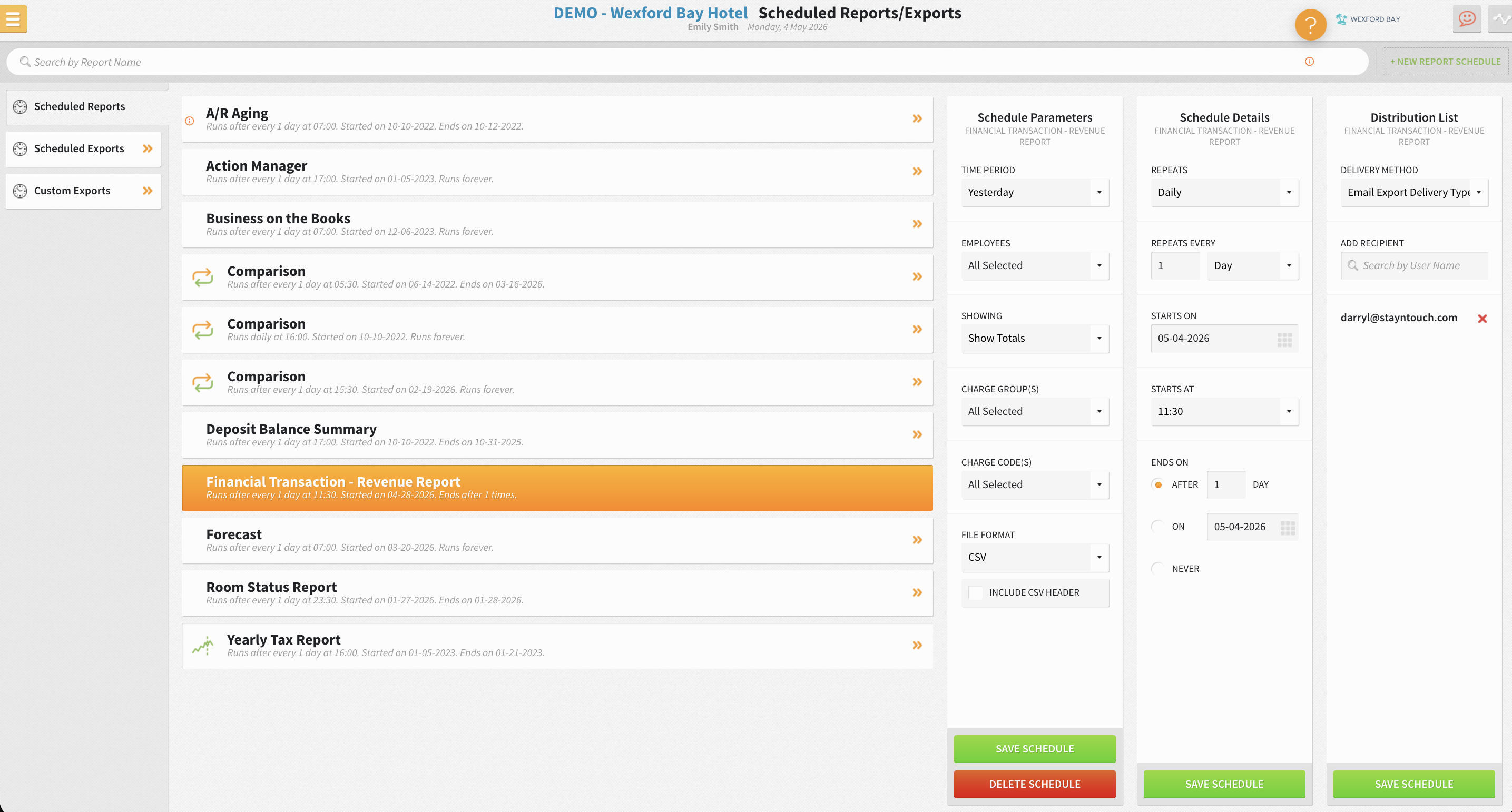
The 2026 TravelTech Breakthrough “Hotel PMS Company of the Year”, Stayntouch PMS surfaces all six metrics in a single dashboard, with scheduled reports delivered automatically by email or cloud drive. View the reporting dashboard.
Advanced Front Desk Strategy for Multi-Property Groups
Multi-property groups face a compounding version of the single-property problem because every configuration decision must be replicated, every new hire trained, and every guest profile reconciled across locations. According to Stayntouch customer data, multi-property management from a single dashboard runs portfolios 70% more efficiently.
Three capabilities define a successful multi-property rollout.
-
Centralized configuration with local flexibility. Push rate types, deposit and cancellation policies, charge codes, user permissions, and housekeeping task lists from a central login to every property. Individual hotels retain operational latitude within those guardrails.
-
Door-lock and POS integrations at no extra cost. Stayntouch connects to 1,400+ integrations, including ASSA ABLOY, dormakaba, Salto, VingCard, Toast, Oracle Micros, and Lightspeed, with unlimited connections and no per-interface fees. A webhook, which is a connection that pushes data the moment something happens, notifies the door-lock system the instant a guest checks in, so the key is ready without a manual step.
-
Webhook-driven automations across the portfolio. Event-driven architecture covers reservation creation, check-in, checkout, room assignment, and room moves. Every connected system, including messaging, housekeeping, and payments, receives updates in real time. The 2026 Hotel Technology Outlook produced by the NYU SPS Jonathan M. Tisch Center of Hospitality found that 38% of hotel respondents cite integration as a top pain point, and open APIs help eliminate that friction.
Stayntouch has deployed 139 properties in 90 days across 29 U.S. states, covering more than 7,000 rooms. A full portfolio typically configures and deploys in 30 to 45 days.
Boutique Hotel Front Desk Operations FAQ
How long does it take to train front desk staff on a modern PMS?
With Stayntouch, full front desk training takes two hours. The full platform, covering all modules including housekeeping, night audit, finance, and revenue management, trains in two days. The Rate Strategy module trains in 20 minutes. Stayntouch Academy provides self-paced eLearning with test environments, certifications, and progress tracking, so new hires can onboard without scheduling a trainer. This matters most in boutique hotels, where high turnover means the training clock resets constantly. Several Stayntouch customers report a more important downstream effect: because the system is easy to learn, they can hire for guest-facing personality rather than technical aptitude.

What is three-way check-in and how does it work in a boutique hotel?
Three-way check-in gives every guest their preferred arrival path simultaneously. The first path is fully mobile: the guest completes registration and payment before arrival and checks in from their phone in 30 seconds. The second is an on-property kiosk: guests check in at a dedicated kiosk that integrates a credit card reader and key encoder for under-a-minute, staffless check-ins, with optional security layers such as ID scanning and facial recognition. The third is staff-assisted anywhere on property: a team member greets the guest in the lobby, lounge, or courtyard with a tablet and completes the full process there, or handles only keys and payment when the guest has already pre-registered. All three paths run at the same time, so the hotel does not choose one model and impose it on every guest.
How should a boutique hotel structure its shift handover to prevent service failures?
A structured shift handover pulled from live PMS data covers four areas: guest status (expected arrivals, VIPs, room discrepancies, out-of-order rooms), open guest issues (unresolved complaints with named owners and due times), financial items (cash drawer reconciliation, failed payment authorizations, online travel agency payments), and operational items (wake-up calls, lost and found, signed shift log). Every open complaint carries a status of Open, In Progress, Resolved, or Needs Follow-up and remains visible in every handover until it is closed. Digital handover logs with read receipts replace verbal briefings, reducing handover time and creating an auditable trail. The incoming shift lead should review the live PMS room diary before the outgoing lead departs.
What KPIs should a boutique hotel track to measure front desk performance?
Six metrics cover the full picture: staff-assisted check-in rate (target below 50%), training hours to competence (target two hours for PMS proficiency), lobby wait time (average minutes from arrival to key issuance), upsell conversion rate (the percentage of guests who purchase an upgrade or add-on during check-in), housekeeping productivity (rooms cleaned per labor hour, with a standard benchmark of 14–16 rooms per 8-hour shift), and chargeback incidence (payment disputes per 100 check-outs). Track all six daily inside the PMS dashboard. Housekeeping and front-desk dashboards must be reviewed together, because room turnaround time delays in housekeeping directly extend front-desk wait times.
Is a cloud PMS suitable for a boutique hotel with a small IT team?
A cloud-native PMS suits properties without a dedicated IT department. There are no on-site servers to maintain, no manual upgrades to schedule, and no downtime for product releases. Stayntouch runs on AWS with 100% system uptime and an average system response time of 256 milliseconds. Implementation runs on a structured six-week process with a dedicated project manager, with remote, on-site, or blended deployment options. Auto-Configuration reduces property setup from approximately 30 hours of manual work to four to five hours. The Dataloader module migrates legacy guest profiles, group reservations, company and travel agent profiles, and deposit totals in one to two hours. After go-live, 24/7/365 support with a guaranteed response under one hour is included at no extra cost and delivered by hospitality specialists, not a chatbot.
Conclusion: Lean Front Desk Operations with Boutique-Level Service
The operational gap in boutique hotel front-desk management is real and measurable. Rising labor costs, 70% annual turnover in U.S. hospitality, and desk-bound legacy workflows combine to create queues, training bottlenecks, and missed revenue. The solution is not fewer staff. It is smarter workflows, a mobile-first PMS, and a cross-training framework that turns every team member into a flexible service asset.
The six-step process in this guide, covering pre-arrival data capture, three-way arrival, real-time room-status updates, structured shift handover, same-shift issue resolution, and automated night audit, gives lean teams a repeatable operating system. The six KPIs give managers the visibility to improve it continuously. A PMS that trains in two hours means turnover stops being a permanent productivity tax.
Stayntouch is a cloud-native PMS built mobile-first for independent boutique hotels and multi-property groups of 75 rooms and above. It connects to 1,400+ integrations at no extra cost, holds a 97% customer retention rate, and earned the 2026 TravelTech Breakthrough “Hotel PMS Company of the Year” award. Book a demo to see efficient boutique front-desk operations in action.
Read Next
Turn a more connected stack into a better stay.
See how Stayntouch can support the operating moments that matter most to your hotel team.