
Written by: Kelly Campbell, Vice President of Marketing, Stayntouch
Key Takeaways for Independent Hotels
-
A cloud-based hotel booking engine on your own website captures reservations without commission instead of routing them through OTAs that charge 15–25%.
-
Independent hotels should focus on real-time two-way PMS synchronization, open integrations, and fast deployment when comparing engines.
-
Shifting even 20% of bookings from OTAs to your direct engine can recover thousands of dollars per year and reduce cancellations.
-
Critical evaluation criteria include mobile optimization, brand customization, upsell merchandising, group and corporate code support, analytics, and clear flat-fee pricing.
-
Stayntouch Booking delivers these capabilities as part of an open ecosystem; request a demo to see how it can increase direct revenue for your property.
How a Cloud-Based Booking Engine Works
A cloud-based hotel booking engine, also called an internet booking engine (IBE), is a reservation widget embedded into a hotel’s existing website. Guests use it to search available dates, view room types, and complete a booking. The engine reads live rates and availability directly from the PMS and writes every new reservation, modification, or cancellation straight back into it.

The cloud-based distinction affects daily operations. Cloud-native software runs on remote servers, in Stayntouch’s case Amazon Web Services (AWS), rather than on hardware installed at the property. There are no on-site servers to maintain, no manual software upgrades to schedule, and no downtime window that disrupts front desk operations. Updates deploy silently in the background.
The two-way PMS connection separates a modern cloud-based booking engine from a basic availability widget. One-way sync shows guests what the PMS contained at the last scheduled update. The gap between updates is where double bookings happen. Two-way sync means the booking engine reads live inventory and writes reservations back instantly, so a room sold on the hotel’s website is unavailable everywhere else within seconds. Deep two-way integration carries not just availability but also rates, taxes, booking rules such as minimum-stay requirements, stop-sell flags, and package rates across every connected channel.
Stayntouch Booking is a plug-and-play engine embedded into the hotel’s existing website with a small piece of code. No developer hire and no website rebuild are required. It connects two-way with Stayntouch PMS, so room features, images, rates, and restrictions sync outward automatically. Updating a room type in the PMS updates the website without anyone touching it twice.
How a Booking Engine Reduces OTA Commissions
Independent hotels typically pay OTA base commissions of 15–25%, with effective rates climbing higher once promotional discounts, visibility programs, and platform fees are added. A decade ago, the average OTA commission sat closer to 15%.
OTA cancellation rates reached 21.8% versus 10.6% for direct bookings in 2025, which compounds the cost. OTA bookings are more expensive to acquire and more likely to cancel. A direct booking engine addresses both problems at the same time.
Stayntouch Booking captures direct reservations at zero commission to Stayntouch. The engine supports promotional codes, group booking codes that let guests book within a specific room block, and add-on packages presented during the booking flow. These tools increase average booking value before arrival without involving OTAs.
See your potential commission savings with a custom direct-booking shift calculation for your property.
Core Booking Engine Features to Review
Independent hotel operators can use the following checklist when assessing a cloud-based booking engine.

-
Real-time two-way PMS sync. Rates, availability, restrictions, and reservations update instantly in both directions with no manual reconciliation.
-
Mobile optimization. A large share of hotel searches happen on a phone. A clumsy mobile flow loses the reservation to whichever channel is easier, usually an OTA.
-
Brand customization. Colors, logos, fonts, and language preferences should be configurable to match the property without a developer.
-
Upsell and package merchandising. Room upgrades, add-ons, and packages should appear during the booking flow, not after arrival.
-
Access and group codes. Contracted corporate rates and group room blocks must be accessible by code, keeping negotiated inventory separate from public rates.
-
Analytics integration. Google Tag Manager and GA4 event coverage should report the full booking journey so marketing teams can see where guests abandon the process.
-
Bot protection. Invisible reCAPTCHA should screen automated bots that hold or book inventory no real guest will occupy, without adding friction for genuine bookers.
-
Accessibility compliance. AccessiBe support helps guests using screen readers or assistive technology and supports legal compliance in many jurisdictions.
-
Open integration architecture. The engine should connect to the hotel’s existing channel manager, revenue management system (RMS), and customer relationship management (CRM) platform without per-connection fees.
-
Transparent pricing model. A flat subscription or clearly structured fee avoids recreating OTA-style commission on every direct booking.
Schedule a feature walkthrough to see how Stayntouch Booking maps to these criteria for your property type.
Real-Time Inventory Sync and Two-Way PMS Integration
Real-time inventory synchronization forms the technical foundation of a direct booking strategy. Even a 15-minute delay in synchronization during a busy weekend is enough time for two channels to sell the same room, creating overbooking risk at high occupancy. A double booking, where the same room sells on two channels within minutes, is one of the most damaging distribution failures a hotel can experience.
Stayntouch Booking connects to Stayntouch PMS through a two-way, event-driven architecture using webhooks. Webhooks push data the moment something happens rather than requiring another system to keep asking. When a reservation is created, modified, or cancelled anywhere in the system, every connected channel updates immediately. Room features and images sync outward automatically from the PMS, so the booking engine always reflects the current state of the property without manual intervention.
The same open architecture extends to the broader technology stack, which matters because a booking engine must share data with systems that set rates, manage guest relationships, and distribute inventory. Stayntouch connects to 1,400+ integrations at no additional cost to Stayntouch. Third-party platforms charge their own platform fees, but Stayntouch charges nothing for the integration itself. This includes revenue management systems such as IDeaS and Duetto that set the rates the engine displays, CRM platforms such as Salesforce and Revinate that personalize the booking experience, central reservation systems (CRS) such as Sabre SynXis and Amadeus TravelClick iHotelier that handle multi-property inventory, and channel managers reaching 400+ distribution channels worldwide. The hotel chooses its specialist tools, and the PMS connects to them.
IT directors evaluating the architecture can review Stayntouch’s Connect APIs, which are webhook-enhanced and event-driven, with documented endpoints across 1,400+ connections, sandbox environments for safe testing before going live, and webhook testing tools. Integration access is scoped using OAuth, so each connected application sees only the data it needs. A door lock application can see a room number and checkout date but is blocked from payment details or guest address data.
Training, Support, and Implementation Timeline
Implementation risk often keeps independent hotels on systems they have outgrown. Stayntouch addresses this with three tools that compress the timeline and reduce the risk of a messy migration.
Auto-Configuration cuts property setup from approximately 30 hours of manual work to 4–5 hours using standardized templates with a pre-submission audit. The Dataloader module migrates legacy guest profiles, group reservations, company and travel agent profiles, and deposit totals in as little as 1–2 hours. For properties with legacy data that is not clean, Stayntouch provides an internal Colab-based file cleanup and validation process that reformats and validates messy exports before migration rather than rejecting the file.
Manual data entry remains available as a fallback, and certain fields such as group blocks are always created manually regardless of export quality. Non-standard data such as group rooming lists or revenue budgets can be uploaded via CSV bulk upload. A single property deploys in approximately one month. A full portfolio configures and deploys in 30 to 45 days. In one customer case, a single management company deployed 139 properties in 90 days across 29 states, which shows how a structured, scalable implementation process performs at enterprise scale.
Full platform training across all modules takes 2 days. After go-live, 24/7/365 follow-the-sun support is included for every customer at no extra cost, with a guaranteed ticket response under one hour. Teams are staffed across multiple time zones so a request always reaches someone currently on shift rather than waiting for one office to open. Support is delivered by hospitality and product specialists, not a chatbot.
Comparison Checklist for Independent and Multi-Property Hotels
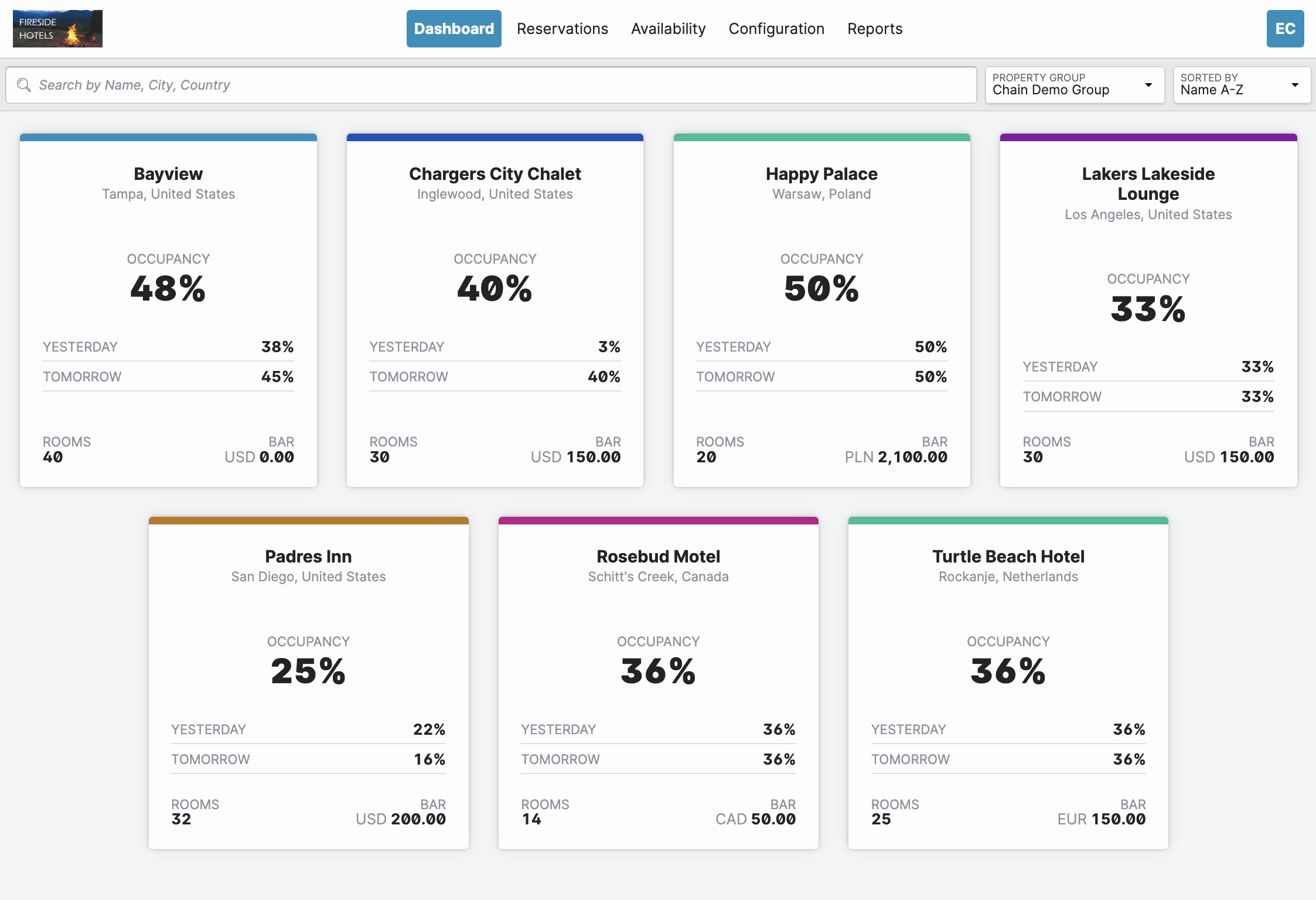
The table below compares best-in-class and all-in-one platform categories across dimensions that matter most to independent and multi-property operators. All Stayntouch figures come from Stayntouch customer data and published platform specifications. Category-level figures for all-in-one platforms reflect published industry ranges.
|
Dimension |
Best-in-class PMS (Stayntouch) |
All-in-one platform (category) |
|---|---|---|
|
Real-Time Two-Way Sync |
Webhook-driven, event-pushed, booking engine, channel manager, and PMS update simultaneously |
Varies, native sync within the suite, but depth of external channel sync depends on architecture |
|
Integration Cost |
1,400+ integrations at no additional cost to Stayntouch, third-party platforms charge their own fees |
Legacy all-in-one platforms can charge as much as $10,000 per integration, modern all-in-one marketplaces vary |
|
Full Platform Training Time |
2 days across all modules, according to Stayntouch |
Enterprise systems may charge for on-site training, legacy platforms typically require three months to reach a basic working grasp |
|
Uptime Record |
100% system uptime sustained over the past two years, hosted on AWS, according to Stayntouch |
Varies by vendor, on-premise and hybrid systems subject to local server failure and scheduled downtime for upgrades |
|
Multi-Property Support |
100+ properties manageable from a single login, portfolio management runs 70% more efficiently via a centralized multi-property dashboard, according to Stayntouch customer data |
Varies, all-in-one suites offer portfolio views but 67% of independent hotels continue to operate with disconnected systems regardless of platform type |
Request a side-by-side comparison tailored to your property count and room volume.
Choosing the Right Booking Engine for Your Hotel
The right booking engine for a hotel captures the most direct revenue with the least friction for guests and staff. That requires real-time two-way PMS sync that eliminates double bookings, a mobile-optimized flow that converts on any device, brand customization that keeps the guest inside the hotel’s own experience, and an open integration architecture that connects to the revenue management, CRM, and channel management tools the property already uses.
Independent hotels, boutique brands, and multi-property groups also need a transparent cost model. A booking engine that charges commission on direct bookings recreates the OTA cost structure the engine is supposed to replace. Stayntouch Booking operates on a subscription model with no commission on direct reservations captured through the engine.
The 2026 TravelTech Breakthrough “Hotel PMS Company of the Year” award and a 94% recommendation rating from 249 hotels on Hotel Tech Report reflect the platform’s standing among operators who have evaluated alternatives. Stayntouch Booking sits inside that same ecosystem as a native component of an open, best-in-class PMS built specifically for independent and multi-property hotels.
The 2026 Hotel Technology Outlook, produced by the NYU SPS Jonathan M. Tisch Center of Hospitality with Stayntouch and IDeaS (300+ hotel professionals, published November 2025), found that best-in-class PMS users report 70% satisfaction versus 55% among all-in-one users. The report also found that 30% of all-in-one users intend to move to best-in-class solutions, against 14% moving the other way. The direction of the market favors best-in-class platforms.
How Much Booking Engines Cost
Booking engine pricing across the market follows two primary models. Commission-based engines charge 1–3% of each reservation value, which means the engine’s cost scales with revenue and partially recreates the OTA commission structure. For most independent properties, a flat-fee subscription model is preferable because it makes costs predictable.
SaaS booking engine solutions typically carry an initial setup cost plus monthly fees, with time to first booking of several weeks for configured deployments. Custom-built engines cost substantially more and take significantly longer.
Stayntouch Booking is priced as a turnkey monthly subscription based on property size and room count. There are no maintenance fees, no per-integration charges, no fees for API certification, and no commission on direct bookings captured through the engine. Implementation costs are quoted separately and are structured around actual work performed rather than pre-allocated hours billed regardless of use. Contact Stayntouch for pricing specific to your property or portfolio, since the right configuration depends on property size, module selection, and portfolio scope.
The total cost comparison should also account for what the engine saves. Using the commission rates described earlier, with a blended 18% on 60% of bookings, a 75-room property running at 70% occupancy and a $150 average daily rate (ADR) pays approximately $41,000 in annual OTA commissions. Shifting 20 percentage points of that volume to direct bookings recovers roughly $8,200 per year before accounting for the booking engine’s subscription cost.
Common Questions Answered
How long does it take to deploy a cloud-based booking engine?
For Stayntouch Booking, deployment sits inside the broader PMS implementation timeline. A single property goes live in approximately one month. A full portfolio deploys in 30–45 days. The plug-and-play embed, a small piece of code placed on the hotel’s existing website, requires no website rebuild and no developer engagement for standard configurations. Auto-Configuration reduces property setup from approximately 30 hours of manual work to 4–5 hours.
Will a booking engine create double bookings if it is not perfectly synced?
Double bookings occur when synchronization is delayed or incomplete. Stayntouch Booking uses a webhook-driven, event-pushed architecture. When a reservation is created anywhere in the system, every connected channel updates immediately. Real-time two-way synchronization between a PMS and channel manager can reduce overbookings and improve booking accuracy compared with manual processes. The real risk lies in choosing a booking engine whose sync is scheduled rather than event-driven.
What happens to OTA bookings once a direct booking engine is in place?
OTA channels remain active and are managed through Stayntouch Channel Manager, which reaches 400+ distribution channels worldwide. The booking engine does not replace OTA distribution. It adds a commission-free direct channel alongside it. The goal is a balanced distribution strategy where direct bookings grow as a share of total reservations, reducing blended commission costs without abandoning the demand OTAs deliver. Independent hotels that treat OTAs as part of a balanced distribution strategy while actively investing in websites and booking engines achieve greater resilience against rising intermediary costs.
Does the booking engine work for multi-property groups?
Yes. Stayntouch Booking operates across a portfolio managed from a single login. Group booking codes let guests book within specific room blocks, and promotional codes unlock contracted corporate or promotional rates. The multi-property dashboard provides centralized visibility across the portfolio, with configuration templates pushed centrally to maintain brand consistency. The efficiency gains from centralized management, detailed in the comparison table above, come from eliminating property-by-property administration in favor of portfolio-wide visibility and control.
How does the 2026 Hotel Technology Outlook inform the best-in-class versus all-in-one decision?
The 2026 Hotel Technology Outlook (NYU SPS Jonathan M. Tisch Center of Hospitality with Stayntouch and IDeaS, 300+ hotel professionals) found that all-in-one users report check-in delays at 46% versus 23% for best-in-class users, booking errors at 57% versus 45%, and missed guest preferences at 51% versus 41%. Among all-in-one users who intend to switch platforms, only 34% are satisfied with training and support. The data supports the structural argument that when an all-in-one vendor’s engineering team spreads development effort across revenue management, CRM, point-of-sale (POS), and PMS, depth in any single category suffers. A best-in-class PMS concentrates that effort on the system a hotel touches every hour of every day.
Conclusion: Keep More Revenue on Property
A cloud-based hotel booking engine functions as a revenue recovery mechanism, not just a marketing tool. Every direct booking it captures is a reservation the hotel keeps in full instead of paying 15–25% to an OTA. For a 75-room independent hotel, that arithmetic compounds across thousands of room nights per year.
The engine’s effectiveness depends on what it connects to. A booking engine without real-time two-way PMS sync creates double-booking risk. A booking engine locked inside a closed all-in-one suite blocks the hotel from adopting a specialist revenue management system, a preferred CRM, or a better channel manager. A booking engine that charges commission on direct reservations recreates the cost structure it was supposed to solve.
Stayntouch Booking is a plug-and-play engine embedded in the hotel’s existing website, connected two-way to Stayntouch PMS, and sitting inside the open integration ecosystem described earlier. It deploys as part of a full-portfolio implementation in the timelines described earlier, with training and support structured to minimize operational disruption.
Watch a live demo of Stayntouch Booking to see how a shift in direct booking share can affect your property’s bottom line.
Frequently Asked Questions
What is the difference between a cloud-based booking engine and an OTA?
An online travel agency (OTA) is a third-party booking site such as Booking.com or Expedia that markets a hotel’s rooms to its own audience and charges a commission, typically 15–25% of the room rate, on every reservation it delivers. A cloud-based booking engine is software embedded directly on the hotel’s own website that allows guests to search availability and complete a reservation without leaving the hotel’s domain. Bookings captured through the hotel’s own engine carry no commission to the booking engine provider, so the hotel keeps 100% of that room revenue. The two channels are complementary. OTAs deliver demand the hotel’s website might not reach on its own, while the direct booking engine captures guests who arrive at the hotel’s site and converts them without an intermediary cost.
Does Stayntouch Booking require a website rebuild or developer resources to install?
No. Stayntouch Booking is a plug-and-play engine that embeds into the hotel’s existing website using a small piece of code. A booking link, calendar widget, or full booking flow renders inside the existing site without a website rebuild or ongoing developer engagement for standard configurations. Hotels customize colors, logos, fonts, and preferred-language selection to match their brand through the Stayntouch platform. The two-way connection to Stayntouch PMS is native. Room types, rates, restrictions, and images sync automatically from the PMS to the booking engine, so updates made in one place reflect everywhere without manual duplication.
How does Stayntouch Booking handle group reservations and corporate rates?
Stayntouch Booking supports group booking codes that allow guests to book within a specific room block at contracted rates, with inventory automatically updated as reservations are made against the block. Access codes unlock contracted corporate or promotional rates for eligible guests without exposing those rates to the general public. Group blocks are managed within Stayntouch PMS, including shoulder-date support for the nights either side of a group’s main block where attendees often extend their stay, and the booking engine reflects block availability in real time. Charges and routing rules configured in the PMS apply automatically to group reservations made through the engine.
What security and compliance standards does Stayntouch Booking meet?
Stayntouch Booking operates within the Stayntouch platform’s security architecture, which includes hosting on AWS Private VPC infrastructure, SOC 2 Type 1 certification, GDPR compliance, and ISO 27001/27018 certification for information security management and personal data protection in the cloud. Payment processing through Stayntouch Pay is certified to PCI DSS Level 1, the most stringent tier of the card industry’s security standard, with point-to-point encryption that scrambles card data from the moment it is entered until it reaches the processor, and tokenization that replaces real card numbers with meaningless substitute values so raw card data is never stored in the system. Invisible reCAPTCHA screens automated bots from the booking flow without adding friction for genuine guests. The platform maintains product compliance in 60+ countries across six regions, with jurisdictional diligence completed in advance on the hotel’s behalf.
Is Stayntouch Booking suitable for smaller independent hotels, not just large properties?
Yes. Stayntouch is purpose-built for independent hotels, boutique brands, and multi-property groups. The platform serves hotels of all sizes, including those under 75 rooms. The booking engine’s plug-and-play architecture, flat-subscription pricing model, and 30-to-45-day portfolio deployment timeline are designed to be accessible without a large IT team or capital budget. Smaller independent properties benefit from the same real-time two-way PMS sync, open integration architecture, and 24/7/365 follow-the-sun support as larger portfolios. Operational fit matters more than room count. Stayntouch works best for independent properties, independent hotel groups, and branded properties in the process of leaving a major brand flag to operate independently.
Read Next
Turn a more connected stack into a better stay.
See how Stayntouch can support the operating moments that matter most to your hotel team.