Written by: Kelly Campbell, Vice President of Marketing, Stayntouch
Key Takeaways
-
Hotel housekeeping software cuts labor costs by targeting five sources of waste: scheduling against live occupancy, routing room assignments by floor, replacing radio and paper with real-time status updates, flagging overtime before it is incurred, and tracking minutes per room.
-
Three essential metrics define the problem: cost per occupied room (CPOR), minutes per occupied room (MPOR), and overtime hours. Measure all three before evaluating any software.
-
Four operational preconditions determine success: accurate room-type configuration, mapped floor plans, real-time PMS integration, and consistent staff use of the mobile app.
-
Policy decisions such as stayover opt-out programs can deliver the largest labor savings. Software supports those policies but management must set them.
-
Stayntouch delivers real-time room status, automated assignment, forward scheduling, and productivity analytics within its core PMS, and customer data shows a 25% increase in housekeeping productivity.
See How Stayntouch Cuts Housekeeping Labor Costs
Start With Your Own Housekeeping Labor Number
Housekeeping is the largest controllable labor line in most hotels, and the cost has risen sharply. Wage cost per occupied room rose 12.8% in 2025, from $42.82 to $48.32, according to HotelData.com powered by Actabl’s Hotel Effectiveness platform (~5,000 U.S. hotels). These are U.S. figures, and labor dynamics differ in other markets.
This article explains how to calculate your own housekeeping CPOR and MPOR, where the real savings sit, what must be true operationally for hotel housekeeping software to reduce labor cost, and when the investment will not pay off.
Calculate Your Housekeeping ROI With Stayntouch
How Housekeeping Software Reduces Labor Costs
Hotel housekeeping software reduces labor costs through five specific mechanisms. Each one targets a different source of waste in the daily operation.
Smart Scheduling Against Live PMS Occupancy Data
Smart scheduling assigns housekeeping labor to match tomorrow’s expected departures and stayovers rather than reacting on the day. A property management system (PMS) holds the occupancy data that makes this possible. Without a live PMS feed, a housekeeping manager is staffing against yesterday’s assumptions. A sound forecasting method pulls the next day’s occupancy from the PMS, then converts those room categories into labor minutes, labor hours, and a projected headcount compared against currently scheduled staff.
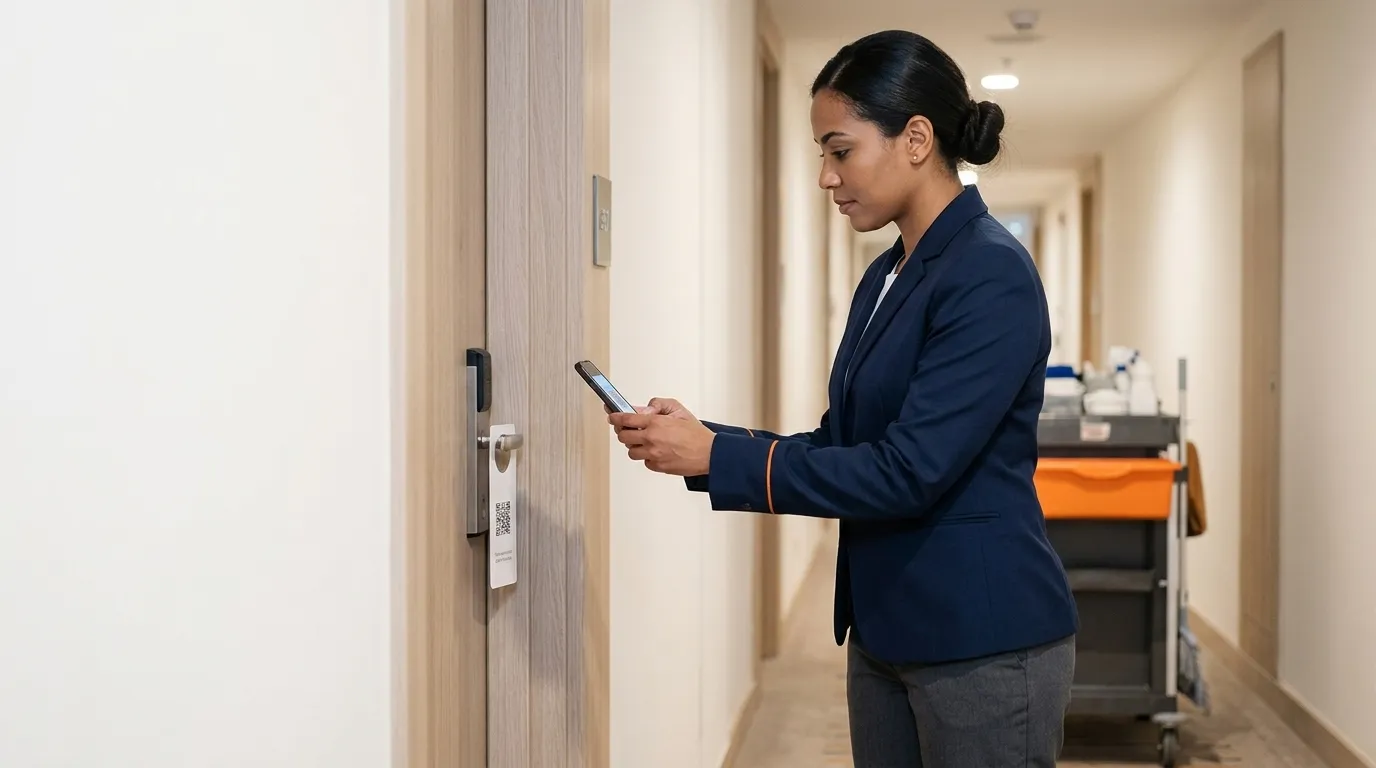
Stayntouch’s mobile housekeeping module supports forward task assignment. A manager can staff tomorrow against tomorrow’s expected departures, and room status updates propagate across the system the moment a room is inspected.

Route-Optimized Room Assignment
Route-optimized room assignment groups rooms by floor or section so housekeepers do not cross the property repeatedly. Walking time is invisible in most labor models because MPOR measures cleaning time, not transit time, yet it accumulates across a shift. Real-time workload balancing that auto-assigns new urgent rooms to the nearest housekeeper with capacity typically cuts 5–10 minutes per turnover by eliminating cross-property walking and idle time. Stayntouch’s housekeeping module assigns work by floor or section, and managers can see progress live.
Real-Time Room Status Replacing Radio and Paper
Real-time room status lets the front desk see a room become available the moment it is inspected, so guests are not queued for rooms that are already ready. 67% of hotels report delayed room availability as a friction point, where rooms show as unavailable longer than needed because PMS updates lag behind actual cleaning. The classic failure mode is the “clean but not communicated” room, which is physically ready but invisible to the systems that could sell or assign it.
Overtime Alerting
Overtime alerting flags when the day’s workload will push staff past scheduled hours before the overtime is incurred. Overtime is the most expensive labor a hotel buys, because premium pay often reflects a scheduling failure rather than a true demand spike. HotelData.com’s Q1 2026 Labor Costs Report found that overtime increased among several key housekeeping roles even as overall housekeeping productivity improved. Operators still need better tools to catch overtime before it appears in payroll.
Productivity Analytics
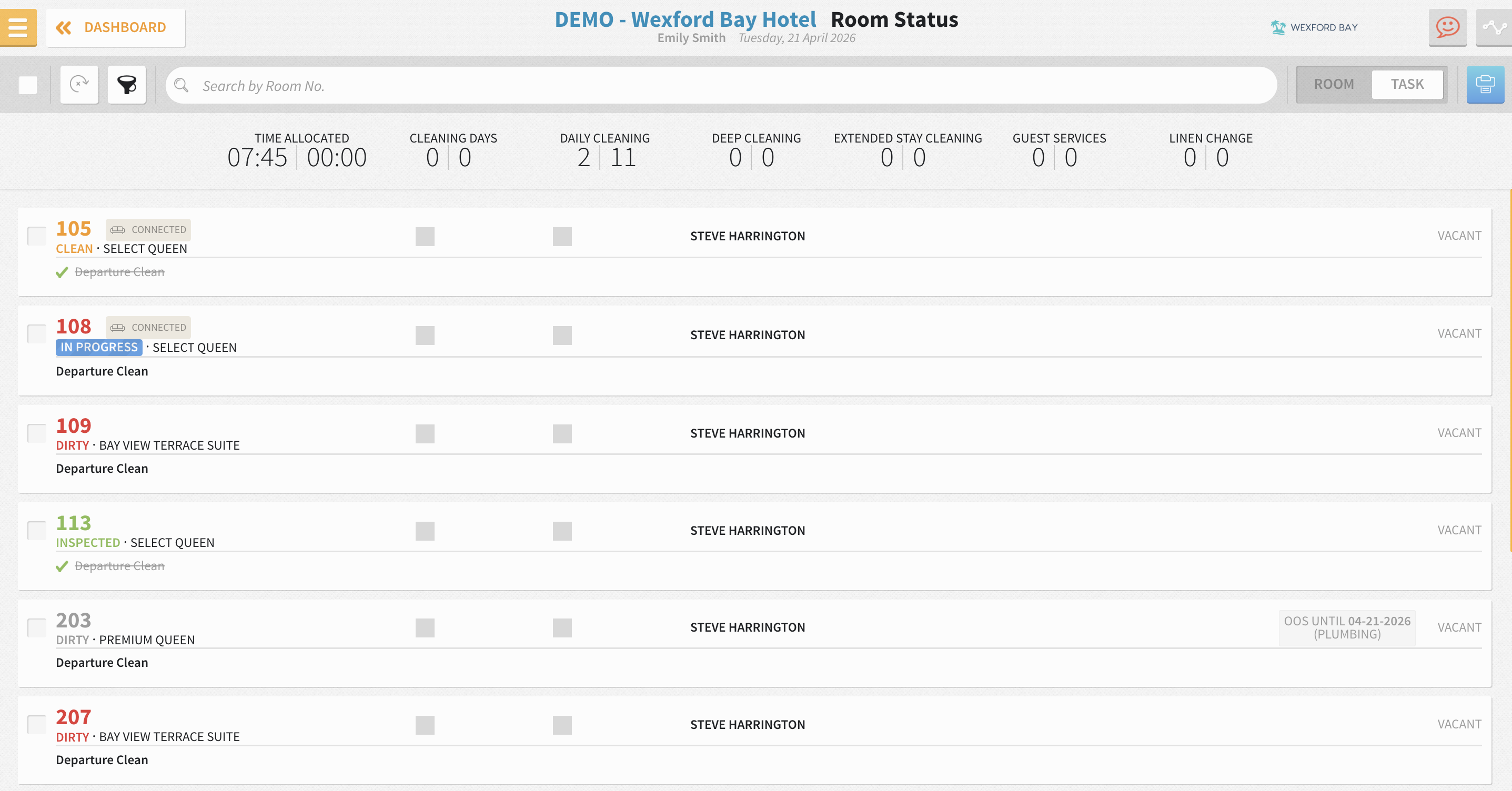
Productivity analytics track minutes per room and cost per occupied room so managers can see where the time actually goes. Without this data, a housekeeping manager knows the total labor cost but cannot identify whether the problem is room assignment, walking time, room type mix, or individual performance variation. According to Stayntouch customer data, hotels using Stayntouch’s mobile housekeeping module report a 25% increase in housekeeping productivity.
See Productivity Analytics In Action
The Three Numbers You Need Before You Talk To Any Vendor
Three metrics define the housekeeping labor problem. Know all three before evaluating any software.
|
Metric |
What It Measures |
Why It Matters |
|---|---|---|
|
Cost per occupied room (CPOR) |
Total housekeeping labor cost ÷ occupied rooms serviced |
The lagging indicator a controller sees in the P&L |
|
Minutes per occupied room (MPOR) |
Average cleaning time per serviced room |
The leading indicator that moves when the operation changes |
|
Overtime hours |
Hours worked beyond scheduled shifts |
The most expensive labor a hotel buys |
MPOR is the leading indicator and CPOR is the lagging one. MPOR moves when the operation changes, and CPOR moves when MPOR and the wage rate move together. A hotel can watch CPOR rise while MPOR improves, simply because wages rose faster. The 12.8% wage increase mentioned earlier is a clear example of that pattern.
The good news from more recent data is encouraging. HotelData.com’s H1 2026 Hotel Labor Report found that every hourly housekeeping position analyzed required fewer minutes per occupied room than in H1 2025, with select-service room attendants posting a 5.0% MPOR decline, roughly 1.2 minutes per occupied room, even as wages continued to rise.
The Worked ROI Calculation: A 200-Room Hotel At 75% Occupancy
This model illustrates the arithmetic so you can plug in your own numbers. The result is a framework you can defend in a budget meeting.
Stated assumptions:
-
200 rooms
-
75% occupancy
-
30 minutes per room (MPOR). HotelData.com’s Q1 2026 data shows U.S. room attendant MPOR at approximately 23.91 minutes across all hotel types, with select-service at 22.85 minutes.
-
$22.00 per hour labor rate, using your actual blended housekeeping wage in practice.
Step-by-step arithmetic:
-
Rooms serviced per day = 200 × 0.75 = 150 rooms
-
Labor minutes per day = 150 × 30 = 4,500 minutes
-
Labor hours per day = 4,500 ÷ 60 = 75 hours
-
Labor cost per day = 75 × $22.00 = $1,650
-
Annualized labor cost = $1,650 × 365 = $602,250
-
A 10% reduction in MPOR (from 30 to 27 minutes) produces annualized savings of approximately $60,225
The 10% reduction is illustrative. Replace it with your own expectation. The only defensible way to set that expectation is to measure your own MPOR baseline first, before any software is purchased. A hotel already running at 23 minutes per room will see smaller absolute gains than one running at 35. The arithmetic does not change. Only the inputs do.
CPOR for this model is $1,650 ÷ 150 rooms, which equals $11.00 per occupied room in housekeeping labor alone. That figure excludes benefits, supervision, and supplies. Add those and the all-in number rises materially, which explains why the HotelData.com figures, which capture total wage cost, run higher than a simple hourly-rate calculation suggests.
Run This Model With Your Own Numbers
What Has To Be True For The Savings To Materialize
The ROI model only holds if the operation supports it. Four operational preconditions determine whether housekeeping software delivers its theoretical savings.
-
Room types and service policies configured correctly. Automated room assignment only saves money when the system knows which rooms require a full departure clean, which require a stayover refresh, and which are opted out. If room types and service policies are not configured accurately in the PMS, the assignment logic works against you.
-
Floor plan mapped for routing. Route optimization requires a mapped floor plan. A system that does not know which rooms are on which floor cannot group assignments to minimize walking time.
-
PMS integration live and real-time. Occupancy data must flow from the PMS to the housekeeping module in real time, not in batches. Most PMS-to-task-manager connections default to 15-minute sync intervals, which is too slow for checkout notifications during peak season; hotels should require real-time or at minimum 5-minute sync intervals using webhooks or API-based updates. Ask any vendor whether their sync is event-driven or interval-based, and what happens when the connection drops.
-
Staff actually using the mobile app. Housekeeping adoption succeeds when the interface is simple, visual, and available in the languages the team speaks. Icon-driven status buttons and minimal text input make that possible. A system that housekeepers do not use produces no data and no savings. Wi-Fi coverage on guest floors is a physical precondition. Staircases, service corridors, basements, and thick-walled heritage buildings are notorious dead zones, so walk the property with a device and test coverage in the exact places housekeepers work before rollout.
The Stayover And Do-Not-Disturb Lever
The single largest labor-allocation decision a hotel makes is whether to clean a room at all. When a guest opts out of daily housekeeping through a do-not-disturb preference, a sustainability program, or an explicit opt-in policy, the labor demand for that room disappears. This is a policy decision more than a software one, and it rarely appears in discussions of housekeeping cost reduction.
Saved hours represent capacity, not automatic cash savings. Whether they become labor cost reduction depends on what management does with them. Options include deeper departure cleans, overdue public-area work, more inspections, or reduced use of temporary staffing in peak weeks. The software can show the hours saved, and management decides how to use them.
When Housekeeping Software Does Not Pay Off
Some operations will not see a strong return from housekeeping software, even with solid tools.
-
Very small properties. Properties with very few rooms often cannot recover the cost of a dedicated housekeeping software layer. The coordination overhead that software eliminates is smaller when the team is two or three people who can communicate directly.
-
Scheduling problems, not visibility problems. If the root cause is chronic under or overstaffing relative to occupancy, software will not fix it. Software improves how existing labor is deployed and does not solve a structural staffing mismatch.
-
No change in service policy. A hotel that buys housekeeping software without reviewing its service policy, including stayover frequency, opt-out options, and room type time standards, will see limited savings. The software executes the policy, but management must define it.
-
Poor PMS integration. 67% of negative housekeeping software feedback in verified hotel reviews concerns PMS integration connectivity issues affecting data synchronization. If the integration is unreliable, the data is unreliable and the savings do not materialize.
What To Demand From Any Housekeeping Software Vendor
Before signing with any vendor, verify that the platform delivers all of the following capabilities.
-
Automated room assignment by floor or section
-
Labor forecasting against live PMS occupancy data
-
Real-time productivity dashboards with MPOR tracking
-
Overtime alerts before overtime is incurred
-
CPOR reporting
-
Live, event-driven PMS integration (not batch sync)
-
Mobile housekeeping app with offline capability
-
Live room status visible to the front desk the moment a room is inspected
-
Workload balancing across staff
-
Forward task assignment so tomorrow’s work can be planned today
Stayntouch’s mobile housekeeping module delivers all of these within the core PMS. Housekeeping runs on mobile devices with custom task lists and automated task assignment by floor or section. Room status updates propagate instantly across the system. Tasks can be assigned forward in time so a manager can staff tomorrow against tomorrow’s expected departures. The 25% productivity gain noted earlier comes from hotels using these capabilities together.
Stayntouch is a cloud-native hotel property management system (PMS) for independent hotels, boutique brands, and multi-property groups. It connects to 1,400+ integrations at no extra cost, meaning users pay each third-party platform its own platform fee while Stayntouch charges nothing for the integration itself. The 2026 TravelTech Breakthrough Award named Stayntouch “Hotel PMS Company of the Year”, and the platform holds a 97% customer retention rate and a 94% recommendation rating on Hotel Tech Report.
Conclusion: Bring A Number To The Budget Meeting
Housekeeping is the largest controllable labor bucket in Select Service hotels (and the largest labor driver in the Rooms Department), and in 2025 hotel labor cost per occupied room rose 12.8%, outpacing national wage benchmarks. The hotels that defend their housekeeping labor number in a budget meeting know their MPOR baseline, understand which of the five mechanisms apply to their operation, and set a savings expectation they can trace back to arithmetic rather than a marketing claim.
Stayntouch’s mobile housekeeping module is built into the core PMS and delivers real-time room status, automated assignment, forward scheduling, and productivity analytics that make that arithmetic possible. The 25% housekeeping productivity improvement reported by Stayntouch customers starts with the same calculation this article walked through. Run it with your own numbers first.
Talk To A Housekeeping Productivity Specialist
Frequently Asked Questions
How Long Does It Take To See Labor Cost Savings After Implementing Housekeeping Software?
Most hotels begin to see measurable changes in MPOR and room turnaround time within the first four to eight weeks of full staff adoption. The timeline depends on how quickly staff adopt the mobile app, whether the PMS integration is live and real-time from day one, and whether the hotel has established a pre-implementation MPOR baseline to measure against. Properties that record a baseline before go-live can quantify savings within the first full month. Properties without a baseline can see operational improvement but must reconstruct historical data to prove it financially.
Do We Need To Change Our Service Policy To See Savings?
The largest savings lever, stayover opt-out, is a service policy decision. Software executes whatever policy the hotel sets and improves the efficiency of that execution. If the policy is full daily service for every occupied room, the software will make that policy more efficient but will not reduce the number of rooms cleaned. Hotels that review their stayover service policy alongside a software implementation typically see larger savings than those that treat the two decisions separately.
What PMS Integration Is Required For Real-Time Room Status?
The housekeeping module must receive live checkout and occupancy events from the PMS, not batched updates. The integration should be event-driven, meaning the PMS pushes a notification the moment a room status changes rather than the housekeeping system polling for updates on a fixed interval. Ask any vendor whether their integration uses webhooks or polling, what the typical propagation time is between a room being marked inspected and the front desk seeing it as available, and what happens to queued updates when the connection drops. A certified integration on the PMS’s own marketplace is usually more reliable than a custom one-off connection.
How Much Training Does Housekeeping Staff Need?
For a well-designed mobile housekeeping app, a well-organized crew can be fully onboarded in a single 90-minute pre-shift training session, though broader mobile app adoption across a property may take 1–3 days. The interface should be icon-driven and require minimal text input, because housekeeping teams are often multilingual and working quickly. Plan for hands-on training in small groups, designate floor-level champions who can support colleagues, and expect a parallel-run period of one to two weeks where the old and new systems run simultaneously before the old one is retired. Wi-Fi coverage on guest floors must be confirmed before rollout because dead zones in service corridors and stairwells will disrupt adoption regardless of how good the software is.
How Is Housekeeping Software Priced?
Pricing models vary by vendor. Some charge per room per month, others per property, and others per user. Stayntouch’s housekeeping module is part of the core PMS, configured within Stayntouch PMS under Settings > Rooms > Housekeeping and Task Management, rather than a separately priced add-on. That structure means the labor visibility and room status capabilities are available without an additional platform contract. For any vendor, ask whether PMS integration is included or priced separately, whether there are per-user fees that scale with team size, and what the total cost of ownership looks like across implementation, training, and ongoing support.
Does This Work For A Property Under 75 Rooms?
Stayntouch works with hotels of all sizes, including those under 75 rooms. The housekeeping module’s value scales with the complexity of the operation. Larger properties with more floors, more room types, and larger teams see the largest absolute gains from route optimization and automated assignment. Smaller properties benefit most from real-time room status and the elimination of radio and paper coordination. The key question is whether the coordination overhead the software eliminates is large enough to justify the cost.
What Happens If Our Wi-Fi Has Dead Zones On Guest Floors?
Dead zones are a real risk and should be tested before go-live. Walk the property with a device and test signal in service corridors, stairwells, basements, and any thick-walled areas where housekeepers work. A well-designed housekeeping app buffers status updates offline and syncs when signal returns, so a housekeeper in a dead zone can still record progress and the update reaches the system when they move back into coverage. Confirm that your chosen solution handles offline operation this way before committing. Properties with persistent dead zones may need a Wi-Fi infrastructure investment alongside the software rollout.
How Do We Measure Whether It Worked?
Establish a baseline before go-live on four metrics: MPOR by room type, CPOR, overtime hours per week, and room turnaround time (checkout to sellable-ready). Review all four at 30 days and 90 days post-implementation. MPOR and turnaround time will move first, and CPOR will follow as MPOR improvements compound across occupied rooms. If MPOR improves but CPOR does not, check whether wage rates rose faster than the efficiency gain, because that reflects market conditions rather than a software failure. If neither moves, the most common causes are incomplete staff adoption, a PMS integration running on batch sync rather than real-time, or room type configuration that does not reflect actual service standards.
Get A Personalized Stayntouch Demo
Read Next
Turn a more connected stack into a better stay.
See how Stayntouch can support the operating moments that matter most to your hotel team.