Written by: Kelly Campbell, Vice President of Marketing, Stayntouch
Key Takeaways for Small-Hotel Housekeeping Software
- Standalone housekeeping apps replace paper checklists but create an integration tax once properties need a full PMS, including data migration, workflow retraining, and paid setup fees.
- Real-time room status updates from mobile devices to the front desk remove communication delays that cause guest complaints and lost early-check-in revenue.
- Mobile-first design fits housekeepers who move constantly between rooms and floors, while desktop-only tools force batch updates that lag behind reality.
- High staff turnover multiplies training costs across disconnected systems, and a unified PMS reduces repeated dual-system training cycles.
- Properties ready to scale can contact Stayntouch to replace standalone housekeeping tools with a cloud-native PMS that manages housekeeping, front desk, and 1,400+ integrations in one platform.
The Hidden Problem With Standalone Housekeeping Apps
Communication gaps between housekeeping, maintenance, and management teams create the most common operational drag in small hotels. A housekeeper finishes Room 22, marks it clean on a paper sheet, and hands that sheet to a supervisor at the end of the shift. By the time the front desk learns the room is available, the guest who was waiting in the lobby has already complained.
Standalone housekeeping apps solve the paper problem but introduce an integration problem. A separate housekeeping app not connected to the same booking record as the front desk creates a manual sync step that risks selling a dirty room or holding a clean room empty. That manual sync step is the integration tax, and it compounds every time the property adds a tool.
Without centralized tracking, hotel managers cannot see where delays occur or which operational areas need improvement in housekeeping workflows. A standalone app gives housekeepers a better checklist but does not give the general manager a single view of operations. Those are different problems, and solving only one of them creates a new version of the original friction.
Housekeeping Tool Options for Small Hotels: Side-by-Side Comparison
The table below compares representative categories of housekeeping tools across six operational dimensions. Every data point comes from published sources or Stayntouch customer data, cited inline.
| Tool Category | Real-Time Room Status | Mobile Access | PMS Integration | Maintenance Ticketing | Pricing Model |
|---|---|---|---|---|---|
| Paper / whiteboard | None, status is as current as the last handwritten update | None | None | None | No software cost; high labor cost |
| Spreadsheet / shared doc | Manual refresh only, limited accountability and lost information across shifts | Partial, requires device and app access | None | None | No software cost; reconciliation labor cost |
| Standalone housekeeping app (basic) | Within the app only, front-desk availability requires manual reconciliation | Yes, core use case | Limited or none; requires manual re-keying | Basic or add-on | Per-user or per-room monthly fee; integration setup fees may apply |
| Standalone housekeeping specialist (advanced) | Yes, within the specialist platform | Yes | API-dependent, PMS integration typically requires setup fees per connection | Yes, full ticketing | Custom pricing, implementation fees for complex multi-property deployments |
| All-in-one PMS with housekeeping module | Yes, shared within the platform | Varies by vendor | Native, no separate connection needed | Varies by vendor | Per-room or tiered flat rate; payment processing fees often the largest hidden cost |
| Stayntouch PMS (cloud-native, mobile-first) | Yes, instant dirty-to-clean propagation across front desk and housekeeping; 25% housekeeping productivity increase per Stayntouch customer data | Yes, mobile-first by design; staff update status from the room itself | Native, housekeeping is a core PMS module; 1,400+ third-party integrations at no extra integration cost (each third-party platform charges its own fee) | Yes, maintenance ticketing built in | Quote-based SaaS; no per-integration fees, no maintenance fees, support included |
How Real-Time Room Status Works in Practice
Without real-time room status sync, front desk teams must call housekeeping to confirm room readiness, which delays check-ins. That call takes about 90 seconds. Multiply it by every arrival on a busy Saturday and the front desk spends an hour on the phone instead of welcoming guests.
The mechanics of status updates determine whether this happens. When a housekeeper marks a room clean on a mobile device, that status should reach the front desk instantly, not at the next sync interval and not after a supervisor approves a paper form. Housekeeping management systems with real-time room status updates reduce communication delays between housekeeping and front office teams, which improves coordination when staffing is limited.

Stayntouch Mobile Housekeeping follows this model by design. Housekeepers update room status from the room itself, and the front desk sees the change the moment it is made. Guests who paid for early check-in can receive a room assignment the instant it passes inspection, which turns an operational signal into revenue, according to Stayntouch customer data.
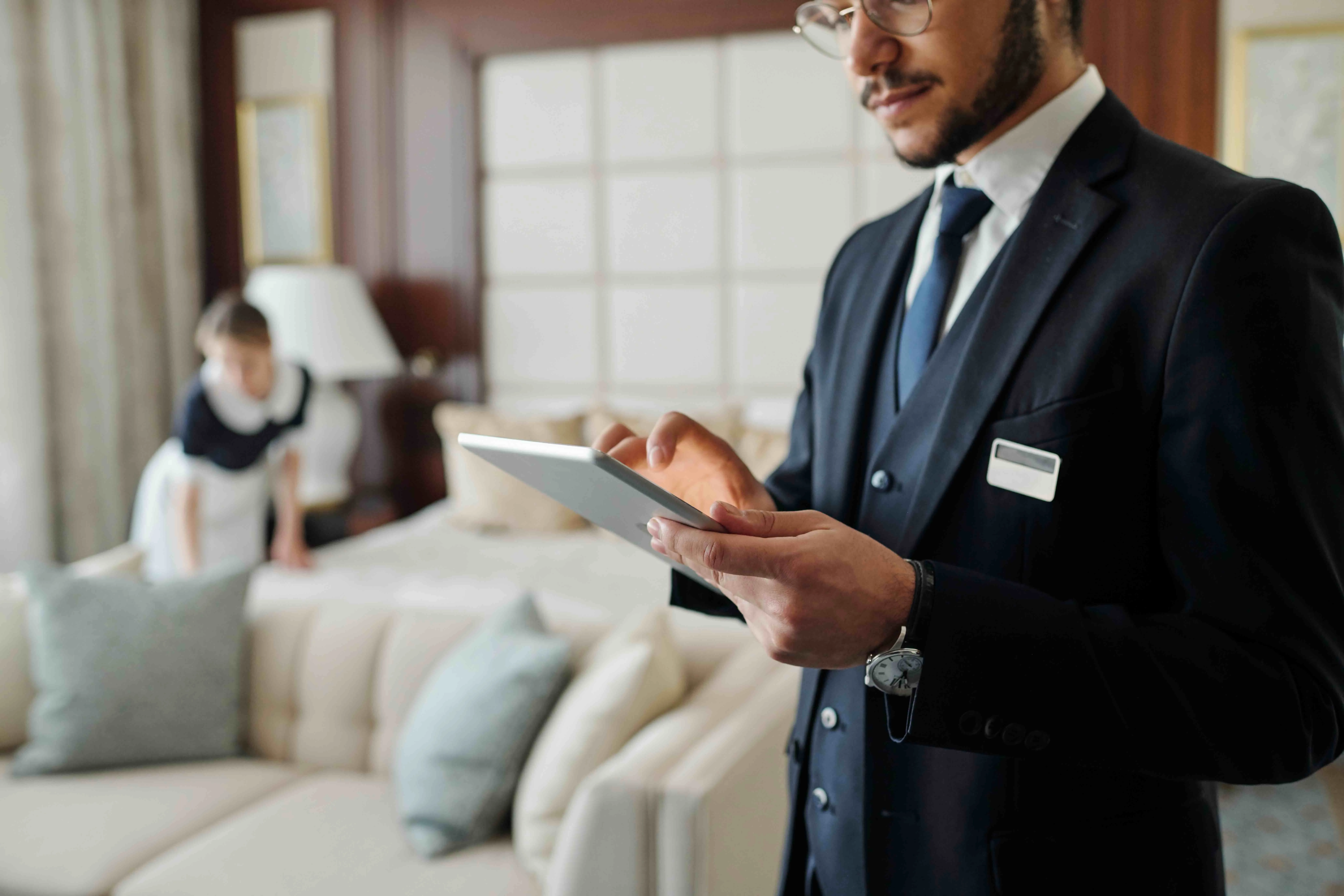
US independent hotels often face delayed inspection approvals, where rooms are cleaned but remain unavailable because supervisors are not notified in real time. A mobile-first system closes that gap, while a desktop-only system widens it.
Why Mobile Beats Desktop for Housekeeping Teams
Housekeepers work on the move, not at workstations. They move between floors, rooms, and sometimes buildings. A desktop-only housekeeping tool forces them to walk to a terminal to update status, so updates happen in batches and always trail reality.
Reliance on walkie-talkies, paper checklists, or scattered messaging apps slows task coordination during peak hours in US hotels. Replacing paper with a desktop app solves legibility but not mobility.
Mobile-first design means the update happens at the point of work, in the room, the moment the housekeeper finishes. Mobile apps change cleaning procedures by enabling real-time task updates from the point of work rather than requiring staff to return to a central station. For a 30-room property with two housekeepers on shift, that difference separates a front desk that knows what is happening from one that is guessing.
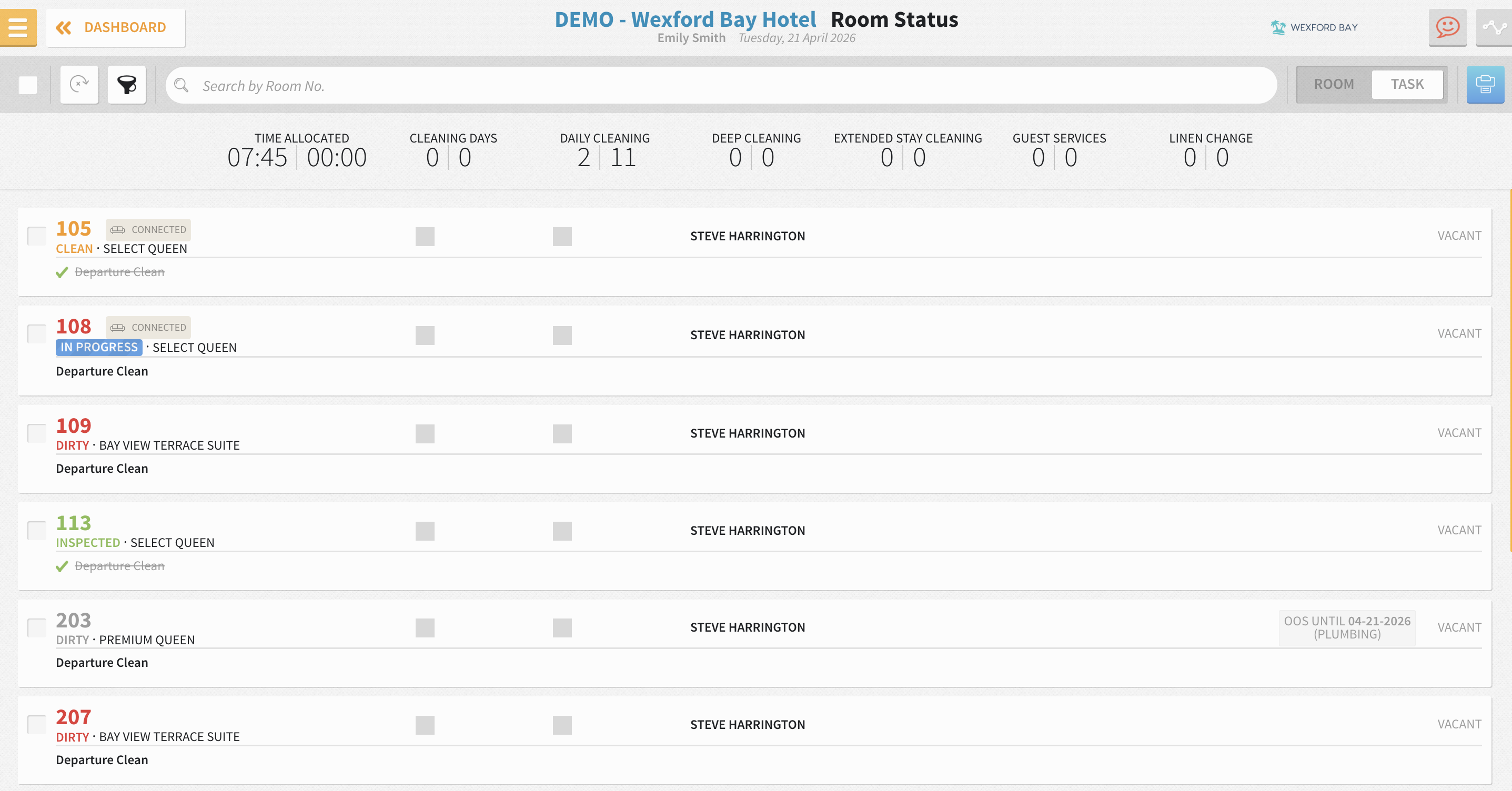
Stayntouch runs natively on phones and tablets, so staff are not tied to a front desk. Managers assign work by floor or section and see progress live. The platform was built mobile-first, not adapted for mobile later.
The Integration Tax When You Add a PMS Later
The integration tax is the hidden cost of switching from a standalone housekeeping tool to a full PMS once the property outgrows the point solution. It has three main components.
First, data migration. Guest history, room configurations, and task templates built inside the standalone tool do not transfer automatically. Someone re-keys them, or they are lost.
Second, workflow reconstruction. Staff learned one system, and the new system works differently, so training resets. 65% of surveyed US hotels report staffing shortages according to the 2025 AHLA survey, and industry estimates put annual US hospitality turnover near 70%, against 12–15% in most other sectors. Training time therefore recurs every time someone new is hired.
Third, integration setup. PMS and third-party integrations for specialist housekeeping tools typically require setup fees that depend on the number of systems connected and integration complexity. That cost appears when the property connects the standalone tool to a PMS and appears again when the property later replaces the standalone tool with a PMS module.
Integration failures between separate tools are harder to diagnose than a single-system failure because the error may sit at the boundary between two systems and require access to multiple vendor support teams. A property running a standalone housekeeping app alongside a separate PMS now has two support queues, two update schedules, and two potential break points every time either vendor releases an update.
How Pricing Models Hide Per-User and Per-Room Fees
Per-room pricing for hotel software typically charges a monthly fee per room, so a 25-room hotel pays a proportional monthly amount. That structure sounds manageable at first. Add a per-user seat license for each housekeeper and the number climbs faster than expected.
Small hotels should confirm which unit controls the fee and what happens when rooms, staff accounts, or usage grow. A tool priced at a fixed rate per room per month costs more at 30 rooms than at 25, and more again at 50. At 75 rooms, where many properties consider a PMS upgrade, the property pays more per room plus integration fees plus per-user charges for the larger housekeeping team.
Onboarding, migration, and setup fees for PMS tools are rarely quoted upfront and often reach four figures, particularly during migrations. The advertised monthly rate is not the total cost. The total cost includes setup, migration, integration, training, and the ongoing labor of reconciling two systems that were never designed to share data.
The total monthly cost of a mid-range hotel PMS can run two to three times the advertised base price once integrations, channel manager fees, OTA sync costs, and per-transaction charges are included. Properties need to evaluate the full stack cost, not just the headline number.
Maintenance Tickets, Turnover, and Training Burden
A disconnected maintenance ticketing system creates a second communication gap alongside the room status gap. A housekeeper finds a broken fixture in Room 18 and notes it on a paper form. The form goes to a supervisor, who enters it into a separate maintenance system. The front desk does not know Room 18 is out of service until someone tells them, which may be after a guest has already been assigned to it.
Maintenance teams depend on housekeeping staff to identify issues during cleaning so repairs can be scheduled before they become larger operational problems. When the reporting path runs through paper and a separate system, issues are reported late, logged inconsistently, and resolved slowly.
Staff turnover multiplies the training cost of every disconnected system. The US quit rate in accommodation and food services was 4.3% in March 2026, close to double the 2.2% private-sector average per the Bureau of Labor Statistics Job Openings and Labor Turnover Survey (JOLTS). With turnover rates this high, every new hire on a standalone housekeeping app needs to learn that app, and every new hire on a separate PMS needs to learn that system too. Two systems mean two training cycles, repeated every time someone leaves.
Stayntouch trains front desk staff in 2 hours and covers the full platform across all modules in 2 days. Stayntouch Academy provides self-paced eLearning with test environments and certifications, so new hires can onboard without scheduling a trainer. Maintenance ticketing lives in the same system housekeepers already use, so there is no second app and no second training cycle.
When Room Count Turns Standalone Tools Into Extra Work
Standalone housekeeping tools reach a breakpoint where they create more work than they save. Below that point, a standalone housekeeping app may be sufficient, especially if the property has no plans to grow and already runs a capable PMS with a housekeeping module. A small independent property that mainly needs the desk and the floor to share one truthful board often gets what it needs from the housekeeping module inside a platform it already runs rather than a standalone specialist tool.
Above that point, the coordination surface expands. More floors, more housekeepers, and more simultaneous arrivals and departures increase complexity. Without PMS sync, housekeeping status requires human re-keying between two screens and the board becomes stale the moment staff look away. Stale data costs rooms per shift, and the integration debt from the standalone tool becomes a daily operational problem rather than an occasional inconvenience.
A property with a complex housekeeping operation and labor-forecasting needs is the natural home for specialist platforms. A property in growth mode is not that property yet, and planning only for today’s room count rather than the operation 18 months from now is a common and expensive mistake.
The key question is whether the standalone tool will still work when the property adds rooms, additional staff, and a revenue management system (RMS), which is software that analyzes demand and recommends or sets rates. If the answer is no, the cost of switching later exceeds the cost of choosing an integrated platform now.
Free Housekeeping Tools for Very Small Hotels
For properties seeking to minimize upfront costs, free and low-cost housekeeping tools exist. Base subscriptions for hotel management software range from free to several hundred dollars per month depending on property size and included features. Some platforms offer a permanent free tier covering basic front desk operations and a mobile app, with channel integration available only as a paid add-on.
Free tools fit properties under 15 rooms with stable operations and no growth plans. They do not fit properties evaluating growth, because the cost of migrating off a free tool, including data migration, retraining, and integration rebuild, matches the cost of migrating off a paid one. The tool being free does not make the switching cost free.
Hidden costs for hotel software often appear through overlapping tools, manual re-entry of data between systems, and additional support fees. A free housekeeping app that requires a separate PMS, a separate channel manager, and a separate booking engine is not truly free. It often becomes the most expensive option once staff time and integration labor are counted.
Properties evaluating free options should focus on one question: does this tool share a live room-status record with the front desk, or does it require manual reconciliation? If the answer is manual reconciliation, the tool is not solving the core problem and is only replacing paper with a slightly better version of paper.
Room Status as the Core of Small-Hotel Operations
Room status sits at the center of hotel operations. A room cannot be assigned to an arriving guest until housekeeping has cleaned and inspected it. When that status lives in a separate system from the front desk, the front desk works from information that is minutes or hours old.
Housekeeping teams in hotels face room status delays that prevent the front desk from assigning ready rooms quickly to incoming guests. The delay may be only five minutes per room, but across 20 arrivals on a busy afternoon that becomes 100 minutes of unnecessary guest wait time and a lobby full of guests forming an early opinion of the property.
Real-time room status requires two elements: a mobile device in the housekeeper’s hand and a live connection between that device and the front desk system. Standalone apps usually provide the device but not the live connection without a paid integration. A PMS with a native housekeeping module provides both, because the housekeeper and the front desk work inside the same system.
Housekeeping tools should be evaluated on whether a checkout automatically creates a prioritized cleaning task and whether marking a room clean instantly updates front-desk availability in the same record, otherwise the property builds in a reconciliation gap. This is the right evaluation criterion, and it should apply to every tool under consideration.
Standalone Housekeeping Tool vs. PMS Housekeeping Module
The comparison between a standalone housekeeping tool and a PMS housekeeping module centers on integration, training, and scalability.
Integration. A standalone tool requires a connection to the PMS to share room status. That connection costs money to set up, requires maintenance, and breaks when either vendor releases an update. A PMS module shares the same database as the front desk, so no connection is required and no reconciliation gap or integration tax appears.
Training. A standalone tool means two systems to learn. Every new housekeeper learns the housekeeping app, and every new front desk agent learns the PMS. When a housekeeper moves to the front desk, which is common in small hotels where staff wear multiple hats, they learn a second system from scratch. A PMS module means one system for both roles.
Scalability. The need for dedicated housekeeping software grows as room count, floor count, and turnover pressure increase. A standalone tool scales the housekeeping function. A PMS module scales the entire operation, including housekeeping, front desk, reservations, maintenance, and reporting, from a single platform. When the property adds rooms, the PMS module grows with it. When the property adds a second location, the multi-property dashboard covers both. A standalone tool does not provide that reach.
Integrated hotel operations platforms connect daily workflows such as housekeeping status updates and front desk requests in one place, reflecting a broader market signal that the industry wants simplification rather than more point solutions.
When to Move From Point Solutions to an Integrated PMS
Three signals show that a property has outgrown its standalone housekeeping tool.
- The front desk calls housekeeping more than twice per shift to confirm room status.
- A new integration, such as a channel manager, revenue management system, or payment platform, requires a separate connection to the housekeeping app as well as the PMS.
- A new hire needs more than one day to understand how room status flows from housekeeping to the front desk.
When any of these conditions appear, the standalone tool is creating more work than it saves and the integration debt is compounding. The better move is to consolidate onto a platform that handles housekeeping, front desk, reservations, and reporting inside a single system before the debt becomes a renovation project.
Stayntouch is a cloud-native PMS built mobile-first and connected to 1,400+ integrations at no extra integration cost, since users pay each third-party platform its own fee and Stayntouch charges nothing for the connection itself. Mobile Housekeeping is a core module, not a bolt-on. Room status updates reach the front desk instantly, and maintenance ticketing is built in. Properties report the productivity gains described earlier after switching, because housekeepers complete more rooms per shift when status updates happen in real time.
Stayntouch works with hotels of all sizes, including those under 75 rooms. The platform serves properties and groups that plan to grow, such as independent hotels, boutique brands, and multi-property groups that need a PMS capable of scaling from one location to a portfolio of 100+ without rebuilding the tech stack at every milestone. The 94% recommendation rating on Hotel Tech Report and a 97% customer retention rate show what happens when a property spends more time managing guests and less time managing systems.
The 2026 TravelTech Breakthrough “Hotel PMS Company of the Year” award and the findings of the 2026 Hotel Technology Outlook, produced by the NYU SPS Jonathan M. Tisch Center of Hospitality with Stayntouch and IDeaS and based on a survey of more than 300 hotel professionals, confirm the direction of travel. In that research, 30% of all-in-one users intend to move to best-in-class solutions, compared with 14% moving the other way.
Contact us to see how Stayntouch replaces standalone housekeeping tools with a mobile-first PMS that scales with the property.
Frequently Asked Questions
Does Stayntouch work for hotels with fewer than 40 rooms?
Yes. Stayntouch works with hotels of all sizes, including those under 75 rooms. The preferred sweet spot is 75 rooms and above, and the platform is built for properties and groups that plan to grow. Smaller independent hotels benefit from ease of use and a structured onboarding experience, which the implementation team provides. Growth trajectory matters more than room count, so a 35-room property planning to expand to 60 rooms in the next two years is a better fit than a 35-room property with no growth plans.
How long does it take to train housekeeping staff on Stayntouch?
Stayntouch Academy provides role-based, self-paced eLearning with test environments, certifications, and progress tracking. The full platform, covering all modules including housekeeping, front desk, night audit, finance, and revenue management, trains in 2 days. Front desk staff training covers reservation management and front desk operations in 2 hours. Because the system is designed to be intuitive, new housekeeping staff can update room status and complete task lists within their first shift, so high turnover stops being a training crisis.
What happens to room status data if the internet goes down?
Stayntouch is cloud-native on AWS with 100% system uptime sustained over the past two years. There are no on-site servers to fail and no manual upgrades to schedule. Product releases require no downtime and generally have no impact on staff usage or the guest experience. The platform supports continuous operation, which matters in a hotel where the PMS is touched every hour of every shift.
Can Stayntouch replace a standalone housekeeping app and a separate PMS at the same time?
Yes. Stayntouch Mobile Housekeeping is a core module of the PMS, not a separate product. Switching to Stayntouch replaces both the standalone housekeeping app and any legacy PMS in a single migration. The Dataloader module migrates guest profiles, group reservations, company and travel agent profiles, and deposit totals in as little as 1–2 hours. Auto-Configuration reduces property setup from about 30 hours of manual work to 4–5 hours. A single property typically deploys in roughly a month. For properties with messy legacy exports, Stayntouch provides data cleanup support through an internal validation process rather than rejecting files outright.
How does Stayntouch handle maintenance ticketing alongside housekeeping?
Maintenance ticketing is built into Stayntouch PMS. When a housekeeper identifies an issue during cleaning, such as a broken fixture, a faulty lock, or a damaged piece of furniture, they log it directly in the same mobile interface they use to update room status. The ticket routes to the maintenance team without a separate app, a paper form, or a phone call. The front desk sees the room’s out-of-service status immediately. When the repair is complete, the room returns to the available pool automatically. There is no second system to learn, no second support queue, and no integration to maintain between housekeeping and maintenance workflows.
Read Next
Turn a more connected stack into a better stay.
See how Stayntouch can support the operating moments that matter most to your hotel team.