
Written by: Kelly Campbell, Vice President of Marketing, Stayntouch
Key Takeaways
-
Contactless check-in has become standard for hotels as guests expect it and labor remains tight, with the market projected to reach USD 872 million by 2032.
-
Hotels should evaluate contactless solutions across four dimensions: integration cost, training hours, uptime risk, and staff-time impact.
-
PMS-native solutions with direct cloud-to-cloud integration remove vendor complexity, reduce failure points, and keep data in sync without manual re-entry.
-
Stayntouch customers report a 54% reduction in staff-assisted check-in, up to 20-point gains in guest satisfaction, and ROI increases of up to 240% on mobile check-in.
-
Ready to modernize your arrival experience? Contact Stayntouch to see how PMS-native contactless check-in can change daily operations at your property.
Defining Contactless Hotel Check-In
Contactless hotel check-in is the process where a guest completes arrival steps such as identity verification, payment authorization, room assignment, and key delivery without a face-to-face transaction at a staffed front desk. The guest uses a mobile app, a web-based registration flow, a lobby kiosk, or interacts with a staff member carrying a tablet instead of waiting in a queue at a fixed counter.
Many travelers now expect contactless check-in, checkout, and payments as standard features, and 73% of hotel guests prefer properties offering some form of mobile check-in. For independent hotels and small groups with lean front-desk teams, the operational case is strong as well. Sixty-five percent of hotels report staffing shortages, with front-desk positions among the hardest to fill.
Four-Step Contactless Check-In Flow for Hotels
A well-integrated contactless check-in flow follows four clear steps.
-
Mobile pre-arrival registration. The guest receives a link before arrival, completes a digital registration card, authorizes payment, and selects preferences, all from their own device. Stayntouch delivers this in about 30 seconds.
-
Kiosk self-service. Guests who prefer an on-property touchpoint use a lobby kiosk to confirm their reservation, verify identity via ID scanning and facial recognition, collect a physical key, and complete payment without staff involvement.
-
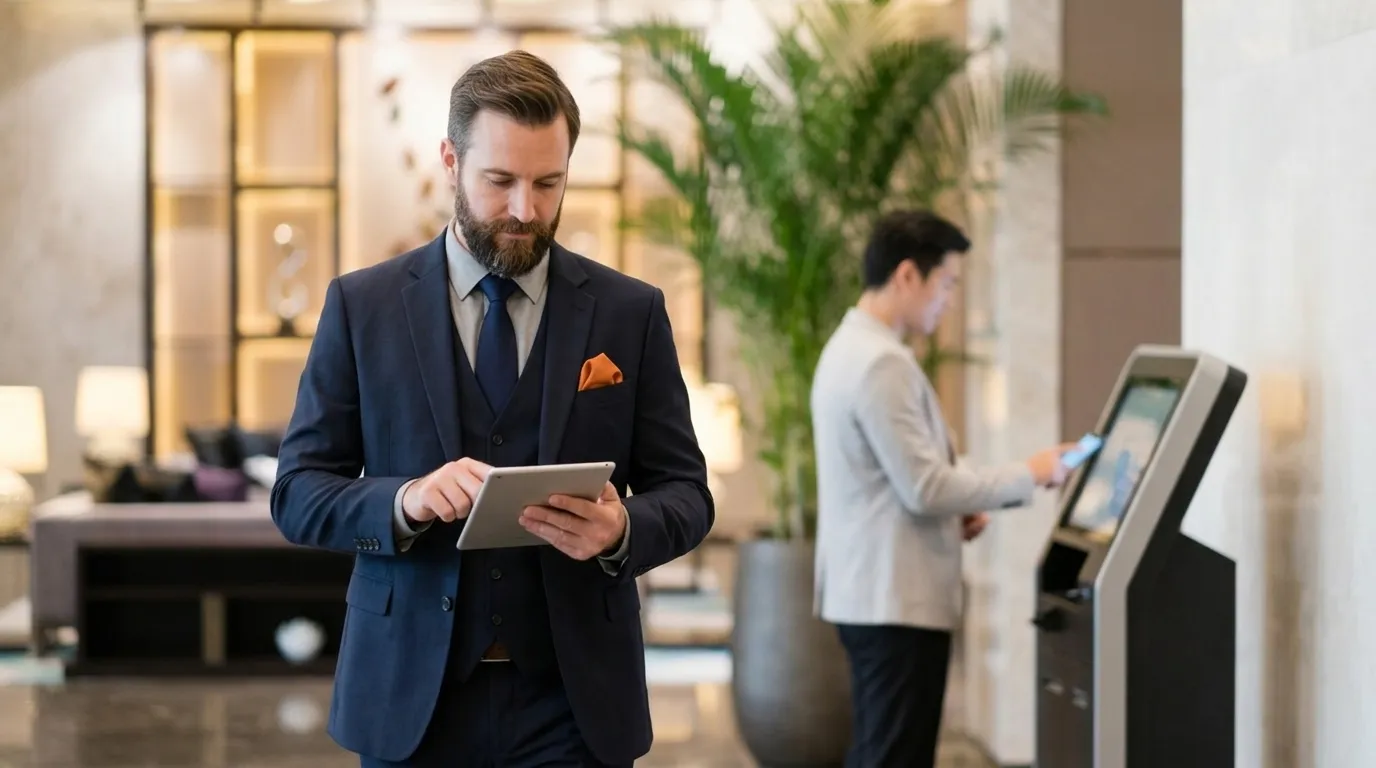
Staff-assisted tablet check-in anywhere on property. Guests who want a human welcome meet a staff member in the lobby, lounge, or courtyard. The staff member carries a tablet running the full property management system (PMS), so the front desk becomes optional, not mandatory.
-
Digital key delivery. Once check-in is confirmed, a webhook, which is a connection that pushes data the moment something happens, triggers the door lock system instantly. The system delivers a mobile key to the guest’s phone or encodes a physical key card at the kiosk.
Hotels see the strongest results when all four steps are native to the PMS rather than connected through a separate third-party app. According to Stayntouch customer data, hotels reduce staff-assisted check-in by 54%. High mobile check-in adoption can free hundreds of front-desk hours every year.
Ready to see this four-step flow in action? Walk through the full arrival experience with a Stayntouch specialist.
Contactless Check-In PMS Integration Architecture
The architecture behind contactless check-in determines whether the system runs reliably or creates new operational problems. Two main approaches exist.
Direct cloud-to-cloud integration means the check-in tool and the PMS are the same system or connect through a direct API, or application programming interface, with real-time webhooks. When a guest checks in via mobile, the PMS updates instantly. Room assignment is confirmed, the folio, or running bill, opens, and the door lock system receives the key credential at the same moment. This approach removes lag, manual re-entry, and the risk of double assignment.
Third-party bridge connections insert middleware between the guest-facing check-in tool and the PMS. A common integration failure occurs when a polished guest-facing check-in interface does not write back to the PMS, forcing front-desk staff to manually re-enter arrivals and collapsing the contactless benefit during peak periods. Bolt-on apps that rely on bridges also introduce a second vendor, a second support contract, and a second point of failure.
Stayntouch Connect APIs use an event-driven, webhook-enhanced architecture. The moment a guest checks in, real-time updates push to door locks, guest messaging, and any connected system, with no polling required. Stayntouch offers 1,400+ integrations at no extra cost for the integration itself, while each third-party platform charges its own platform fee. Legacy enterprise platforms can charge as much as $10,000 per integration, which turns every technology decision into a budget negotiation.
Three Check-In Paths Within a PMS-Native System
Hotels running a PMS-native contactless solution give every guest a choice while working with a single vendor. Stayntouch delivers three paths at the same time.
-
Fully mobile. Guests complete pre-arrival registration and check in from their own phone in about 30 seconds. Web-based flows do not require an app download.
-
Kiosk self-service. The Stayntouch Kiosk includes an integrated credit card reader and key encoder, supports ID scanning and facial recognition, and handles walk-in reservations without staff involvement. Guests can check in in under a minute.
-
Staff-assisted anywhere on property. Staff carry tablets running the full PMS, greet guests in any space, and complete check-in without returning to a fixed desk.
Full platform training across all modules takes 2 days. In an industry where annual hospitality turnover runs near 70%, training time becomes a permanent operating cost rather than a one-time onboarding expense. A system that trains in hours instead of months means a new hire is productive on their first shift.
Choosing Kiosk Plus Mobile or Mobile-Only
Mobile-only check-in handles most arrivals efficiently, while a kiosk adds capabilities that a phone-based flow cannot match.
Lobby traffic patterns guide the decision. Properties with concentrated peak arrival windows, typically 3 to 6 p.m., benefit from a kiosk that absorbs volume without extra front-desk staffing.
Twenty-four-seven Grab & Go retail revenue represents a kiosk-specific opportunity. The Stayntouch Grab & Go Kiosk operates as a self-service retail point of sale, open around the clock for guests and lobby visitors to purchase food, drinks, and essentials, with charges posting automatically to the guest folio or paid by card. No additional staffing is required.
Identity verification requirements often favor the kiosk for properties that need documented ID capture at check-in. The Stayntouch Kiosk supports ID scanning and facial recognition, with encrypted image storage and automatic deletion 30 days after checkout. Mobile check-in can also support ID scanning via the device camera for properties that require it across all arrival paths.
Decision Framework: Four Evaluation Dimensions
When evaluating contactless check-in software for hotels, the architectural differences between PMS-native and bolt-on solutions create measurable operational consequences. Four dimensions capture those consequences. Integration cost shapes total ownership cost. Training hours determine how quickly you can onboard new staff during turnover. Uptime risk affects guest service reliability. Measured impact shows whether the solution delivers on its promises. The table below contrasts the two approaches across these dimensions without naming specific competitors.
|
Dimension |
PMS-native (e.g., Stayntouch) |
Bolt-on app or standalone tool |
|---|---|---|
|
PMS integration cost and scope |
Check-in is built into the PMS, with 1,400+ integrations included at no extra cost for the connection itself. Real-time webhooks push updates to door locks and messaging instantly. |
Properties on pre-2020 legacy PMS platforms can face significant integration costs before contactless check-in becomes available to guests. Third-party bridges add a second vendor and a second point of failure. |
|
Front-desk training hours |
Full front-desk staff training on Stayntouch PMS takes about 2 hours. Full platform training across all modules takes 2 days. Self-paced eLearning via Stayntouch Academy continues after go-live. |
Staff must learn both the PMS and the separate check-in tool. Underestimating staff training is a frequent operational pitfall during PMS-integrated check-in deployments. |
|
Uptime and support guarantees |
Stayntouch is cloud-native on AWS with 100% system uptime, a performance record sustained over the past two years. Support runs 24/7/365 with a guaranteed response under one hour, no service tiers, and hospitality specialists on every case. |
Absence of 24/7 support is a red flag for self check-in software vendors because a guest stranded at 1 a.m. with a failed check-in creates an unrecoverable one-star review. Bolt-on tools introduce a second SLA to manage. |
|
Measured staff-time and revenue impact |
According to Stayntouch customer data, hotels see a 54% reduction in staff-assisted check-in. Guest satisfaction scores rise by up to 20 points with kiosk check-in. Automated upsells drive ROI increases of up to 240% on mobile and up to 120% on kiosk at individual standout properties. |
A well-executed digital pre-check-in reduces front-desk interaction time per guest, but only when the check-in tool writes back to the PMS in real time. Broken integrations remove the gain and add manual re-entry. |
Buyer Readiness Checklist for Contactless Check-In
Before selecting contactless check-in software, hotels should evaluate readiness across four areas.
Operational readiness
-
Does your current PMS support real-time two-way API integration with check-in tools, or does it require middleware?
-
Have you mapped your peak arrival windows and identified where lobby queues form?
-
Do you have a defined fallback process for guests whose mobile check-in fails because of an app crash, dead battery, or connectivity gap?
Technical readiness
-
Is your Wi-Fi and Bluetooth coverage reliable in all guest-facing areas, including lift lobbies and parking areas where digital keys must function?
-
Are your door lock systems compatible with NFC or BLE, or Bluetooth Low Energy, key protocols, or will hardware replacement be required?
-
Does your PMS expose reservation lifecycle events such as check-in, room assignment, and checkout as webhooks, or does it require polling?
Financial readiness
-
Have you calculated the total integration cost, including any per-interface fees your current PMS charges for new connections?
-
Have you modeled the staff-time savings against the cost of the solution, including ongoing support fees?
-
Is the vendor’s pricing model transparent, with one monthly fee, or does it include hidden per-transaction or per-integration charges?
Compliance readiness
-
Does your jurisdiction require identity document capture at check-in, and does the solution support compliant ID scanning with appropriate data retention and deletion policies?
-
Is guest payment data handled under PCI DSS, or Payment Card Industry Data Security Standard, Level 1 certification, with tokenization and point-to-point encryption?
-
Does the vendor maintain product compliance in your operating jurisdiction, or does that diligence fall to your team?
Not sure how your current setup measures up? Schedule a property configuration review with a Stayntouch specialist.
Conclusion: Turning the Front Desk into a Concierge Hub
Contactless check-in does not remove the front desk, but it changes its role from bookkeeper to concierge. Staff move from processing transactions behind a monitor to guiding guests anywhere on property. That shift happens reliably when the check-in tool and the PMS are the same system or connect through a direct, real-time integration that writes back without manual intervention.
Bolt-on contactless apps add a second vendor, a second support contract, integration fees, and a second training burden on top of an existing PMS. PMS-native contactless check-in, built on real-time webhooks, trained in about 2 hours at the front desk, and backed by 100% uptime and 24/7 support with no service tiers, removes those variables.
Stayntouch is a best-in-class property management system, not an all-in-one platform. It focuses on the PMS and its guest-facing surround, including mobile check-in, kiosk, guest messaging, digital registration, and payments. It also integrates with the revenue management, CRM, POS, and CRS platforms hotels already use, leveraging the 1,400+ no-cost connections described earlier. The 2026 TravelTech Breakthrough “Hotel PMS Company of the Year” recognition reflects that focus.
The 54% reduction in staff-assisted check-in reported by Stayntouch customers shows the operational impact of this architectural choice. The framework in this guide, which covers integration cost, training hours, uptime risk, and measured impact, gives you criteria to evaluate any solution against that benchmark.
See what a best-in-class PMS actually feels like. Experience Stayntouch in action.
Frequently Asked Questions
What is the difference between PMS-native contactless check-in and a bolt-on check-in app?
A PMS-native contactless check-in solution is built directly into the property management system, which is the core software a hotel uses for reservations, room assignment, guest billing, and housekeeping. When check-in is native, every action a guest takes during arrival, such as completing a registration card, authorizing payment, or receiving a room assignment, updates the PMS in real time through direct webhooks. There is no separate vendor, no middleware, and no risk of the guest-facing interface failing to write back to the system of record.
A bolt-on check-in app is a standalone product that connects to the PMS through a third-party integration. The guest experience may look similar, but the underlying architecture introduces additional points of failure. The integration can break, the check-in status may not write back automatically, and staff may need to manually re-enter arrivals during peak periods. Bolt-on tools also add a second vendor relationship, a second support contract, and often a per-integration fee on top of the existing PMS cost. For independent hotels and small groups that need to reduce complexity rather than add it, this architectural difference has real operational impact.
How long does it take to train hotel staff on a contactless check-in system?
Training time depends entirely on the system. With Stayntouch, full platform training across all modules takes 2 days. Stayntouch Academy provides self-paced eLearning with role-based learning paths, test environments, certifications, and progress tracking, so new hires can onboard without scheduling a dedicated trainer session.
Stayntouch’s 2-day full platform training timeline, mentioned earlier, reflects a design priority. In an industry with about 70% annual turnover, training time resets every time a staff member leaves. A system that trains in hours rather than weeks means a new hire is productive on their first shift, and hotels can hire for guest-facing ability rather than technical aptitude. Several Stayntouch customers report that the ease of the system has changed how they recruit, because they screen for personality and communication skills, knowing the PMS can be learned quickly.
What uptime and support standards should hotels require from contactless check-in software vendors?
A contactless check-in system that goes offline at 1 a.m. during a late arrival wave creates an immediate guest service failure and a likely negative review. Hotels should require 24/7/365 support with a guaranteed response time, not a ticket queue that opens at 9 a.m., and should verify whether support is delivered by hospitality specialists or a generalist help desk. Tiered support models, where smaller properties receive slower or email-only responses, create a meaningful operational risk for independent hotels.
On uptime, cloud-native architecture hosted on a major infrastructure provider removes the on-premise server failure risk that affects many legacy systems. Stayntouch is cloud-native on AWS and has sustained 100% system uptime over the past two years, which is a performance record rather than a contractual guarantee. Product releases and updates require no downtime and generally have no impact on staff or guests. Hotels should also ask vendors specifically about graceful degradation. When a connectivity issue occurs, the system should queue check-in events for replay instead of failing silently and leaving staff without visibility into what happened.
Does contactless check-in work for guests who prefer a traditional welcome?
Contactless check-in can support guests who want a traditional welcome when the system offers multiple paths. Stayntouch delivers three simultaneous check-in paths. Fully mobile check-in serves guests who want to walk from the curb to their room without stopping at a desk. Kiosk self-service supports guests who prefer an on-property touchpoint. Staff-assisted check-in anywhere on property lets a team member greet the guest with a tablet and complete the arrival in any space the hotel chooses. All three paths run at the same time, and the guest decides which to use.
The operational effect is that staff are freed from the desk for routine transactions and redeployed to guests who want personal interaction instead of remaining tied to a monitor while guests queue. This three-way model delivers the 54% reduction in staff-assisted check-in mentioned earlier, so staff spend more of their time on meaningful interactions and less on administrative processing.
What integrations does contactless check-in software need to function reliably?
A reliable contactless check-in workflow requires real-time, two-way integration across five systems. The PMS acts as the single source of truth for reservation data, room assignment, and check-in status. The payment gateway manages deposit authorization and folio settlement. The door lock system handles digital key delivery or physical key encoding. The guest messaging platform supports pre-arrival communication and arrival instructions. The housekeeping system provides real-time room status so guests are not assigned rooms that are not yet ready.
Stayntouch Connect APIs use an event-driven, webhook-enhanced architecture across all of these categories. The moment a guest checks in, updates push simultaneously to the door lock, the messaging platform, and the folio, with no polling delay. Stayntouch integrates with access control systems including Salto, dormakaba, ASSA ABLOY Hospitality, VingCard, and Onity, among others, and with guest messaging platforms and payment gateways, all at no extra cost for the integration itself. Each third-party platform charges its own platform fee, while Stayntouch charges nothing for the connection.
Turn a more connected stack into a better stay.
See how Stayntouch can support the operating moments that matter most to your hotel team.