

Written by: Kelly Campbell, Vice President of Marketing, Stayntouch
Key Takeaways on Front Desk Training Time
- Front desk turnover of 50–80% means hotels replace 10–16 staff annually on a 20-person team, triggering repeated training cycles.
- Legacy PMS platforms often require three months for basic competency and six to nine months for full mastery, while modern cloud-native systems can complete front desk training in about two hours.
- A six-step training framework with needs assessment, curriculum design, test-environment practice, supervised shadowing, certification checkpoints, and ongoing support reduces time-to-competence and error rates.
- Extended onboarding creates hidden costs such as lost senior productivity, billing errors, slower check-ins, and missed upsell opportunities that compound with every hire.
- Hotels can compress front desk training from months to hours. Contact us to see how Stayntouch makes it possible.
Core Concepts That Shape Training Timelines
Clear definitions keep front desk training focused and consistent across properties.
- PMS (property management system): The central software platform a hotel operates on. Front desk and housekeeping staff interact with it every hour of every shift.
- ADR (average daily rate): Average room revenue per paid occupied room. Revenue managers track this alongside occupancy as a primary performance metric.
- Folio: A guest’s running bill for the stay, including room charges and anything posted from restaurants, spa, minibar, or retail.
- Night audit: The end-of-day process that closes out the day’s transactions, posts room charges and taxes, and rolls the system into the next business day. On legacy systems this is often manual and time-consuming, while on modern platforms it runs automatically.
The timelines in this guide apply to properties of all sizes, including those with fewer than 75 rooms, and to multi-property groups and management companies where training inefficiency multiplies across the portfolio.
Six-Step Hotel Front Desk Training Framework
A structured training program shortens time-to-competence, lowers error rates, and produces staff who can handle real guest situations without constant supervision. This six-step framework reflects current best practice across independent and boutique hotel operations.

- Needs assessment. Before training begins, identify the exact tasks a new front desk agent must perform on day one. Five core tasks form the foundation: checking in a guest with or without a prior booking, checking out and closing a bill, moving a guest to a different room, adding a charge to a guest account, and searching for a booking by name or number. Introduce no other functions until these are solid.
- Curriculum design. Build role-specific modules around real daily scenarios rather than generic theory. Effective programs structure sessions around situations staff will actually face, such as long check-in queues, early arrivals when rooms are not ready, group arrivals, and guests disputing charges at checkout. Interactive, scenario-based content outperforms passive binders and slide decks on both completion and retention.
- Hands-on practice in a test environment. New hires should practice in a sandboxed or test environment before handling live guest transactions. This phase typically occupies the first three to five days of a standard four-week program. For properties that cannot double-staff shifts, extending this phase until staff can complete the five core tasks without hesitation reduces errors on the floor.
- Supervised shadowing on live shifts. After basic tasks are practiced in a test environment, new hires move to supervised live transactions with an experienced colleague nearby. Assigning a dedicated mentor, ideally a strong performer with at least six months at the property, accelerates both practical learning and cultural integration. Daily debriefs of 10–15 minutes at shift end reinforce learning and surface errors before they become habits.
- Certification and competency checkpoints. Formal checkpoints prevent the common failure mode of assuming competence before it exists. Day 30 is the standard checkpoint for core task independence, and day 60 marks full independence on those tasks. Role-based eLearning platforms with built-in certifications and progress tracking allow managers to verify completion without scheduling a trainer.
- Go-live support and ongoing development. Training continues after certification. A 60-day post-training support structure, including weekly group refreshers on the most common errors and one-on-one remediation for staff still struggling with core functions, sustains the gains from initial training. Advanced features and edge cases enter the curriculum gradually rather than all at once.
These six steps form the foundation of effective front desk training at any property. The framework remains constant across platforms, while the time required for each step varies dramatically by PMS and drives the total program cost.
Hotels that want to cut their training timeline from weeks to hours can contact us to learn how Stayntouch supports this shift.
Legacy vs. Modern PMS Training Timelines
The table below contrasts typical training timelines on legacy PMS platforms against Stayntouch, a cloud-native PMS. Legacy figures reflect internal competitive research on enterprise-category platforms and published industry benchmarks. Stayntouch figures come from Stayntouch customer data.

| Training Milestone | Legacy PMS (typical) | Stayntouch (cloud-native) | Source |
|---|---|---|---|
| Front desk basic competency | Several months | 2 hours (full front desk training) | Hospitalitynet; Stayntouch customer data |
| Full platform mastery | 6–9 months (Stayntouch internal competitive research) | 2 days (all modules) | Stayntouch internal competitive research; Stayntouch customer data |
| Check-in steps before guest receives key | Up to 8 steps (Stayntouch internal competitive research) | 30 seconds mobile self-check-in | Stayntouch internal competitive research; Stayntouch customer data |
| System downtime for upgrades | Extended hotel-wide downtime (Stayntouch internal competitive research) | None, 100% uptime record | Stayntouch internal competitive research; Stayntouch customer data |
The compression from months to hours has a direct financial impact. At a 75-room hotel with 40% annual front desk turnover, each training cycle requiring two weeks of senior staff shadowing consumes eight weeks of reduced senior productivity annually, before accounting for billing errors, slower check-ins, and missed upsell opportunities during the ramp period. Understanding these costs makes it easier to see why even well-designed training programs encounter predictable obstacles.
Common Front Desk Training Challenges
Even strong training programs face recurring issues. Addressing these early prevents small problems from becoming expensive ones.
Software complexity slowing progress. When a PMS requires navigating nested menus to complete routine tasks, new hires spend cognitive energy on the interface rather than the guest. Intuitive front desk software reduces training time and removes repetitive administrative work, allowing staff to focus on meaningful guest interactions. If staff are still struggling with core tasks at the day-30 checkpoint, the interface, not the staff, may be the root cause.
Staff anxiety during live shifts. Studies show that 20% of turnover happens within the first 45 days of employment for restaurant employees, and a significant share of early departures trace back to staff feeling underprepared. Extending the test-environment phase, assigning a consistent mentor, and providing laminated quick-reference cards with PMS shortcuts reduce the anxiety that drives early attrition.
Inconsistent coaching across shifts. When training quality depends on which senior staff member happens to be on shift, outcomes vary. Standardized operating procedures (SOPs) in checklist format, combined with role-based eLearning modules that staff can access independently, reduce reliance on any single trainer. Well-implemented SOPs reduce training time for new staff, lower error rates during peak periods, and deliver consistent guest service across every shift.
Documentation gaps. Records that cannot be exported by employee name, completion date, course version, and property location are not audit-ready, regardless of whether training was technically completed. Digital tracking with exportable completion records protects the property during brand audits and gives managers visibility into who is ready for independent shifts.
KPIs That Show Training Is Working
Training programs need measurable outcomes to improve over time. Three objective KPIs provide a clear picture of program performance.
- Time-to-competence. Track how long it takes each new hire to complete the five core tasks without assistance. New staff should approach parity with experienced colleagues on core task completion times by week three of a standard program. This metric reveals whether your training program is working, and any hire still significantly slower at that checkpoint needs additional support. On a modern PMS, this benchmark moves significantly earlier.
- Error-rate reduction. Billing errors, incorrect room assignments, and failed payment processing are measurable signals of incomplete training. Tracking these during the first 60 days identifies staff who need additional support before errors reach guests.
- Guest satisfaction lift. Cornell’s Center for Hospitality Research consistently links employee turnover to declining guest satisfaction and lower RevPAR (revenue per available room, room revenue divided by total rooms available, occupied or not). Tracking guest satisfaction scores by cohort, comparing scores during periods of high new-hire concentration against stable periods, quantifies the service cost of extended training timelines.
Scaling Front Desk Training Across Portfolios
Scaling across portfolios. At a multi-property group, training inefficiency multiplies quickly. A program that takes three months per hire at one property takes three months per hire at ten properties at the same time. A cloud-native PMS with a multi-property dashboard and centrally pushed configuration templates allows corporate teams to standardize training materials, certifications, and SOPs across the entire portfolio from a single login, rather than rebuilding from scratch at each property.
Integrating adjacent systems. Front desk training rarely covers the PMS in isolation. Staff also need to understand how charges post from point-of-sale (POS) systems, the software restaurants, bars, and shops use to ring sales, to the guest folio, how door lock integrations work, and how payment processing flows. A PMS with 1,400+ integrations at no additional cost (note: each third-party platform carries its own platform fee; Stayntouch charges nothing for the integration itself) reduces the number of separate systems staff must learn and the number of manual reconciliation steps that create errors.
Continuous iteration. Research published in the Journal of Human Resources in Hospitality and Tourism found that training in most hospitality organizations is insufficient and fails to keep pace with operational change. Treating training as a living program, updated when SOPs change, when new integrations are added, or when recurring errors signal a gap, sustains competence across the full tenure of each staff member, not just the first 90 days.
Frequently Asked Questions
How long does hotel front desk training typically take?
On a standard four-week program using a conventional PMS, new front desk staff often reach basic competency by day 10–14 and solid competency by week four to six. Full mastery of advanced features on a legacy enterprise platform can take six to nine months. As shown in the comparison table above, modern cloud-native platforms like Stayntouch compress this timeline dramatically, with two hours for full front desk training and two days for the complete platform.
What is the real cost of front desk turnover for a hotel?
Total turnover costs average almost $6,000 per frontline hotel worker according to the 2006 Cornell Center for Hospitality Research study. The hidden cost is larger, because lost productivity during the ramp period accounts for roughly half to two-thirds of total turnover cost, and overtime coverage, management time diverted to hiring, and guest experience impacts add further. For a hotel with 100 hourly employees and 60% annual turnover, total annual turnover cost averages around $360,000 at about $6,000 per departure.
How does the choice of PMS affect training time?
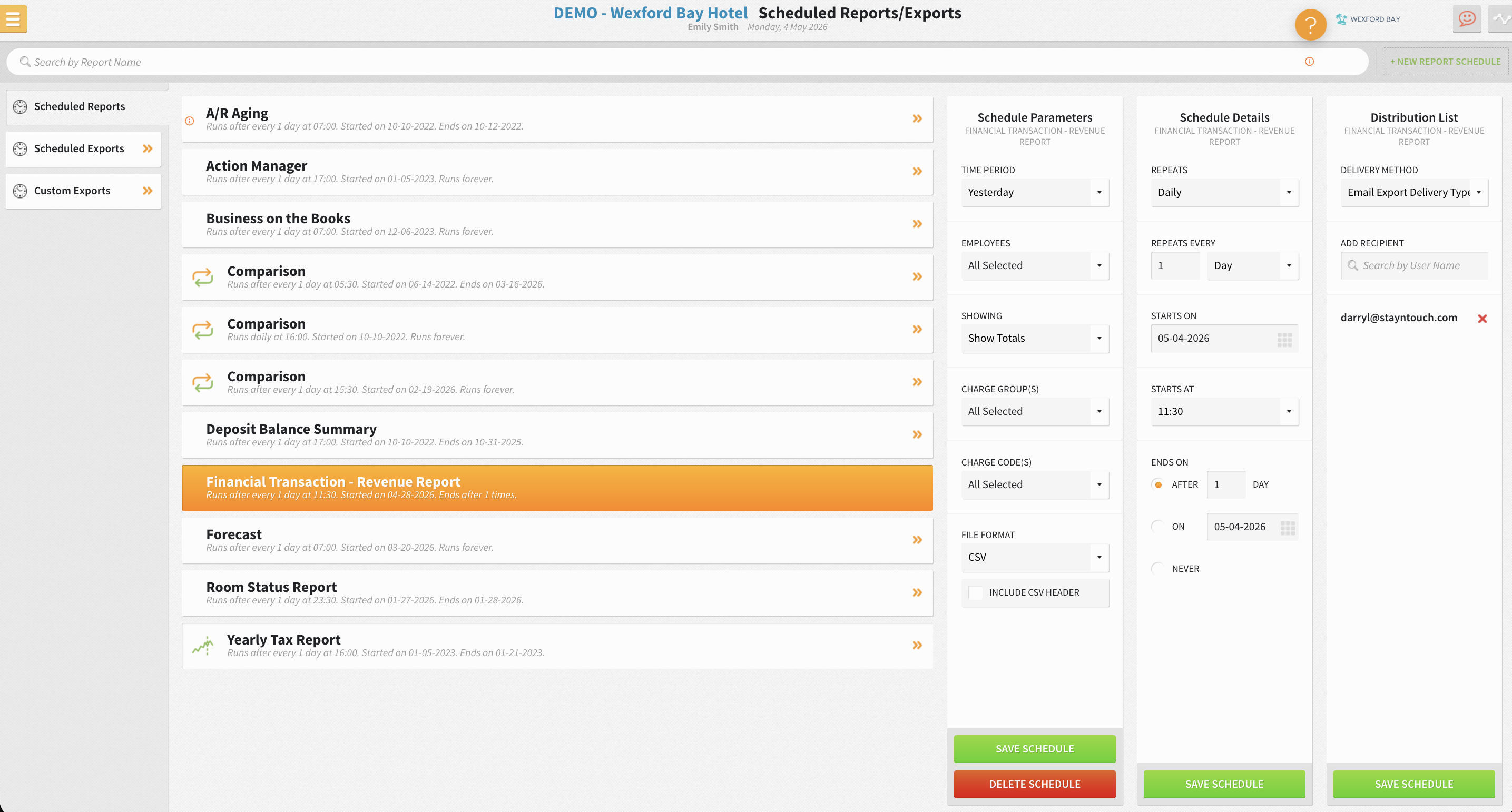
The PMS design has a significant impact on training time. A PMS with nested menus, multi-step workflows, and limited intuitive design requires weeks of guided practice before staff can handle live guest interactions independently. A PMS designed around real front desk workflows, with select-and-click navigation, a color-coded room diary, and drag-and-drop room assignment, compresses that learning curve to hours. The interface design directly affects how quickly a new hire can raise their eyes from the screen and engage with the guest in front of them.
What are the five core tasks a front desk agent must master first?
The five core tasks outlined in the training framework, check-in, checkout, room moves, charge posting, and booking search, form the foundation of front desk competency regardless of property size or PMS platform. Staff who can complete these tasks independently can handle the majority of guest interactions on any given shift.
How can multi-property groups reduce training costs across their portfolio?
Standardization is the primary lever for portfolio-wide savings. A multi-property dashboard that allows corporate teams to push configuration templates, SOPs, and training materials to every property from a single login eliminates the need to rebuild programs property by property. Role-based eLearning platforms with certifications and progress tracking allow new hires to onboard without scheduling a dedicated trainer, and managers can verify completion across the portfolio in real time. According to Stayntouch customer data, multi-property management run through a single dashboard operates 70% more efficiently than property-by-property administration.
Conclusion: Turning Training Time into an Advantage
Hotel front desk training time functions as a recurring operating cost, not a one-time investment. With front desk turnover running 40–70% annually at full-service hotels, the training clock resets constantly, and the length of each cycle is determined by the PMS at the center of the operation.
Legacy platforms that require three months to reach basic competency and six to nine months to master turn every new hire into a months-long productivity event. The cost compounds, as Cornell research found that lost productivity during the ramp period accounts for roughly half to two-thirds of total turnover cost, and the Skillcast Lost Hours Report found that hospitality businesses lose £55 million annually on inefficient staff training, while hospitality (accommodation and food services) shows the highest share of businesses reporting workforce skills gaps at 78.8% per Canadian employer survey data, though no source reports a 6.2% deficit figure. As noted in the timeline comparison, this focus on lost productivity explains why the cost calculation centers on senior staff shadowing time.
A modern cloud-native PMS compresses that timeline from months to hours. As demonstrated in the timeline comparison, Stayntouch compresses training from months to hours, a reduction that turns onboarding from a permanent operating cost into a competitive advantage. Stayntouch Academy provides self-paced eLearning with role-based learning paths, test environments, certifications, and progress tracking, so new hires can onboard without scheduling a trainer, and managers can verify readiness before any staff member handles a live guest interaction.
For general managers and operations leaders evaluating their current training timeline and its true cost, the platform choice is the single highest-leverage variable available.
Contact us to see how Stayntouch reduces front desk training to two hours and turns onboarding from a permanent operating cost into a competitive advantage.
Turn a more connected stack into a better stay.
See how Stayntouch can support the operating moments that matter most to your hotel team.