Written by: Kelly Campbell, Vice President of Marketing, Stayntouch
Key Takeaways
-
Portfolio housekeeping is a standardization and labor-allocation challenge. Paper lists and radio calls break down once you add more properties.
-
Configuration drift, invisible labor hours, and room-status lag are the three primary failure modes when scaling beyond a single hotel.
-
Centralized configuration and real-time PMS syncing keep standards consistent and push room status updates to the front desk instantly.
-
Forward task assignment and mobile attendant apps let managers staff against tomorrow’s departures while housekeepers update status from the room.
-
Stayntouch delivers a multi-property PMS architecture that connects housekeeping, the front desk, and corporate configuration in one system.
What Changes When Housekeeping Goes From One Property To Many
Three things break at portfolio scale that a single-property tool cannot absorb.
The first is configuration drift. Every property invents its own task lists, cleaning sequences, and inspection criteria. A new general manager (GM) at one hotel rewrites the checkout checklist; another property adds a step for pet rooms; a third drops the minibar verification entirely. None of these changes is wrong on its own, but together they mean the group has no shared standard, only ten variations of one: different managers creating their own checklists, duplicate versions of policies, and no way to compare performance across locations.
The second is labor visibility. Housekeeping is the largest labor line in most hotels. U.S. hotel labor cost per occupied room rose from $45.96 in Q1 2025 to $46.79 in Q1 2026, according to Actabl’s Q1 2026 Labor Report based on approximately 5,000 U.S. hotels. These are U.S. figures; labor dynamics differ materially in other markets. Without a portfolio-level view, a director of operations has no single answer to where housekeeping hours are going across sites. Each property reports separately, overtime accumulates invisibly, and staffing decisions are made reactively rather than against tomorrow’s forecast.
The third is room-status lag. When room status travels by radio or paper board, the front desk is working from information that is minutes or hours old. Guests wait in the lobby for rooms that are already clean. Early check-in revenue is lost because no one knows which rooms are ready. A single-property housekeeping app can track tasks at one hotel, but it cannot carry the two-way connection to the front desk and folio that makes room status actionable across a group.
Centralized Configuration And Standardized Housekeeping Standards
Centralized configuration keeps brand standards consistent across every property. Task lists, cleaning standards, and inspection criteria are written once at corporate and pushed to every property, so teams hold standards without constant policing. A new property opens on a template rather than a blank system. The tenth hotel takes less effort to launch than the second did.
Stayntouch Multi-Property is built around this model. Central configuration pushes housekeeping task lists, rate types, deposit and cancellation policies, charge codes, and user permissions down to every property in the group. Corporate teams manage global configuration for 100+ properties from a single login. According to Stayntouch customer data, portfolio management runs 70% more efficiently under this model.
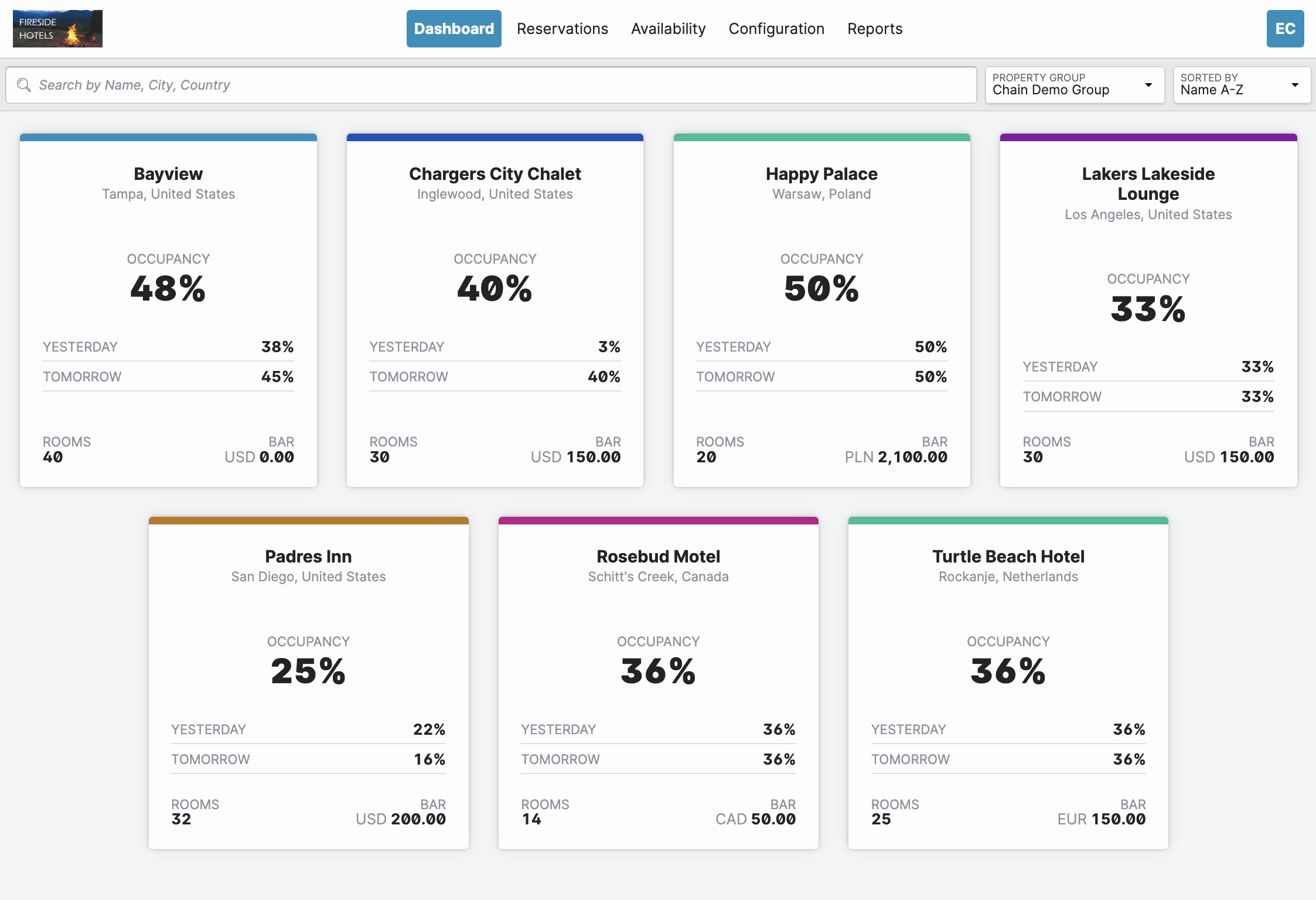
Multi-property operations research distinguishes a portfolio standard, where every property inspects rooms and records completion, from an identical workflow, which breaks at the first differently flagged hotel. The practical answer is a three-tier structure: core checks that apply everywhere, format checks that apply to relevant property types, and local checks for specific locations. Stayntouch’s central configuration supports this structure. A corporate template defines the non-negotiables, and property-level configuration handles the variables.
Inspection checklist research recommends that hotel groups standardize shared portfolio standards while allowing differences by room type, property format, facilities, and local requirements. A resort needs pool-area checks that a business hotel does not. Without template control, two locations may believe they are following the same inspection standard while actually using different questions, which makes cross-property performance comparison meaningless.
The governance model matters as much as the software. Standards without a named portfolio owner drift back to local practice within a quarter, usually without anyone deciding they should. Central configuration in the PMS enforces the standard technically. The named owner enforces it operationally.
Real-Time Room Status: The Hinge Of Portfolio Housekeeping
Real-time room status links housekeeping directly to front desk visibility, guest wait times, and early check-in revenue. A room cannot go to an arriving guest until housekeeping has cleaned and inspected it. When room-status information lags reality by even 30 minutes, both revenue and guest satisfaction leak. The front desk holds rooms defensively rather than releasing them. Guests wait for rooms that are already clean, and early check-in becomes a gamble rather than a sellable product.

Stayntouch Mobile Housekeeping closes this gap. Housekeepers update room status from the room itself, post minibar charges with fast-posting, and check out zero-balance guests directly. Status updates propagate instantly, so the front desk sees a room become available the moment it is inspected. According to Stayntouch customer data, this workflow produces a 25% increase in housekeeping productivity.
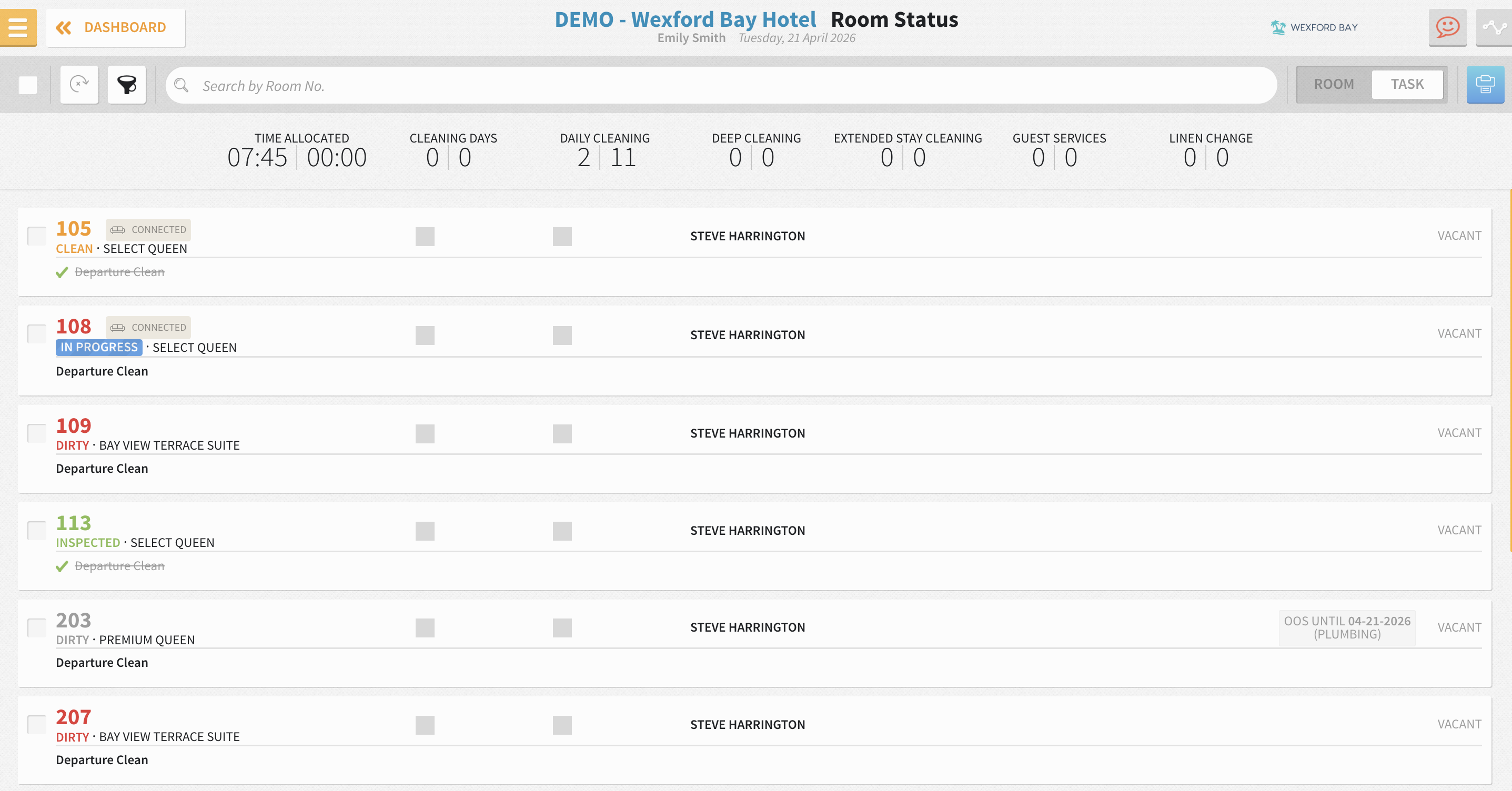
The revenue connection is direct. A guest who paid for early check-in gets their room as soon as it is inspected, so an operational signal becomes billable revenue. Live room status combined with predictive clean-time data turns early check-in from a gamble into a sellable, deliverable product. Automated upsell engines offering room-type upgrades at check-in only work if the target rooms are genuinely available and ready. Stale status data produces offers the property cannot fulfill.
At portfolio scale, this mechanism multiplies. Every property in the group operates from one live view rather than conflicting versions of the truth. The front desk and housekeeping work from the same data. Guests who paid for early check-in at any property in the group receive their rooms as soon as they are ready, without waiting for a supervisor to relay the status.
See how real-time room status works
Labor Allocation And Forecasting Across Properties
Effective labor allocation starts with tomorrow’s departures, not yesterday’s occupancy. A full house of stayovers is a light housekeeping day, while a half-full house that entirely turns over is a heavy one, and the PMS knows tomorrow’s departures precisely the night before. A 92% occupied night with 18 checkouts may be easier to turn than a 70% occupied night with 46 checkouts.
Forward task assignment is the mechanism that makes this work. Tasks are assigned forward in time rather than only reflecting the current state. A manager staffs tomorrow against tomorrow’s expected departures instead of reacting on the day. Daily labor forecasting should be performed the day before each operating day, pulling the next day’s occupancy forecast from the PMS, including total occupied rooms, expected departures, expected arrivals, and stayovers. Room counts must be broken down by status, because each category carries a different time standard.
At portfolio level, forward task assignment becomes a cross-property labor visibility question, and the stakes are rising. The U.S. quit rate in accommodation and food services was 4.3% in March 2026 against a 2.2% private-sector average, according to the Bureau of Labor Statistics JOLTS data. U.S. hotel wage cost per occupied room rose 12.8% in 2025, from $42.82 to $48.32, according to HotelData.com and Actabl Hotel Effectiveness data covering approximately 5,000 U.S. hotels. These are U.S. figures and do not apply to other markets. According to the AHLA/Hireology survey fielded December 2024 to January 2025, housekeeping was the single most-cited staffing shortage area at 38% of hotels.
A portfolio operator with no single view of where housekeeping hours are going across sites cannot make informed staffing decisions. Stayntouch’s multi-property dashboard provides that view: property-level housekeeping data aggregated into a portfolio-wide picture. Forward task assignment then lets managers plan against the actual workload rather than copying last week’s roster.

Standalone Housekeeping App Vs. Multi-Property PMS
Most multi-property operators must decide whether a standalone housekeeping app or a multi-property PMS is the right architecture. The table below shows where the two diverge. A standalone app handles tasks at one property, while a multi-property PMS connects configuration, guest profiles, room status, and reporting across the group.
|
Capability |
Standalone Housekeeping App |
Multi-Property PMS (Stayntouch) |
|---|---|---|
|
Centralized configuration |
Not available, each property configures separately |
Task lists, rate types, policies, and permissions pushed from corporate to every property |
|
Shared guest profiles |
Not available, guest data siloed per property |
Guest, company, and travel agent profiles shared across the group |
|
Real-time room status to front desk |
Limited, status may not sync to PMS or folio |
Status updates propagate instantly; front desk sees room become available the moment it is inspected |
|
Portfolio reporting |
Not available, single-property reporting only |
Portfolio-wide reporting with property-level detail |
A standalone housekeeping app tracks tasks at one property. It lacks shared guest profiles, centralized configuration, portfolio reporting, and the two-way connection to the front desk and folio that makes room status actionable. Automation works best when it starts from the PMS because most hotel work connects back to reservations, rooms, guests, billing, and reports. A housekeeping tool that sits outside the PMS creates the disconnection it was meant to solve: rooms cleaned but not marked ready, front desk assigning rooms before inspection is complete, and charges missed from the folio.
Stayntouch is a cloud-native PMS with housekeeping built in. It connects to 1,400+ integrations. Stayntouch charges nothing for the integration itself, though users still pay each third-party platform its own platform fee. There is no vendor lock-in, because the hotel keeps its choice of revenue management system (RMS), customer relationship management (CRM) platform, point-of-sale (POS) system, and central reservation system (CRS). The 2026 Hotel Technology Outlook, produced by the NYU SPS Jonathan M. Tisch Center of Hospitality with Stayntouch and IDeaS (300+ hotel professionals, November 2025), found 30% of all-in-one users intend to move to best-in-class solutions, against 14% moving the other way.
Mobile Attendant Workflows And Inspections
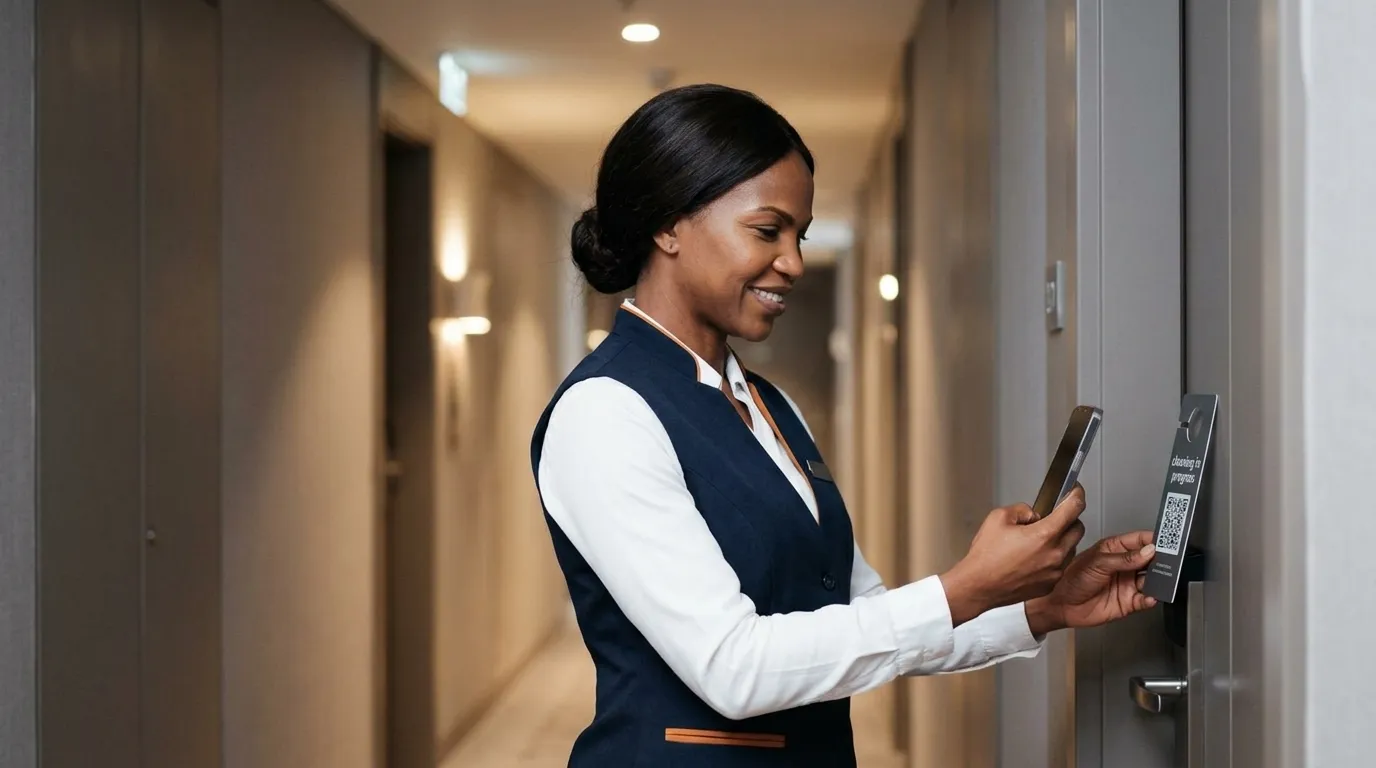
Mobile workflows for housekeepers and supervisors turn portfolio housekeeping standards into daily practice. Stayntouch Mobile Housekeeping gives attendants custom task lists built from the central configuration template. Tasks are assigned automatically by floor or section. Room status updates from the room itself, instead of from a phone call to the desk or a paper board a supervisor keys in later.
Fast-posting lets housekeepers post minibar charges directly from the room, so earned revenue is actually billed. Zero-balance guests can be checked out directly by housekeeping, which removes a step from the front desk queue. Supervisors see progress live across their section and across the property. Inspection data feeds portfolio reporting, so a director of operations can see which properties are releasing rooms on time and which are creating arrival-window bottlenecks.
Attendant-level adoption is the whole game: the best data model fails if housekeepers find the app slow, confusing, or available only in a language they do not read. Stayntouch’s mobile-first design was built around real staff workflows, and the guest-facing side of the platform supports preferred-language selection, which is a practical consideration for properties with multilingual housekeeping teams.
Portfolio-Size Segmentation
The right housekeeping architecture depends on how many properties you operate. The same principles, such as centralized configuration, real-time status, and forward task assignment, apply differently at each scale, so it helps to see how they play out across portfolio sizes.
For small hotel groups of 1–10 properties, the priority is keeping corporate overhead lean. A single revenue manager or GM oversees everything from one multi-property dashboard. Centralized configuration means the second property opens on the same template as the first, and the GM sees room status across all properties without logging into separate systems. Stayntouch works with hotels of all sizes, including those under 75 rooms, and focuses on larger properties, multi-property groups, and management companies, so smaller properties in a mixed portfolio are fully supported.
For mid-sized groups of 10–50 properties, deep centralization becomes the operational requirement. Standardized brand templates hold cleaning standards across the portfolio. Portfolio-wide reporting lets operations leaders see where housekeeping hours are going, which properties are releasing rooms on time, and where overtime is accumulating. New properties open on a template rather than a blank system, so the onboarding effort does not multiply with each addition.
For growing enterprises of 50+ properties, global configuration from a single login is the defining capability. Stayntouch supports management of 100+ properties from one login, with custom property groups by region, brand tier, or management cluster. Corporate teams push configuration changes to every property simultaneously. A policy update that once required weeks of property-by-property implementation now happens in one action.
What To Look For When Evaluating
Effective evaluation of multi-property housekeeping software focuses on operations, not cosmetics. A dashboard that looks good but updates on a delay does not support real-time decisions. A mobile app that housekeepers do not use does not support real workflows. The checklist below reflects what actually matters at portfolio scale.
-
Centralized configuration that pushes task lists, policies, and permissions from corporate to every property
-
Forward task assignment that lets managers staff against tomorrow’s departures rather than reacting on the day
-
Portfolio-wide reporting with property-level detail, instead of a simple sum of separate reports
-
Real-time PMS sync so room status propagates instantly to the front desk and availability logic
-
Mobile-first design built for housekeepers working on devices in rooms, not supervisors at desks
-
Shared guest profiles across the group so a returning guest is recognized at any property
-
Support with no service tiers, 24/7/365, under one hour guaranteed, included at no extra cost
Frequently Asked Questions
These are the questions multi-property operators ask most often when evaluating housekeeping software.
How Does Housekeeping Work Across Multiple Hotel Properties?
Housekeeping across multiple hotel properties runs on four connected mechanisms. Centralized configuration pushes task lists, cleaning standards, and inspection criteria from a corporate template to every property, so brand standards hold without property-by-property policing. Real-time room status updates propagate instantly through the PMS, so the front desk sees a room become available the moment it is inspected. Mobile attendant apps let housekeepers update room status, post minibar charges, and check out zero-balance guests directly from the room. Automated scheduling assigns tasks by floor or section and forward in time, so managers staff tomorrow against tomorrow’s expected departures rather than reacting on the day. Together, these mechanisms create a portfolio where every property operates from the same live data, configuration drift is prevented at the source, and room status connects housekeeping productivity to front desk revenue decisions.
How Many Housekeepers Should A Hotel Have?
The number of housekeepers a hotel needs depends on tomorrow’s departures and stayovers, not yesterday’s occupancy. A full house of stayovers is a light housekeeping day, while a half-full house that entirely turns over is a heavy one. The PMS knows tomorrow’s departures precisely the night before, which is why forward task assignment, scheduling against the forecasted workload rather than copying last week’s roster, is the correct approach. At portfolio level, the question becomes a cross-property labor allocation problem: which properties have the heaviest checkout load tomorrow, and where are hours being absorbed by overtime rather than planned staffing? The practical benchmark is a credit-based model. A standard stayover carries a lighter credit than a checkout, a suite checkout more than a standard room, and the daily board is built from credits rather than room counts so workloads are balanced on actual effort rather than simple numbers.
Do You Need A Standalone Housekeeping App Or A Multi-Property PMS?
As noted earlier, a standalone app tracks tasks at one property but lacks the shared profiles, centralized configuration, and portfolio reporting that a multi-property PMS provides. For a single property, a standalone app may be sufficient. For a portfolio, the core problem is standardization and labor allocation across sites, which requires one system to hold the guest profile, room status, folio, and configuration template. A multi-property PMS with housekeeping built in connects all of these in one place. Room status propagates instantly to the front desk. Minibar charges post directly to the folio. Configuration changes push from corporate to every property simultaneously, while a standalone app sitting outside the PMS cannot provide that level of connection.
How Do You Standardize Housekeeping Across A Hotel Portfolio?
Standardizing housekeeping across a hotel portfolio starts with writing task lists, cleaning standards, and inspection criteria once at corporate and pushing them to every property through the PMS. New properties open on a template rather than a blank system. Central configuration pushes housekeeping task lists, rate types, deposit and cancellation policies, charge codes, and user permissions down to every property in the group. The three-tier structure described earlier, with core, format, and local checks, applies here. As noted, a pre-configured template is what makes the tenth hotel easier to launch than the second. Standards still need a named portfolio owner, because the technology enforces the standard technically while the owner enforces it operationally.
Conclusion And Next Steps
Housekeeping across a portfolio is a standardization and labor-allocation problem. The dashboard is only the output; the real solution is the architecture behind it. Paper lists and radio calls do not scale past one property. Configuration drift, invisible labor hours, and room-status lag are the real failure modes, and they require an architecture that connects housekeeping to the front desk, the folio, and the corporate configuration layer in one system.
A multi-property PMS with housekeeping built in delivers that architecture more effectively than a standalone housekeeping app. When evaluating options, focus on which system carries centralized configuration, forward task assignment, real-time room status, shared guest profiles, and portfolio-wide reporting, and connects all of them to the front desk and folio where revenue is actually won or lost.
Stayntouch is a cloud-native PMS built for multi-property groups, with Mobile Housekeeping, centralized configuration, and portfolio reporting included. It connects to 1,400+ integrations, deploys a full portfolio in 30 to 45 days, and supports every property from a single login.
Plan your multi-property rollout
Read Next
Turn a more connected stack into a better stay.
See how Stayntouch can support the operating moments that matter most to your hotel team.