Written by: Kelly Campbell, Vice President of Marketing, Stayntouch
Key Takeaways: Faster Check-In With Three-Way Choice
- Traditional front-desk check-in takes 4–8 minutes because legacy PMS platforms force staff through multiple data-entry steps at a fixed workstation.
- A best-in-class PMS enables three-way check-in, with fully mobile, hybrid pre-check-in, or staff-assisted tablet workflows so guests choose their preferred path.
- Pre-arrival mobile registration, ID scanning, real-time housekeeping status, and digital keys each remove a specific bottleneck that slows arrival.
- Staff training drops to two hours and staff-assisted check-ins fall 54 percent when the PMS supports mobile workflows and three-way choice.
- Hotels ready to cut check-in time to under 90 seconds can contact Stayntouch to see how the platform delivers these results.
The Problem: How Legacy PMS Platforms Slow Check-In
Traditional hotel front-desk check-in commonly runs 5 to 8 minutes per guest when the process includes ID collection, registration card completion, payment pre-authorization, and room assignment. At peak arrival windows, typically 3:00 to 6:00 PM, that figure can exceed 20 minutes when queues form. Check-in waits beyond 5 minutes reduce American guest satisfaction by 50 points on a 100-point scale.

Labor costs compound the problem. In U.S. hotels, wage cost per occupied room rose 12.8% in 2025, from $42.82 to $48.32, while hotel labor cost per hour rose 8.0% against U.S. consumer price inflation of 2.7% over the same period, according to HotelData.com powered by Actabl Hotel Effectiveness (~5,000 U.S. hotels). Annual hospitality turnover in the U.S. runs near 70%, against 12–15% in most other sectors, so the training clock resets constantly.
Legacy PMS platforms make this worse in several connected ways. First, staff are workstation-bound, so every check-in requires a guest to stand at a fixed desk while a staff member works through multiple screens. This workstation dependency is compounded by the fact that on some legacy systems, the check-in process runs to eight steps before a guest receives a key, so staff spend more time clicking than welcoming. The complexity also drives up training costs, because legacy platforms typically take around three months to reach a basic working grasp and six to nine months to master in a high-turnover environment. Finally, legacy enterprise integrations can cost as much as $10,000 each, which turns every technology decision into a budget negotiation and discourages upgrades that would speed up arrival.
The average daily rate (ADR, average room revenue per paid occupied room) and guest satisfaction scores both fall when the arrival experience is slow. The fix is not more staff. It is a PMS architecture that removes the bottleneck before the guest walks through the door, which is exactly what a best-in-class PMS delivers.
The Solution: Three-Way Check-In With a Best-in-Class PMS
A best-in-class PMS is a specialized tool that focuses on solving one core problem, property management, with strong performance, intuitive user experience, and deep workflow integration. It differs from an all-in-one platform, where a single vendor’s engineering team spreads development effort across revenue management, point of sale, CRM, and other products, which dilutes the depth of the PMS itself.
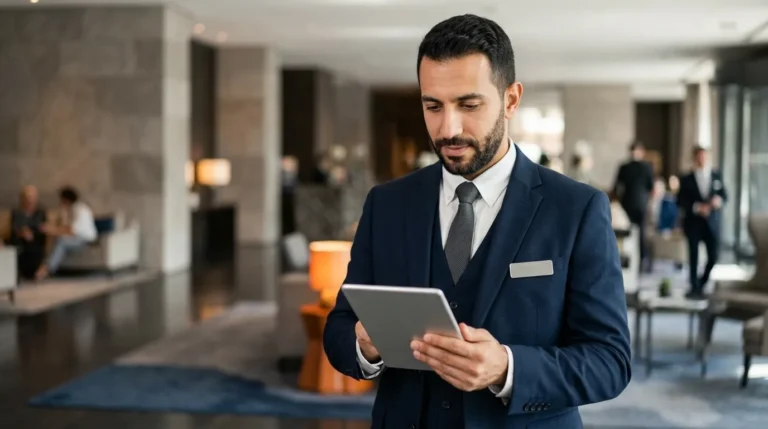
The 2026 TravelTech Breakthrough “Hotel PMS Company of the Year” Stayntouch PMS is built around three-way check-in. Guests choose fully mobile check-in, completing registration and payment before arrival and checking in from their phone in 30 seconds, hybrid pre-check-in, registering in advance while staff handle keys and payment on arrival, or staff-assisted check-in anywhere on property via tablet. All three paths run simultaneously so no guest is forced into automation they do not want.
The platform connects to 1,400+ integrations at no additional cost beyond each third-party platform’s own fee, because Stayntouch charges nothing for the integration itself. That includes door lock systems from ASSA ABLOY, dormakaba, Salto, and VingCard, point-of-sale platforms including Toast and Oracle Micros, and revenue management systems including IDeaS and Duetto.
The 2026 Hotel Technology Outlook, produced by the NYU SPS Jonathan M. Tisch Center of Hospitality with Stayntouch and IDeaS (November 2025, 300+ hotel professionals), found that all-in-one users report check-in delays at 46% versus 23% among best-in-class users, a gap that traces directly to PMS architecture.
Contact us to learn how three-way check-in works at properties like yours.
Step 1: Pre-Arrival Mobile Registration That Turns Check-In Into a Key Handoff
What it is: Pre-arrival mobile registration captures guest identity, payment details, and preferences before the guest reaches the property, so the front desk interaction becomes a key handoff rather than a data-entry session.
Actions and stakeholders:
- The PMS sends a branded pre-arrival link via SMS or email 24–72 hours before arrival.
- The guest completes personal details, uploads ID, signs the digital registration card, and authorizes payment from their phone.
- The PMS writes all captured data directly to the reservation record in real time, with no manual re-entry by staff.
- Front desk staff review completed registrations before the shift begins.
Timing: Link sent 24–72 hours pre-arrival; pre-arrival mobile registration for immigration forms such as Thailand’s TDAC or THIM app typically takes 3–5 minutes.
PMS capabilities required: Two-way API integration between the pre-arrival flow and the reservation record, automated messaging triggers, a digital registration card module with e-signature, and real-time data sync to the guest folio, the guest’s running bill for the stay.
Stayntouch Digital Registration Cards capture signed terms and conditions, pre-fill known fields, and sync automatically to the PMS, creating a documented record that also reduces disputes and chargebacks. Hotels achieve sub-90-second check-in only when the online check-in system is integrated with the PMS via API so that guest-entered data is automatically recorded, validated, and synced in real time to the reservation without manual re-entry.
Step 2: Fast ID Scanning and Secure Digital Registration
What it is: Identity verification at check-in, whether mobile, kiosk, or staff-assisted, that captures and validates a guest’s ID document without requiring staff to handle physical documents or re-enter data.
Actions and stakeholders:
- For mobile check-in, the guest scans their ID using their phone camera during the pre-arrival flow.
- For kiosk check-in, the Stayntouch Kiosk includes integrated ID scanning and facial recognition.
- For staff-assisted check-in, a staff member hands the guest a tablet and the guest scans their own document.
- The PMS extracts name, ID number, date of birth, expiration date, and country of issuance and attaches them to the guest card.
Timing: OCR-based document scanning combined with a liveness check typically takes under two minutes when performed correctly.
PMS capabilities required: Integrated ID scanning with OCR extraction, facial recognition on kiosk and mobile, encrypted storage of ID images in the same AWS region as the PMS instance, automatic deletion 30 days after checkout, and access restricted to administrators.
Stayntouch ID Scanning and Facial Recognition is built into the platform. Because names and addresses on identity documents are often out of date, captured information never overwrites existing PMS data, which prevents data corruption at scale.
Step 3: Real-Time Housekeeping Status and Room Pre-Assignment
What it is: The single most common cause of check-in delay is not a slow front desk, it is a room that is not ready. When housekeeping status lives on paper or travels by radio, the front desk assigns rooms based on information that is minutes or hours old, and real-time integration closes that gap.
Actions and stakeholders:
- Housekeepers update room status from their mobile device the moment a room is cleaned and inspected.
- The PMS propagates that status update instantly to the front desk view.
- The front desk pre-assigns rooms to arriving guests based on live status, guest preferences, and loyalty tier before the guest arrives.
- Guests who completed pre-arrival registration receive their room assignment automatically.
Timing: Status updates are real-time via webhook, a connection that pushes data the moment something happens rather than requiring another system to keep asking. Mobile app updates from housekeeping staff write back to the PMS instantly, reducing the vacant-dirty window compared to traditional walkie-talkie or end-of-shift entry methods.
PMS capabilities required: A mobile housekeeping module with real-time status sync, webhook-driven updates to the front desk view, forward task assignment by floor or section, and integration with the reservation record for pre-assignment.
According to Stayntouch customer data, Stayntouch Mobile Housekeeping delivers a 25% increase in housekeeping productivity. Hotels using integrated digital check-in and housekeeping systems report reduced room turnover time and housekeeping coordination time, achieved without adding staff.
Contact us to see how Stayntouch connects housekeeping and front desk in real time.
Step 4: Express-Lane Front Desk Configuration on Tablets
What it is: For guests who prefer staff-assisted check-in, the front desk interaction should take under 90 seconds because the administrative work is already done. Express-lane configuration means the PMS presents only the actions still required at arrival.
Actions and stakeholders:
- Front desk staff access the full guest profile on a tablet anywhere on property, not at a fixed workstation.
- The PMS displays pre-completed registration details, confirmed payment authorization, and pre-assigned room so staff see everything at a glance.
- Staff confirm identity, hand over the key, and complete check-in with a single action that closes the workflow.
- Upsell prompts for room upgrades, early check-in, or amenities surface automatically at the moment of highest intent.
PMS capabilities required: Mobile PMS access on tablets, a color-coded room diary showing live status, single-screen check-in completion, an integrated upsell workflow, and staff access from anywhere on property.
As Daniel Tennant, Former General Manager of Hotel on Rivington, noted: “Our former PMS was very challenging to use. When checking guests in, the staff could never raise their heads to look the guest in the eye because of all the screens that they had to click through. With Stayntouch PMS, the process takes far fewer steps, and has enhanced our entire welcome and check-in experience.”
Step 5: Kiosks and Digital Keys for Guests Who Want Self-Service
What it is: Self-service check-in via kiosk serves guests who want speed without staff interaction, and digital keys remove the final physical bottleneck, the key card, from the arrival sequence entirely.
Actions and stakeholders:
- The Stayntouch Kiosk runs on a tablet with an integrated credit card reader and key encoder, placed wherever the property layout suits, such as wall-mounted, on a lobby island, or on a coffee table.
- Guests complete check-in in under 30 seconds as the kiosk retrieves the reservation, confirms identity via ID scanning and facial recognition, processes payment, and encodes a key card or issues a digital key.
- Walk-in guests can create a new reservation at the kiosk without staff involvement.
- Digital keys integrate with ASSA ABLOY, dormakaba, Salto, VingCard, OpenKey, and other access platforms, and are delivered to Apple Wallet or Google Wallet without requiring a branded app download.
PMS capabilities required: Full PMS integration with the kiosk for real-time reservation retrieval, an integrated payment gateway, door lock integration via direct API or a bridge through COMTROL for legacy hardware, and webhook-triggered key delivery upon check-in confirmation.
Guests using kiosks are roughly three times more likely to accept an upsell than guests who check in at the front desk. According to Stayntouch customer data, kiosk check-in increases guest satisfaction scores by up to 20 points. The Blackburn Inn & Conference Center delivered 26 digital keys to 24 guests in its first weekend after switching to contactless check-in, with the General Manager describing the integration as “99% seamless.”

Step 6: Staff Training and Script Rollout That Stick
What it is: A sub-90-second check-in workflow fails when staff revert to old habits under pressure, so training must be fast enough to survive high turnover and specific enough to cover every check-in path.
Actions and stakeholders:
- Front desk staff complete full PMS training in 2 hours using Stayntouch Academy, a role-based, self-paced eLearning platform with test environments, certifications, and progress tracking.
- Full platform training across all modules takes 2 days.
- A Property Champion is nominated internally to lead adoption and support new hires after go-live.
- Scripts for each check-in path, mobile, kiosk, and staff-assisted, are documented and rehearsed before launch.
- Managers verify completion via Academy progress tracking, with no trainer scheduling required.
PMS capabilities required: Self-paced eLearning with test environments, role-based learning paths covering Front Desk, Housekeeping, Night Audit, the end-of-day process closing out transactions and rolling the system into the next business day, Finance, and Guest Mobility, plus certifications and progress tracking accessible to managers.
Vibeke Raddum, Former President of First Hotels, on selecting Stayntouch after reviewing 40 PMS platforms, said: “Like many hotel companies, we experience high turnover and thus the system needs the capability to train new employees easily. It is also critical that it be future-minded, e.g., mobile check-in/checkout, door lock integration and whatever next is going to come down the road. This is where Stayntouch did a great job.”
Hotel Belle Epoque completed implementation in two weeks and now hires for guest-facing ability rather than technical aptitude, because the system is straightforward enough that personality matters more than prior PMS experience.
Operational Frameworks: Three-Way Choice Instead of Forced Automation
Some hotels implement contactless check-in by removing the staffed front desk option entirely. That approach works for limited-service properties with a homogeneous guest mix but fails for full-service, boutique, and luxury properties where a segment of guests, such as business travelers arriving late, families with complex requests, or guests celebrating a milestone, want a human interaction.
Three-way check-in resolves this without compromise. All three paths run simultaneously from the same PMS:
- Fully mobile: Guest completes pre-arrival registration, receives room assignment, and checks in from their phone in 30 seconds, with no front desk stop required.
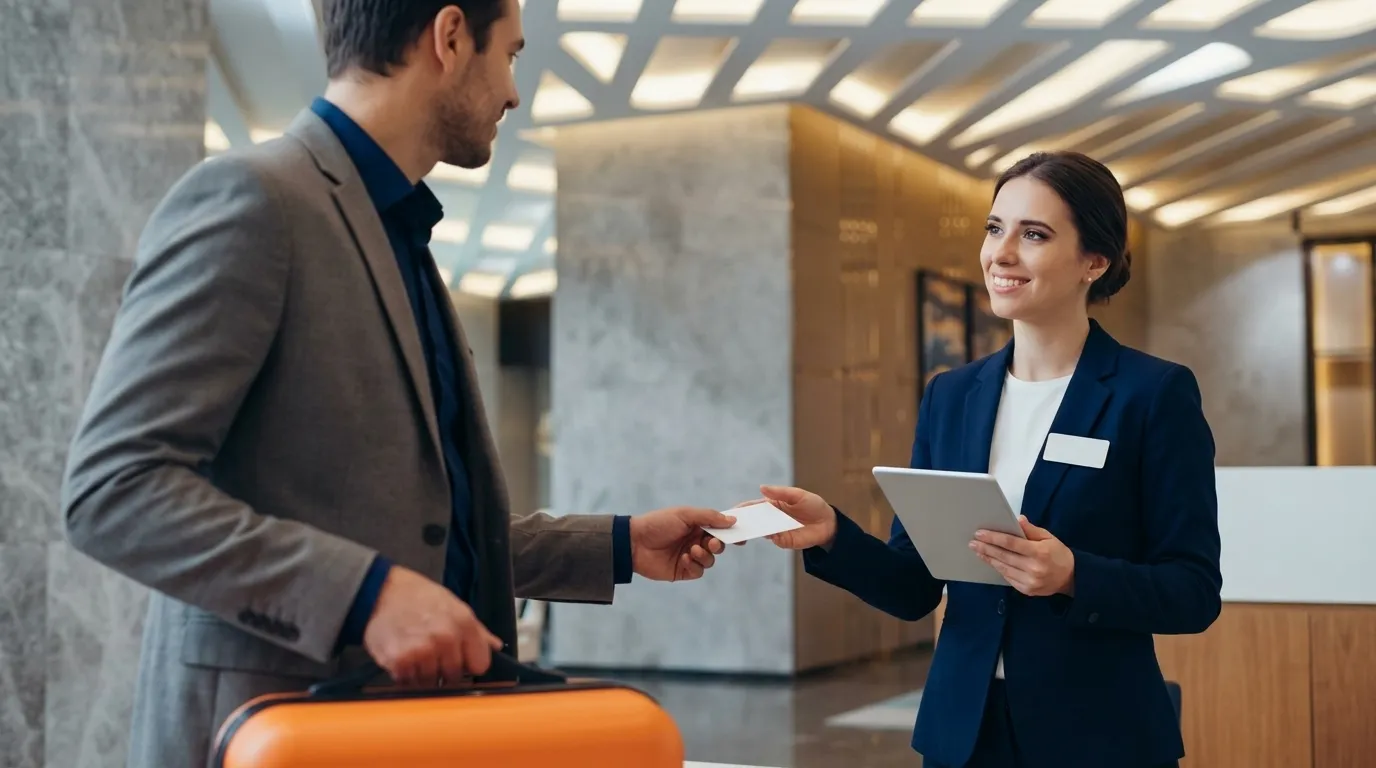
- Hybrid: Guest registers in advance via the pre-arrival link, and staff handle key encoding and any final payment at arrival, so the interaction takes under 90 seconds.
- Staff-assisted anywhere: Staff greet the guest in the lobby, lounge, or wherever they are, with a tablet, and the full check-in completes without a fixed desk.
According to Stayntouch customer data, this model delivers a 54% reduction in staff-assisted check-ins, not by eliminating staff interaction, but by ensuring that guests who want speed get it and guests who want a welcome receive one. As Marco Lemmers, CEO of Conscious Hotels, put it: “Stayntouch PMS lets us serve guests wherever they would like to interact with us, in ways that give them complete freedom of choice.”
Common Challenges and How Stayntouch Addresses Them
Early-morning and late-night arrivals: Guests arriving outside standard hours cannot wait for a room to be cleaned, so the fix is forward task assignment in the housekeeping module. Managers assign rooms to be cleaned before the shift ends based on tomorrow’s expected arrivals, so early-arrival rooms are ready before the first guest walks in. Stayntouch Mobile Housekeeping supports forward task assignment by floor or section.
Legacy data migration: Moving guest profiles, group reservations, company accounts, and travel agent profiles from a legacy PMS is the most common implementation anxiety. Stayntouch Dataloader migrates this data in 1–2 hours. For messy legacy exports, the Stayntouch team uses an internal Colab-based file cleanup and validation process to reformat and validate data before migration rather than rejecting the file. Manual data entry remains available as a fallback, and certain fields such as group blocks are always created manually regardless of export quality. Non-standard data such as group rooming lists or revenue budgets can be uploaded via CSV bulk upload.
Integration costs and legacy hardware: Hotels with installed door lock hardware face a choice between replacing equipment and losing the investment. Stayntouch supports two integration architectures, direct cloud-to-cloud API connections for modern systems and a bridge approach via COMTROL for legacy door locks and PBX, internal telephone, systems. Existing hardware does not need to be replaced. The most common integration failure is not a missing feature but ambiguous ownership between vendors and hotel teams, and defining source-of-truth rules and event timing before go-live prevents the data drift that breaks automated experiences over time.
Guest adoption: Properties that complete phased contactless check-in rollout often see high mobile check-in adoption rates among eligible reservations. Adoption is driven by the timing and channel of the pre-arrival link, because SMS and WhatsApp outperform email and links sent 24–48 hours before arrival outperform those sent at booking. Stayntouch Guest Messaging sends automated pre-arrival SMS and WhatsApp messages with mobile check-in links, with 98% WhatsApp deliverability.
Measuring Success With Clear Check-In KPIs
Sub-90-second check-in is measurable, and the following KPIs provide an objective baseline before implementation and a clear benchmark after.
- Average check-in duration: Measure from guest approach to key delivery and target under 90 seconds for pre-registered guests.
- Staff-assisted check-in percentage: Track the share of arrivals requiring a staff member. According to Stayntouch customer data, hotels achieve a 54% reduction after implementing three-way check-in.
- Mobile check-in adoption rate: Target 30–40% within 60 days of launching pre-arrival registration, scaling to 50–65% at maturity.
- Guest satisfaction score at arrival: Measure via post-stay survey, because guests who experience no wait at check-in rate their stay higher than guests who wait 20+ minutes.
- Training hours per new hire: Target the 2-hour benchmark mentioned earlier for full front desk competency on Stayntouch PMS.
- Room-not-ready incidents at check-in: Track the percentage of arrivals delayed by housekeeping status, and use this to confirm improvements from integrated housekeeping management.
According to Stayntouch customer data, mobile check-in completes in about 30 seconds, which provides a practical benchmark for properties rolling out similar workflows. The Sage Hospitality Group’s Catbird Hotel in Denver achieved a 20% increase in guest satisfaction after implementing Stayntouch PMS with Stayntouch Kiosk.
Frequently Asked Questions
What is the difference between mobile check-in and hybrid check-in?
Mobile check-in is fully self-service, so the guest completes pre-arrival registration, receives a room assignment, and checks in from their phone in 30 seconds, with no front desk stop required. A digital key is delivered to their device and they proceed directly to their room. Hybrid check-in means the guest completes registration in advance but still stops at the front desk or meets a staff member on arrival to collect a physical key card or complete a final payment step. Both paths use the same pre-arrival data capture and reduce the in-person interaction to under 90 seconds. Stayntouch PMS supports both simultaneously, along with fully staff-assisted check-in anywhere on property via tablet.
Does three-way check-in require replacing existing door lock hardware?
Not necessarily. Stayntouch supports two integration architectures. Modern door lock systems from ASSA ABLOY, dormakaba, Salto, VingCard, OpenKey, and others connect via direct cloud-to-cloud API, with digital keys delivered to Apple Wallet or Google Wallet without requiring a branded app. For hotels with legacy installed hardware, Stayntouch uses a bridge approach via COMTROL, which acts as a secure translator between the modern PMS and older lock systems. This means hotels can implement mobile and kiosk check-in without replacing a building’s worth of installed equipment. The integration itself carries no additional cost from Stayntouch, and each third-party platform charges its own platform fee.
How does real-time housekeeping status prevent check-in delays?
The most common cause of check-in delay is not a slow front desk, it is a room that is not ready. When housekeeping status is communicated by radio or paper, the front desk assigns rooms based on information that may be 30 to 60 minutes out of date. Stayntouch Mobile Housekeeping pushes status updates to the PMS the moment a housekeeper marks a room inspected, via webhook, a connection that pushes data instantly rather than requiring the system to check periodically. The front desk sees a room become available in real time and can assign it to an arriving guest immediately. Stayntouch also supports forward task assignment, allowing managers to assign rooms to be cleaned based on tomorrow’s expected arrivals rather than only reacting on the day. According to Stayntouch customer data, this approach delivers a 25% increase in housekeeping productivity.
What training is required for staff to support all three check-in paths?
Full front desk staff training on Stayntouch PMS takes 2 hours. Full platform training across all modules, including housekeeping, night audit, finance, revenue management, and guest mobility, takes 2 days. Training is delivered through Stayntouch Academy, a role-based, self-paced eLearning platform with test environments, certifications, and progress tracking. New hires can complete training without scheduling a trainer, which matters in an industry where annual turnover runs near 70% in the U.S. Managers can verify completion via Academy progress tracking, and several Stayntouch customers report that because the system is easy to learn, they now hire for guest-facing personality rather than prior PMS experience.
How does a best-in-class PMS differ from an all-in-one platform for check-in performance?
An all-in-one platform’s engineering team spreads development effort across multiple product categories, such as revenue management, point of sale, and CRM, which limits the depth of the PMS itself. A best-in-class PMS concentrates all development on the core property management workflow and its guest-facing surround. The operational result is measurable, and the 2026 Hotel Technology Outlook mentioned earlier found a significant gap in check-in delay rates between all-in-one and best-in-class users. Best-in-class users also report 70% PMS satisfaction versus 55% among all-in-one users. The gap traces to integration depth, interface design, and the number of steps required to complete a check-in, all of which are determined by how much engineering attention the PMS receives.
Conclusion: Start Cutting Check-In Time Today
Reducing front desk check-in time from 4–5 minutes to under 90 seconds is not a guest behavior problem, it is a PMS architecture problem. The six steps above, pre-arrival mobile registration, ID scanning and digital registration cards, real-time housekeeping status and room pre-assignment, express-lane front desk configuration, kiosk and digital-key deployment, and staff training, each depend on a PMS that supports two-way API integration, real-time webhooks, mobile staff access, and three-way guest choice.
Stayntouch PMS delivers all of it, including 30-second mobile check-in, a 54% reduction in staff-assisted check-ins, 2-hour front desk training, 1,400+ integrations at no additional cost beyond each third-party platform’s own fee, and 100% system uptime on AWS. Staff escape the front desk. Guests choose their arrival experience. The lobby becomes a place for hospitality rather than administration.
Contact us to start reducing your hotel’s check-in time with Stayntouch PMS.
Read Next
Turn a more connected stack into a better stay.
See how Stayntouch can support the operating moments that matter most to your hotel team.