
Written by: Kelly Campbell, Vice President of Marketing, Stayntouch
Key Takeaways
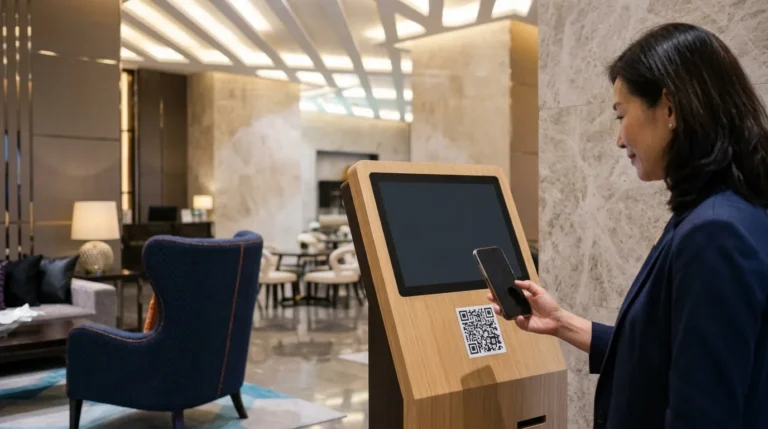
- Mobile check-in for multi-property hotels lets guests complete registration, payment, and room access from a smartphone or kiosk across every property, without separate systems at each location.
- Two critical questions determine scalability: how many properties a team can manage from a single login, and what integration costs the portfolio will incur.
- Successful mobile check-in depends on centralized configuration with local autonomy, shared guest profiles for consecutive-stay continuity, and deep real-time PMS integrations.
- Key operational practices include multi-property dashboard setup, profile synchronization, digital key delivery, pre-arrival verification, and comprehensive staff training across the portfolio.
- Stayntouch delivers these capabilities through a mobile-first PMS that manages large portfolios from one login with 1,400+ integrations at no extra cost for the connection itself. Contact us to see how it works for your portfolio.
Executive Summary: Four Dimensions That Decide Portfolio-Scale Mobile Check-In
Evaluating mobile check-in for a multi-property group requires a four-dimension framework. Each dimension represents a trade-off that a property management system (PMS) must resolve without forcing a choice between portfolio governance and property-level service. These four dimensions determine whether a PMS can scale across your portfolio without sacrificing either central governance or property-level flexibility.
- Central control versus local autonomy. Configuration, rate policies, and brand standards should be set once and pushed to every property. Individual hotels should retain the ability to apply their own operational rules without overriding the central template.
- Shared profiles versus property-specific rules. A guest who stays at three properties in a portfolio should be recognized at all three, with full stay history and preferences available at each front desk. At the same time, each property may have different deposit rules, cancellation policies, or upsell sequences.
- Consecutive-stay continuity. When a guest moves from one portfolio property to another on the same trip, the PMS must treat the journey as a single relationship, not two separate reservations with no connection between them.
- PMS integration depth. Mobile check-in is not a standalone product. It depends on real-time, two-way synchronization between the PMS, door lock systems, payment gateways, and guest messaging platforms. The quality of those connections determines whether the guest experience is seamless or fragmented.
Market and Operational Landscape for Mobile Check-In
Three forces are reshaping how hotel portfolios approach mobile check-in investment.
Labor costs are rising faster than inflation. In U.S. hotels, wage cost per occupied room rose 12.8% in 2025, from $42.82 to $48.32, while labor cost per hour rose 8.0%, against U.S. consumer price inflation of 2.7% over the same period. The U.S. quit rate in accommodation and food services was 4.3% in March 2026, close to double the 2.2% private-sector average. Mobile check-in reduces the volume of staff-assisted arrivals. According to Stayntouch customer data, properties using the platform reduce staff-assisted check-in by 54%, which lowers peak-hour staffing requirements without reducing service quality.
Guests expect choice, not automation. A 2022 Oracle Hospitality study (titled Hospitality in 2025) found that 73% of travelers want to use their mobile device to manage their hotel experience, including checking in and out. Human contact at arrival still matters to a significant share of guests. The correct architecture supports a three-way model where guests choose between fully mobile check-in, hybrid pre-check-in with staff handling keys and payment, and traditional staff-assisted check-in.
The market is moving from all-in-one to best-in-class PMS architectures. This demand for choice rather than forced automation is driving a broader shift in how hotels select their technology stack. The 2026 Hotel Technology Outlook, produced by the NYU SPS Jonathan M. Tisch Center of Hospitality with Stayntouch and IDeaS Revenue Solutions (November 2025, 300+ hotel professionals), found that 30% of all-in-one users intend to move to best-in-class solutions, against 14% moving the other way. A best-in-class PMS integrates with the revenue management system (RMS), customer relationship management (CRM), point-of-sale (POS), and central reservation system (CRS) platforms a hotel already uses, rather than replacing them with inferior built-in versions. This shift spreads engineering effort across specialized vendors rather than concentrating it within a single all-in-one vendor’s team.
Core Considerations and Trade-offs for Multi-Property Portfolios
Centralized configuration versus property-level customization. A multi-property dashboard should allow corporate teams to push rate types, deposit and cancellation policies, charge codes, user permissions, and housekeeping task lists to every property simultaneously. Properties should be able to configure their own operational rules, such as check-in time windows, upsell sequences, and ID verification workflows, without breaking the central template. These are not competing requirements. A well-architected PMS handles both through permission scoping.
Shared guest profiles and consecutive-stay continuity. The same principle of balancing central control with local flexibility applies to guest data management. Unified guest profiles, single records that follow a traveler across every property in the portfolio, form the technical foundation of consecutive-stay continuity. For hotel groups, profiles should consolidate guest data across all properties so a guest who stays at one location in winter and another in summer is recognized and valued at both, with full stay history traveling across the portfolio. When a guest moves between portfolio properties on the same trip, the PMS should carry their folio history, preferences, and loyalty standing without requiring re-registration. Stayntouch shares guest, company, and travel agent profiles globally across the portfolio, with aggregated stay statistics including average daily rate (ADR) and total stays visible at every property.
Integration cost structure at portfolio scale. Stayntouch provides 1,400+ integrations with unlimited connections at no additional cost for the integration itself. Each third-party platform, such as a door lock system, a revenue management platform, or a CRM, charges its own platform fee, while Stayntouch charges nothing for the connection. This pricing model matters at portfolio scale because every new property added to a group typically requires the same set of integrations. A model that charges per connection multiplies that cost across every property and every new tool the portfolio wants to adopt.
Operational and Technical Best Practices for Rolling Out Mobile Check-In
The following seven-step checklist reflects the sequencing that multi-property groups use to deploy mobile check-in without disrupting operations at properties already live. This order prevents the most common implementation failures: profile gaps at go-live, integration scoping errors that expose guest data, and adoption stall caused by incomplete staff preparation.
- Set up the central multi-property dashboard. Configure the portfolio-level view before touching individual properties. Establish property groups by region, brand tier, or management cluster. Push global rate types, deposit rules, and cancellation policies from the center.
- Synchronize guest profiles across properties. Audit existing guest data before migration. Stayntouch’s Dataloader module migrates guest profiles, group reservations, company and travel agent profiles, and deposit totals in as little as 1–2 hours. For messy legacy exports, Stayntouch’s internal Colab-based cleanup tool reformats and validates files before migration rather than rejecting them outright. Certain fields, including group blocks, are always created manually regardless of export quality. Non-standard data such as group rooming lists can be uploaded via CSV bulk upload.
- Configure digital key delivery across sites. Confirm that door lock systems at every property are integrated and that the application programming interface (API) connection uses webhooks, which push data the moment something happens. When a guest completes mobile check-in, the door lock system must receive the room assignment instantly. Stayntouch integrates with ASSA ABLOY, dormakaba, Salto, VingCard, Onity, and others.
- Set up pre-arrival verification. Configure pre-arrival messaging windows, typically sent 4–48 hours before arrival, and ID verification workflows. Any centralized mobile check-in rollout across multiple properties must account for local legal and brand-mandated verification requirements rather than pursuing uniform user-experience goals, because ID verification rules vary by jurisdiction. Stayntouch’s ID scanning and facial recognition capability encrypts and stores ID images in the same AWS region as the hotel’s PMS instance, with automatic deletion 30 days after checkout.
- Configure property-specific rules and scoped access. After central templates are live, configure property-level exceptions such as local tax rules, upsell sequences, room preference options, and check-in time windows. As you configure these property-specific rules, ensure that integration access is scoped appropriately. A door lock application should see only the room number and checkout date it needs to function, not payment details or home addresses that serve no operational purpose.
- Train staff with role-based, time-bound programs. Full platform training across all Stayntouch modules takes 2 days, while front desk staff training on the PMS alone takes 2 hours. Stayntouch Academy provides role-based, self-paced eLearning with test environments, certifications, and progress tracking, so new hires at any property can onboard without scheduling a trainer. For multi-property groups, automation creates consistency across locations by standardizing registration templates, deposit rules, and pre-arrival messaging, which reduces training burden and keeps compliance steps aligned.
- Establish portfolio reporting and success metrics. Define the metrics that will govern ongoing improvement, such as mobile check-in completion rate, digital key activation rate, upsell conversion rate, staff intervention frequency, and guest satisfaction scores by property. When implementing mobile check-in across properties, hotel groups should track metrics including check-in completion rate, average arrival time, guest satisfaction scores, and upsell conversion rates. Stayntouch’s 360° reporting delivers scheduled, filtered reports by email, SFTP, or cloud drive without manual assembly.
Readiness and Evaluation Checklist for Vendors
Apply the following criteria to any vendor under evaluation.
Operational readiness:
- Does the PMS support real-time, two-way synchronization with mobile check-in flows, door lock systems, and payment gateways, not batch processing?
- Can the platform manage large portfolios from a single login with centrally pushed configuration?
- Does the platform support three-way check-in, fully mobile, hybrid, and staff-assisted, simultaneously?
Technical readiness:
- Are APIs (application programming interfaces) open, documented, and webhook-enhanced?
- Does the platform support both direct cloud-to-cloud connections for modern applications and bridge integrations for legacy door locks and PBX (internal telephone) systems?
- Is the platform cloud-native, built for the cloud from the outset, with no on-site servers and no downtime for upgrades?
Financial readiness:
- What is the per-integration cost? Unlimited connections at no extra cost for the integration itself is the benchmark.
- Is pricing quote-based with no hidden maintenance fees or per-interface charges?
- What is the total cost of ownership across a five-year portfolio deployment?
Compliance and security:
- Is the platform certified to PCI DSS (Payment Card Industry Data Security Standard) Level 1 for payments?
- Does the platform maintain product compliance across the jurisdictions where your portfolio operates? Stayntouch maintains compliance in 60+ countries, with jurisdictional diligence completed in advance on the customer’s behalf.
- Does the platform hold SOC 2 Type 1, GDPR, and ISO 27001/27018 certifications?
Change management:
- What is the full platform training duration, and is self-paced eLearning available for ongoing staff onboarding?
- What is the implementation timeline for a full portfolio?
- Is 24/7/365 support included at no extra cost, with a guaranteed response under one hour?
Contact us to walk through this checklist against your portfolio’s specific requirements.
Common Challenges in Portfolio Mobile Check-In
Data migration from legacy exports. Legacy PMS platforms do not always produce clean data exports. Stayntouch addresses this through an internal Colab-based Dataloader file cleanup and validation process that reformats messy exports before migration rather than rejecting them. When even the cleanup process cannot resolve data quality issues, manual data entry remains available as a fallback, though it is slower. Some data types bypass automated migration entirely, and certain fields such as group blocks are always created manually regardless of export quality. For bulk data that does not fit the standard migration format, such as group rooming lists or revenue budgets, CSV upload provides a third path that sits between automated migration and manual entry.
Manual creation of certain fields. Not every data type migrates automatically. Portfolio operators should identify which fields require manual creation during implementation planning, rather than discovering gaps at go-live.
Scoped integration access. When deploying mobile check-in across a portfolio with multiple third-party integrations, such as door locks, payment gateways, and guest messaging platforms, each integration must be scoped to access only the data it requires. A door lock application needs a room number and checkout date, not payment details or home addresses. Stayntouch uses OAuth, an authorization method that gives an application limited, revocable access without sharing the master password, to enforce this scoping across all 1,400+ integrations.
Adoption stall after launch. Contactless check-in adoption stalls primarily due to unclear value propositions, irrelevant pre-arrival messaging, excessive process steps, disconnection from room access, and staff reverting to manual check-in habits. Multi-channel pre-arrival activation, combining email, SMS, and booking confirmation messaging, consistently outperforms single-channel approaches. Hotels implementing comprehensive multi-channel activation strategies often achieve higher pre-arrival digital check-in completion rates compared to single-channel approaches.
Frequently Asked Questions
What is the difference between mobile check-in and a booking engine for hotel portfolios?
A booking engine handles the search and reservation process, where a guest finds available rooms and completes a booking. Mobile check-in is a separate, post-booking capability that allows a guest to complete registration, payment, and room access after a reservation already exists. The two systems serve different moments in the guest journey and are not interchangeable. Stayntouch’s mobile check-in flows are part of the PMS and operate independently of the booking engine.
How does Stayntouch handle consecutive stays across portfolio properties?
Stayntouch maintains shared guest profiles across the entire portfolio. When a guest moves from one property to another on the same trip, their folio history, preferences, loyalty standing, and stay statistics travel with them. The front desk at the second property sees the guest’s full history before they arrive, without requiring re-registration. This capability is enabled by real-time profile synchronization across all properties managed from the single multi-property dashboard.
Can individual properties keep their own operational rules while the portfolio uses centralized configuration?
Yes. Stayntouch’s multi-property architecture separates central governance from property-level configuration. Corporate teams push rate types, deposit and cancellation policies, charge codes, user permissions, and housekeeping task lists from the center. Individual properties configure their own operational rules, such as check-in time windows, upsell sequences, local tax handling, and ID verification workflows, without overriding the central template. Integration access is scoped so that each connected application sees only the data relevant to its function at that property.
How long does it take to train staff across a multi-property portfolio?
Full platform training across all Stayntouch modules takes 2 days. Front desk staff training on the PMS alone takes 2 hours. Stayntouch Academy provides role-based, self-paced eLearning with test environments, certifications, and progress tracking, so new hires at any property in the portfolio can onboard without scheduling a trainer. This matters in an industry where annual turnover runs near 70% in the U.S., so training time becomes a permanent operating cost rather than a one-time onboarding expense.
What happens if a legacy PMS export is too messy to migrate cleanly?
Stayntouch does not reject messy legacy exports. An internal Colab-based Dataloader file cleanup and validation process reformats and validates files before they are run through the migration tool. Manual data entry remains available as a fallback when automated migration is not feasible. Certain fields, including group blocks, are always created manually regardless of export quality. Non-standard data such as group rooming lists or revenue budgets can be uploaded as generic CSV files rather than through the structured migration format.
Conclusion: Turn Mobile Check-In into Portfolio Advantage
Mobile check-in for multi-property hotels succeeds when four conditions are met. Centralized configuration must be pushed from a single dashboard, guest profiles must be shared to enable consecutive-stay continuity, property-level rules must coexist with the central template, and PMS integration depth must connect door locks, payment gateways, and guest messaging in real time without per-connection fees.
The evaluation framework in this guide, central control versus local autonomy, shared profiles versus property-specific rules, consecutive-stay continuity, and PMS integration depth, applies to any vendor. The seven-step rollout checklist provides the sequencing that prevents the most common implementation failures, including profile gaps at go-live, adoption stall after launch, and integration scoping errors that expose guest data.
Stayntouch delivers this through a mobile-first PMS architecture hosted on AWS with 100% system uptime, 1,400+ integrations at no extra cost for the connection itself, and a multi-property dashboard that manages large portfolios from a single login. Staff complete full platform training in 2 days, and front desk teams learn the PMS in 2 hours.
Contact us to book a demo and see how Stayntouch handles mobile check-in across your portfolio, from the first property to the hundredth.
Read Next
Turn a more connected stack into a better stay.
See how Stayntouch can support the operating moments that matter most to your hotel team.