Written by: Kelly Campbell, Vice President of Marketing, Stayntouch
Key Takeaways
- Mobile check-in works without a branded app. Guests complete registration, payment, and ID verification through a mobile browser link sent 24–48 hours before arrival.
- Stayntouch PMS supports three arrival paths: fully mobile, hybrid pre-check-in, and staff-assisted anywhere, so guests choose their preferred experience.
- Independent hotels can connect mobile check-in to existing door locks and PMS without per-interface fees, app development, or lengthy staff training.
- Key benefits include a 54% reduction in staff-assisted check-ins, 2-hour front-desk training, 100% cloud uptime, and 24/7/365 support with no service tiers.
- Ready to modernize guest arrival? Contact Stayntouch to see how three-way check-in can work for your property.
How Mobile Check-in Works for Independent Hotels
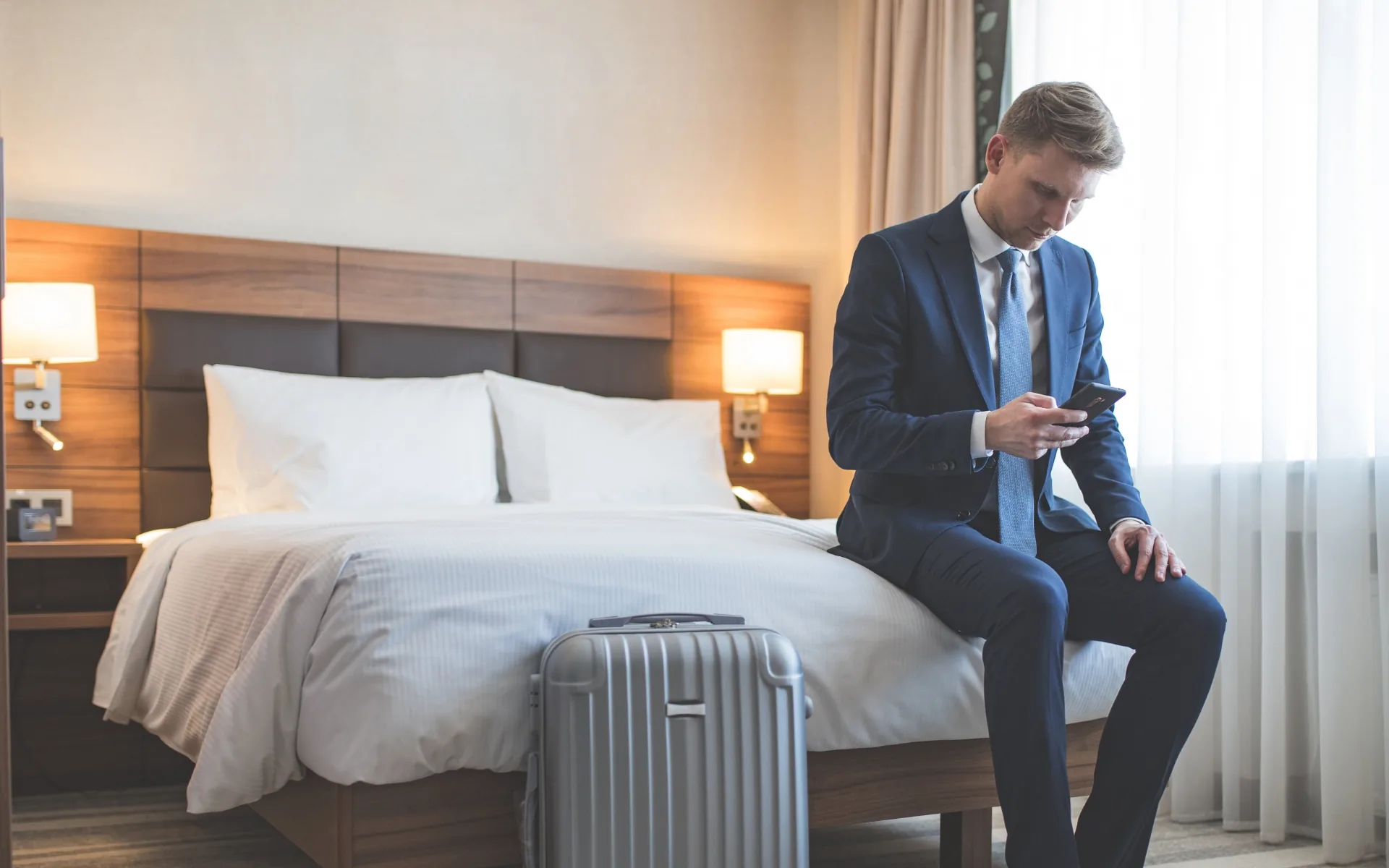
Modern mobile check-in does not require a branded app. Guests receive a pre-arrival link by SMS or email, typically 24 to 48 hours before arrival, and complete registration, payment authorization, and ID verification in a mobile browser. Mobile web check-in removes the app-store detour, account creation, and storage friction that cause leakage in the digital journey, so it becomes the fastest adoption path for independent operators without app development budgets.
Stayntouch PMS centers the arrival experience around three simultaneous paths, called three-way check-in, so each guest chooses their own journey instead of being pushed into a single option:
- Fully mobile in 30 seconds. Guests pre-register, authorize payment, and receive a digital key before arrival. According to Stayntouch customer data, this path reduces staff-assisted check-in by 54% and completes in about 30 seconds at the door.
- Hybrid pre-check-in. Guests complete registration in advance, while staff handle keys and payment on arrival. This suits guests who want speed but still prefer some in-person interaction.
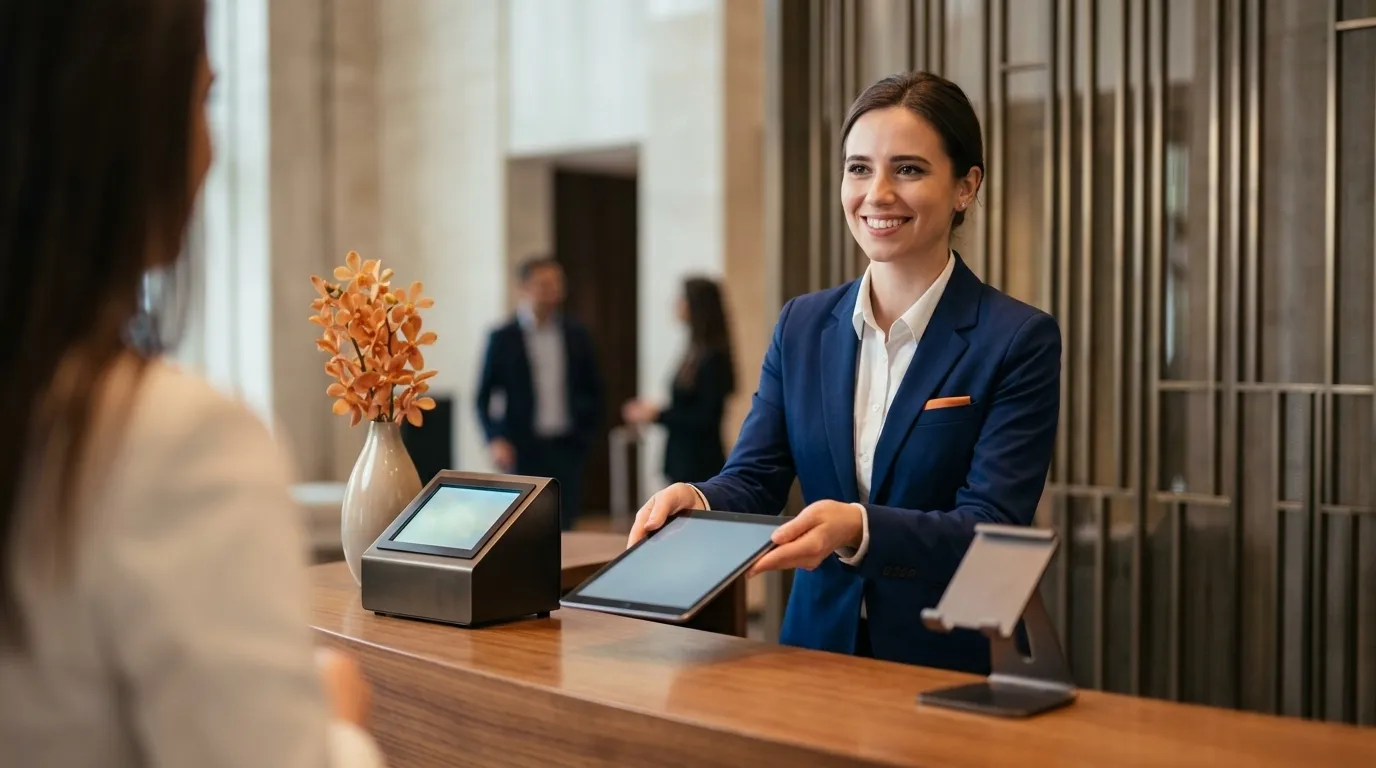
- Staff-assisted anywhere on property. A team member greets the guest in the lobby, lounge, or courtyard using a tablet, so no fixed front desk is required. The PMS runs natively on mobile devices, so staff are not chained to a workstation.
All three paths run on the same PMS. When a guest checks in via mobile, a webhook connection pushes data instantly to the door lock system and guest messaging platform. Room status, folio details, and housekeeping alerts update in real time across every department.

Independent hotels can follow this checklist to roll out mobile check-in in a structured way:
- Audit your current PMS and lock hardware. Confirm whether your locks support Bluetooth Low Energy (BLE) or NFC digital keys, or whether a bridge integration is needed for legacy hardware. If existing locks are not Bluetooth-ready, retrofit costs run from $100 to $400 per door and should be budgeted separately from software.
- Choose a PMS-native solution. Verify that the system connects natively to your PMS without middleware, that sync is bidirectional and real-time, and that PMS updates such as room changes automatically reflect in the guest experience.
- Configure the guest-facing flow. Set the check-in window, usually 24–48 hours pre-arrival, along with required fields, ID verification, and upsell offers for room upgrades, early check-in, and amenities.
- Integrate door locks. Stayntouch connects directly to ASSA ABLOY, Salto, dormakaba, VingCard, Onity, and other vendors. For legacy hardware, a bridge via COMTROL manages the connection so you avoid replacing installed equipment.
- Train staff on exception handling. Front desk teams need training to manage exceptions such as assisted guests, digital key issues, and walk-ins, even after full mobile adoption. Stayntouch front desk staff training takes 2 hours, while full platform training across all modules takes 2 days.
- Send pre-arrival messaging. Mobile check-in adoption improves dramatically when hotels send pre-arrival instructions that explain the process to guests. Stayntouch Guest Messaging automates this via SMS and WhatsApp.
- Monitor, measure, and expand. Track adoption by arrival path, upsell conversion, and guest satisfaction. Start with a pilot focused on one high-impact area, then adjust workflows based on early guest feedback before expanding.
Ready to see how these integrations work in practice? Schedule a demo with Stayntouch.
Risks and Tradeoffs of Mobile Check-in
Mobile check-in delivers measurable operational benefits, and independent operators should also evaluate four categories of risk before committing to a solution.
Legacy lock compatibility. Mobile-only contactless check-in is the lowest-cost and fastest-to-deploy format, while kiosk-only is the safer choice when a meaningful share of guests are international or app-averse. Properties with older lock hardware may need retrofit investment or a bridge integration before digital keys become viable. Stayntouch addresses this through COMTROL for legacy door locks and PBX systems, so existing hardware usually stays in place.
Guest segments that prefer human interaction. Industry research shows 70% of hotels report guests still prefer human interaction for check-in and complex requests. Properties see the strongest guest satisfaction when mobile check-in is presented as opt-in rather than required, with staffed front desks always available. Three-way check-in, which preserves the traditional staffed option alongside mobile and hybrid paths, often outperforms fully automated models for full-service independent hotels.

Connectivity and technical failure risk. Implementing hotel mobile check-in requires management to rewrite standard operating procedures to handle digital discrepancies, key failures, and identity verification protocols, and properties need robust analog backup plans because localized power or internet outages can cause major disruptions. Cloud-native platforms hosted on AWS with documented uptime records reduce this risk but cannot remove it entirely.
Training and change management. Even when technical infrastructure is reliable, human factors determine success. Seventy percent of technology rollouts in hospitality fail to achieve expected goals within the first year primarily because staff were not adequately prepared for the change. Solutions that train in hours rather than weeks reduce this risk in high-turnover environments.
The table below compares key operational metrics across platform categories. Stayntouch figures come from Stayntouch customer data, while category-level figures reflect publicly documented characteristics of legacy and all-in-one platforms.
| Metric | Stayntouch | Generic Legacy Platforms | Generic All-in-One Platforms |
|---|---|---|---|
| Front desk staff training time | 2 hours (per Stayntouch customer data) | 3–5 days basic proficiency, weeks to full comfort | Varies, self-setup guides common |
| Integration cost per connection | No per-interface fee (third-party platform fees apply separately) | Up to $10,000 per integration (per Stayntouch competitive research) | Marketplace connections, depth varies |
| Check-in arrival paths supported | Three: mobile, hybrid, staff-assisted anywhere | Typically front desk, mobile add-on varies | Typically mobile or kiosk, staffed option varies |
| System uptime | 100% sustained over two years (per Stayntouch performance record) | On-premise or partial cloud, downtime for upgrades common | Cloud-native, uptime varies by vendor |
| Reduction in staff-assisted check-in | 54% (per Stayntouch customer data) | Not published at category level | Not published at category level |
Compare these metrics at your property. Book a personalized walkthrough.
Choosing a Mobile Check-in Platform That Fits Your Property
Independent hotel operators face constraints that chain-focused or enterprise solutions rarely address, including limited app development budgets, legacy lock hardware, high staff turnover, and pressure to offer guest choice without forcing automation. These realities make the following criteria especially important when evaluating options.
No per-interface fees. Some legacy platforms charge as much as $10,000 per integration, which turns every technology decision into a budget negotiation. A solution that includes integrations at no additional cost, while each third-party platform charges its own platform fee, removes that barrier. Stayntouch provides more than 1,400 integrations with unlimited connections at no charge for the integration itself.
Open integrations with documented APIs. Operators should judge vendors on the depth and breadth of PMS, payment-gateway, and CRM integrations rather than demo-screen polish, because integration quality determines whether mobile check-in journeys are operationally useful or merely cosmetic. Stayntouch APIs use webhooks with documented endpoints and sandbox environments, so developers can test event-driven connections before going live.
Three-way check-in that preserves guest choice. Hotels that implemented fully digital-only check-in discovered that the segment of guests who want or need human interaction at arrival is larger than early adoption enthusiasm suggested. A solution that forces automation or forces a download will underperform for full-service independent properties. The right platform runs mobile, hybrid, and staff-assisted paths at the same time, so each guest chooses the experience they prefer.
Fast training for high-turnover environments. U.S. annual hospitality turnover runs near 70%, compared with 12–15% in most other sectors (industry estimate, U.S. data only). A PMS that takes weeks to learn becomes a permanent operating cost. Stayntouch uses the rapid training timeline mentioned earlier, and Stayntouch Academy adds self-paced eLearning with certifications and progress tracking so new hires can onboard without scheduling a trainer.
Cloud-native architecture with no downtime for upgrades. On-premise or partially migrated platforms require scheduled downtime for updates, which directly affects guest service. Stayntouch is cloud-native on AWS with a 100% uptime performance record and product releases that require no downtime.
No app required. Independent hotels and small groups rarely justify native app development because transient guest download rates remain in the single digits to low double digits. Mobile web check-in delivered via a pre-arrival SMS or email link achieves higher adoption with no development cost. Post-pandemic data shows roughly 70 to 75 percent of travelers prefer mobile check-in when offered cleanly via a pre-arrival link 24 to 48 hours before arrival.
Support without service tiers. When a digital key fails at 2 a.m., a tiered support model that restricts smaller properties to email-only response does not protect the guest experience. Stayntouch provides 24/7/365 follow-the-sun support, with teams across multiple time zones so a request always reaches someone currently on shift, and a guaranteed response under one hour from hospitality specialists rather than a chatbot.
The 2026 TravelTech Breakthrough “Hotel PMS Company of the Year” recognition and a 97% customer retention rate reflect what operators see when these criteria are met in practice. Vibeke Raddum, former president of First Hotels, selected Stayntouch after reviewing approximately 40 property management systems: “Like many hotel companies, we experience high turnover and thus the system needs the capability to train new employees easily. It is also critical that it be future-minded, e.g., mobile check-in/check-out, door lock integration and whatever next is going to come down the road.”
Conclusion: Mobile Check-in Built for Independent Hotels
Independent hotels can add mobile check-in without building an app, replacing lock hardware, or undertaking a full technology overhaul. The prerequisite is a mobile-first PMS that supports three simultaneous arrival paths, connects to existing door locks and payment gateways, trains staff in hours, and links to the broader technology stack without per-interface fees or vendor lock-in.
A 2022 Oracle Hospitality and Skift study found that 73% of travelers want to use their mobile device to manage their hotel experience, including checking in and out. That preference signals a desire for choice, not full automation. Some guests want to walk from the curb to their room in 30 seconds. Others want a warm welcome from a staff member in the lobby. The right platform supports both experiences at the same time from the same system.
Stayntouch PMS delivers that flexibility with three-way check-in, more than 1,400 integrations at no extra cost for the connection itself, a 100% cloud uptime record, 2-hour front desk training, and 24/7/365 support with no service tiers. The platform is purpose-built for independent hotels, boutique brands, and multi-property groups that want more from their PMS without the complexity of legacy systems or the constraints of all-in-one platforms.
See what a best-in-class PMS actually feels like. Book a demo at stayntouch.com.
Frequently Asked Questions
Can an independent hotel add mobile check-in without replacing its existing door locks?
In most cases, yes. The answer depends on whether existing locks support Bluetooth Low Energy or NFC digital key delivery. Modern locks from vendors such as ASSA ABLOY, Salto, dormakaba, VingCard, and Onity connect directly to Stayntouch PMS via cloud-to-cloud integration. For older hardware that does not support wireless key delivery, Stayntouch uses a bridge integration via COMTROL, which acts as a secure translator between the modern PMS and legacy lock systems. This setup lets a property run mobile check-in with digital key delivery without replacing a building’s worth of installed equipment. The only scenario that requires hardware investment is a lock system with no digital key capability at all, in which case retrofit costs should be evaluated as a separate line item from the software decision.
What happens when a guest does not want to use mobile check-in?
Nothing changes for that guest. Three-way check-in means all three arrival paths, fully mobile, hybrid pre-check-in, and traditional staff-assisted check-in, run simultaneously on the same PMS. A guest who ignores the pre-arrival mobile check-in link arrives at the front desk and checks in exactly as they would have before. Staff can assist from anywhere on the property using a tablet, or from a fixed front desk, so the property and the guest control the experience, not the software. Forcing automation is a configuration decision, not a requirement of mobile check-in adoption. Properties that present mobile check-in as an opt-in option consistently achieve better guest satisfaction outcomes than those that make it mandatory.
How long does it take to implement mobile check-in on Stayntouch PMS?
A single independent property typically deploys in about one month on a structured six-week implementation process that covers team introductions, property configuration, integration setup, payment gateway configuration, guest mobility setup, staff training, and go-live preparation. Auto-Configuration reduces property setup from roughly 30 hours of manual work to 4–5 hours using standardized templates. The Dataloader module migrates legacy guest profiles, group reservations, company and travel agent profiles, and deposit totals in as little as 1–2 hours. For properties with messy legacy data exports, Stayntouch provides a data cleanup process rather than rejecting files outright. Deployment can be fully remote, on-site, or a combination, with a dedicated project manager guiding the process throughout.
Does mobile check-in require a branded hotel app that guests must download?
No. Stayntouch delivers mobile check-in via a browser-based link sent by SMS or email before arrival, so guests avoid app downloads, account creation, and storage requirements on their devices. This approach works best for independent hotels because transient guests at independent properties have no prior relationship with a branded app and download rates for single-property apps remain very low. The mobile check-in flow handles registration, payment authorization, ID verification, and digital key delivery entirely within a mobile browser. For properties that also operate a Stayntouch Kiosk, guests who prefer a physical self-service option can check in at the kiosk in under 30 seconds with an integrated credit card reader and key encoder, again with no app required.
How does mobile check-in affect front desk staffing at an independent hotel?
Mobile check-in redistributes front desk work rather than eliminating it. According to Stayntouch customer data, properties using three-way check-in reduce staff-assisted check-in by 54%. The transactions that remain at the front desk tend to be more complex, such as special requests, issue resolution, and VIP arrivals, so staff spend more time on genuine hospitality and less time processing routine arrivals behind a screen. Several Stayntouch customers report a secondary benefit: because the PMS is straightforward to learn, they can hire staff for their ability to engage with guests rather than for technical aptitude, which widens the hiring pool in a high-turnover industry. Overnight staffing decisions remain a separate operational question. Mobile check-in can handle routine late arrivals autonomously, while 24-hour monitoring for escalations stays a property responsibility.
Read Next
Turn a more connected stack into a better stay.
See how Stayntouch can support the operating moments that matter most to your hotel team.