Written by: Kelly Campbell, Vice President of Marketing, Stayntouch
Key takeaways for independent hotels
- Mobile check-in lets guests complete registration, ID verification, payment, and key issuance on their phone via a secure web link before arrival. This removes front-desk queues while keeping a staffed fallback option for anyone who prefers in-person service.
- The process follows a five-step pre-arrival flow that runs entirely through a browser, with no app download required, and depends on two-way write-back to the PMS for real-time status updates.
- Independent hotels must plan for guest exclusion, adoption stall, integration failure, connectivity dependency, and staff culture shift. A three-way check-in model addresses each of these risks.
- Browser-based mobile check-in removes the download wall and high ongoing costs of native guest apps. Around 70 to 75% of travelers choose this approach when it is offered clearly through a pre-arrival link.
- Stayntouch PMS delivers a 54% reduction in staff-assisted check-in and 30-second mobile guest check-in times. Contact us to see how the three-way check-in model can work for your property.
Five-step mobile check-in flow for hotels
Mobile check-in follows a five-step pre-arrival flow that runs entirely through a browser, with no app download required.
- Pre-arrival SMS or email link. The property management system (PMS) triggers a secure web link sent 24 to 48 hours before arrival. Oracle Hospitality research shows that timing this window correctly is built into effective mobile check-in design.
- ID scan and verification. The guest photographs their identity document using the phone camera. The image is encrypted and stored securely, and the verified status writes back to the PMS in real time.
- Digital registration card signature. The guest reviews and signs the property terms and conditions digitally. This creates a documented record that reduces disputes and chargebacks, which occur when a guest disputes a charge with their bank after departure and the hotel lacks evidence.
- Payment authorization. Card details are captured and tokenized, meaning the real card number is replaced with a meaningless substitute so it is never stored in the system, and the folio (the guest bill for the stay) is authorized.
- Digital key or entry code delivery. A mobile key is provisioned directly to the guest phone, or an entry code is sent, so the guest can access the room without stopping at the front desk.
The decisive technical requirement is two-way write-back. A completed online check-in must automatically set the guest to checked-in status inside the PMS without staff retyping data. Without bidirectional write capability, the check-in screen updates but the PMS does not, which is the most common failure pattern in independent hotel deployments.
Operational drawbacks of mobile check-in
Mobile check-in carries real limitations that independent operators should address before deployment.
- Guest exclusion. Guests without a smartphone, a charged battery, or reliable connectivity, including older travelers and international guests without local data plans, still need a staffed fallback path.
- Adoption stall. Adoption commonly stalls when the value proposition is unclear in pre-arrival messaging, the digital flow contains too many steps, or staff default to manual processing instead of reinforcing the new behavior.
- Integration failure. Weak integration between the mobile check-in tool, the PMS, and electronic door locks is a core implementation risk for independent hotels.
- Connectivity dependency. Digital-only arrival processes are vulnerable to power or internet outages, so properties need analog backup plans and immediate escalation to human assistance.
- Staff culture shift. Staff training and culture shift requirements are among the most commonly cited challenges when independent hotels adopt self-service technology.
Each of these risks is manageable, and none is a reason to avoid mobile check-in. The three-way check-in model described below provides the mitigation.
Remote hotel check-in through a browser link
Remote check-in via a browser-based web link is now standard practice at properties running a modern cloud PMS. A 2022 Oracle Hospitality study found that 73% of travelers want to use their mobile device to manage their hotel experience, including checking in and out. Guests complete identity verification, sign the digital registration card, authorize payment, and receive a room key before the taxi reaches the property.

Contactless check-in trends for independent hotels
The contactless check-in market is growing quickly, and independents are catching up with major chains. The global contactless check-in hotel market was valued at USD 556.12 million in 2025 and is projected to reach USD 872.21 million by 2032, at a compound annual growth rate of 6.64%. Cloud-native, API-first solutions support this growth without heavy IT infrastructure.
Independent hotels that implement contactless services can reduce front desk labor costs and shift staff time from check-in and checkout processing to concierge services and guest problem resolution.
According to Stayntouch customer data, properties using Stayntouch PMS reduce staff-assisted check-in by 54%. This result reflects the three-way check-in model, which gives guests genuine choice instead of forcing automation.
Mobile check-in integration with the PMS
Reliable mobile check-in depends on the quality of the PMS integration underneath it. A check-in integration exchanges five categories of data with the PMS: reservation details, guest profile, room assignment, folio and payment authorization, and check-in status. Modern check-in platforms exchange PMS data over REST APIs with webhooks, which push data the moment something happens, while older systems use HTNG or SOAP protocols.
Stayntouch PMS uses an event-driven webhook architecture. The moment a guest completes mobile check-in, the door lock system and guest messaging platform receive instant updates, with no polling, no delay, and no manual step.
No-app mobile check-in for hotels
That integration architecture matters most when the check-in flow runs in a browser rather than a dedicated app. App-based check-in creates a download wall. Independent hotels face three major disadvantages with native guest apps: high ongoing costs to build and maintain separate iOS and Android versions, the download wall that requires app store visits and account creation, and low value for short stays where guests have no incentive to install software they will delete on departure.
Browser-based mobile check-in removes all three barriers. The guest receives a secure link by SMS or email, taps it, and completes the full check-in flow in the phone browser. Digital room keys can be provisioned directly from a mobile web page into Apple Wallet or Google Wallet, enabling NFC-based access via Express Mode without a dedicated app or phone unlock.
Post-pandemic data shows that roughly 70 to 75% of travelers prefer mobile check-in when it is offered cleanly through a pre-arrival link sent 24 to 48 hours before arrival, with no app download required.
Mobile check-in for hotels without smart locks
Smart locks are helpful but not required for mobile check-in to deliver value. Without them, the pre-arrival flow still completes, so guests verify identity, sign the digital registration card, and authorize payment before arrival. They then collect a physical key card at a kiosk or from a staff member and skip the paperwork queue.
Without smart lock integration, contactless check-in reduces to form-filling only, and guests still visit the front desk for physical key cards after completing pre-arrival steps, but this still removes the longest part of the traditional check-in process.
Stayntouch integrates with ASSA ABLOY Hospitality, VingCard, dormakaba and Saflok, Salto, Onity, OpenKey, 4Suites, Zaplox, and Goki for full digital key delivery. For properties with legacy lock hardware, Stayntouch uses COMTROL as a bridge so existing hardware can remain in place.
Mobile check-in software needs for 75-room hotels
A 75-room independent hotel has specific requirements that chain-focused or enterprise solutions often miss. These properties need no per-integration fees, fast staff training in a high-turnover environment, browser-based guest flows that work without a dedicated app, and a PMS that connects to existing lock and point-of-sale (POS) systems without a six-figure infrastructure overhaul.
Properties under 75 rooms can typically rely on mobile check-in alone or paired with a tablet, while properties over 200 rooms require all three paths to manage peak arrivals such as conference blocks or coach tours. A 75-room property sits at the point where fully mobile, kiosk, and staff-assisted paths deliver the most value when they run simultaneously.
According to Stayntouch customer data, front desk staff complete full training on Stayntouch PMS in 2 hours. In an industry where the U.S. quit rate in accommodation and food services ran at 4.3% in March 2026, close to double the 2.2% private-sector average (U.S. Bureau of Labor Statistics JOLTS), training time becomes a permanent operating cost rather than a one-time project.
Disadvantages of mobile check-in for small hotels
For smaller independent properties, the disadvantages of mobile check-in are real but addressable with the right platform and process.
- Integration complexity. Independent hotels commonly cite high cost, low guest acceptance, and difficulty connecting the technology to an existing PMS as the three primary adoption barriers. Choosing a PMS with open, included integration architecture avoids separate integration fees.
- Guest exclusion risk. Uneven guest adoption and accessibility gaps are among the most commonly cited challenges when independent hotels adopt self-service technology. A hybrid model that preserves the front desk option removes this risk.
- Staff resistance. Staff training and adoption challenges for hotel automation often stem from unclear workflows rather than resistance to the technology itself. Role-specific training and clear exception-handling protocols address this issue.
- Upfront cost perception. Modern cloud-based contactless check-in platforms require zero on-site hardware, with guests using their own phones via pre-arrival links, which shifts the cost model from capital expenditure to a predictable subscription.
Three-way check-in model for guest choice
The most effective mobile check-in strategy for independent hotels keeps the front desk while giving every guest a preferred path. Stayntouch calls this the three-way check-in model.

- Fully mobile. The guest completes the entire pre-arrival flow via browser link and walks directly to the room. Check-in takes 30 seconds, according to Stayntouch customer data.
- Hybrid pre-check-in. The guest registers in advance via the web link, and a staff member handles keys and any remaining payment at arrival, combining digital efficiency with a human welcome.
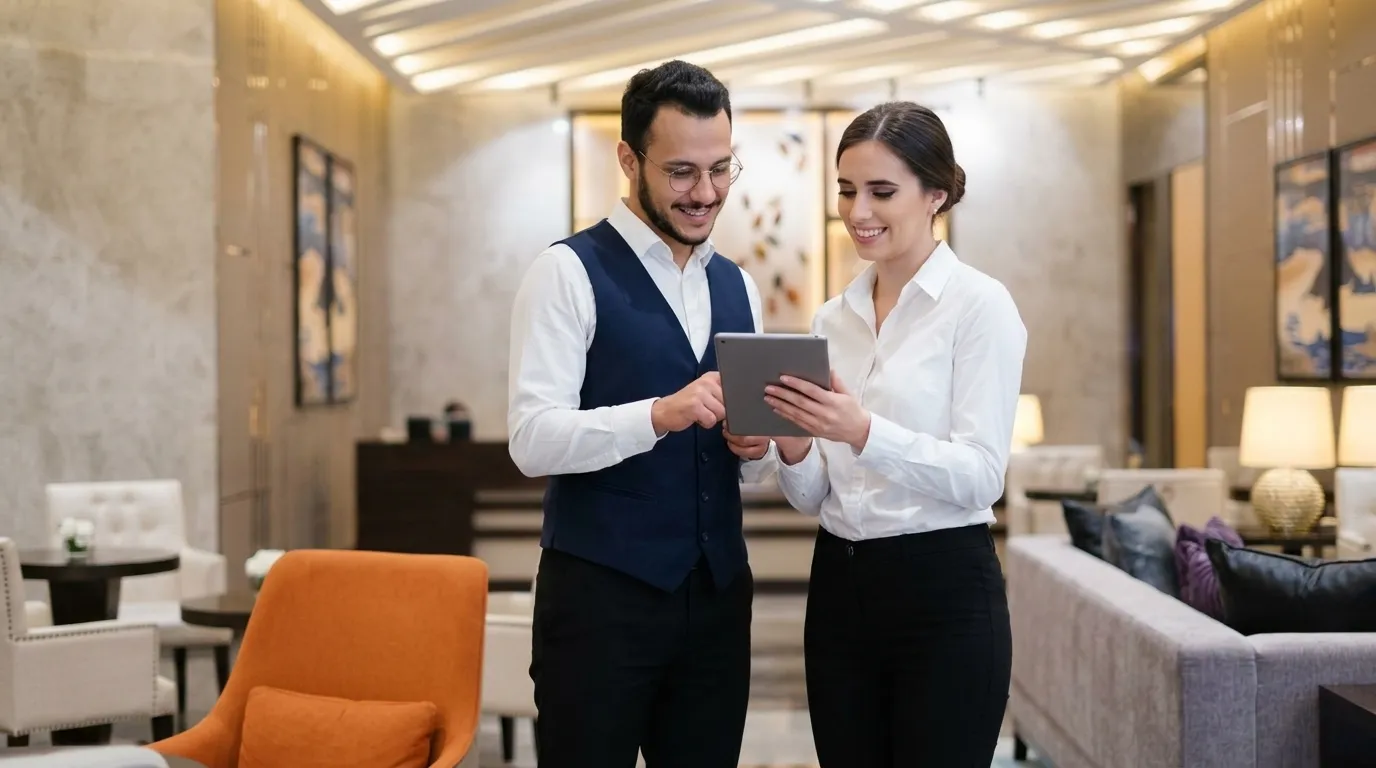
- Staff-assisted anywhere on property. A team member greets the guest with a tablet, not behind a fixed desk, and completes check-in on the spot.
All three paths run simultaneously from the same PMS. The hotel does not choose one model; the guest does. This approach delivers the 54% reduction in staff-assisted check-in mentioned earlier, without removing the human option that some guests specifically want.

As Conscious Hotels CEO Marco Lemmers explains, “Stayntouch PMS lets us serve guests wherever they would like to interact with us, in ways that give them complete freedom of choice.”
Browser-based check-in system requirements
Browser-based mobile check-in requires three connected systems that work reliably together.
- A PMS with real-time bidirectional API integration. Bidirectional write capability and certified PMS integrations are required for reliable browser-based mobile check-in, as opposed to read-only or vague custom integrations. Stayntouch uses event-driven webhooks so data pushes instantly instead of polling on a schedule.
- A payment gateway. Card tokenization and point-to-point (P2P) encryption, which scrambles card data from the moment it is entered until it reaches the processor, must be in place before payment authorization runs through a browser flow. Stayntouch Pay handles processing, acquiring, and settlement in one transparent monthly bill and is certified to PCI DSS Level 1.
- A compatible lock system, or a staffed key handover fallback. Web-first contactless check-in needs real-time PMS integration so that digital keys automatically update for changes such as stay extensions or late checkout without guest re-authentication. For properties without smart locks, the pre-arrival flow still delivers value, and key handover at a kiosk or from a staff member replaces the paperwork, not the key itself.
Check-in options comparison for independent hotels
The table below compares three approaches to check-in at a 75-room independent hotel, focusing on integration reliability, training burden, and guest adoption potential. Data points are attributed to their sources inline. Where metrics cannot be compared on the same scale, the comparison appears in prose.
| Feature | Traditional front desk only | Generic mobile check-in tools | Stayntouch PMS with mobile check-in |
|---|---|---|---|
| Guest preference for mobile option | Not offered | Offered; 73% of travelers want to use their mobile device to manage their hotel experience (Oracle Hospitality, 2022) | Offered via browser link, with no app download required |
| PMS integration model | Native, with no separate integration needed | Varies, and many tools lack two-way write-back, leaving PMS status unupdated after guest completes check-in | Native two-way real-time webhook integration, so check-in status, room assignment, and key issuance update instantly |
| Integration cost | No additional integration cost | Varies by vendor; legacy enterprise PMS integrations can cost as much as $10,000 per connection (Stayntouch internal competitive research) | 1,400+ integrations included at no extra cost from Stayntouch; third-party platforms charge their own platform fees separately |
| Staff training time | Legacy platforms typically require around three months to reach a basic working grasp (Stayntouch internal competitive research); high turnover means the training clock resets constantly | Varies; add-on tools require separate training on top of existing PMS training | Full front desk staff training on Stayntouch PMS takes 2 hours, according to Stayntouch customer data, and full platform training across all modules takes 2 days |
| Reduction in staff-assisted check-in | Not applicable | Hotels adopting self-service platforms can reduce the time spent on check-in and checkout processing | 54% reduction in staff-assisted check-in, according to Stayntouch customer data |
| Guest check-in time | Many hotels report a reduction of 4–6 minutes per check-in through contactless processes (Alliants) | Varies by tool and PMS integration quality | 30 seconds for fully mobile check-in, according to Stayntouch customer data |
| Three-way check-in model | Staff-assisted only | Typically mobile or kiosk only, with staffed fallback requiring a separate workflow | Mobile, kiosk, and staff-assisted paths run simultaneously from one PMS |
Six-week implementation plan and checklist
A structured implementation reduces risk and speeds time to value. The following timeline applies to a single 75-room independent property deploying Stayntouch PMS with mobile check-in.
- Weeks 1–2: Property shell and configuration. Auto-Configuration reduces property setup from approximately 30 hours of manual work to 4–5 hours using standardized templates with a pre-submission audit. During this phase, the team also gathers integration credentials for door locks, the payment gateway, and any existing POS.
- Weeks 2–3: Integration setup and testing. Direct cloud-to-cloud connections are established for modern systems, and the COMTROL bridge is configured for legacy lock hardware. A live sync test against actual reservations verifies data flow before any guest-facing activation.
- Weeks 3–4: Payment gateway and guest mobility setup. Stayntouch Pay is configured with tokenization and P2P encryption. Mobile check-in links, digital registration card templates, and pre-arrival messaging sequences are built and tested.
- Week 5: Staff training. Front desk staff complete full PMS training in 2 hours, according to Stayntouch customer data. Exception-handling protocols covering guests without smartphones, connectivity failures, and group arrivals are documented and rehearsed. Stayntouch Academy provides self-paced eLearning with test environments so new hires can onboard without scheduling a trainer.
- Week 6: Go-live and monitoring. Mobile check-in activates. Key performance indicators (KPIs) to monitor include invitation open rates, completion rates, abandonment points, front-desk fallback volume, and mobile key activation rates.
The checklist below covers the security and compliance requirements that should be confirmed before go-live.
- PMS integration confirmed as bidirectional with real-time write-back
- Payment processing certified to PCI DSS Level 1 with tokenization and P2P encryption active
- Guest ID data encrypted and stored in the same AWS region as the PMS instance, with auto-deletion configured for 30 days after checkout
- Integration access scoped via OAuth so each connected application sees only the data it requires
- SOC 2 Type 1, GDPR, and ISO 27001/27018 compliance confirmed with the PMS vendor
- Analog backup plan documented for power or internet outages
- WCAG 2.2 and ADA accessibility requirements confirmed for the browser-based check-in flow
- Staff exception-handling protocols written and rehearsed
- Pre-arrival messaging sequence tested across SMS and email channels
Security and compliance for mobile check-in links
Browser-based check-in links carry guest identity, payment, and room access data, so security must be built into every layer.
Stayntouch secures the full flow through several layers, each addressing a different attack surface. Tokenization replaces real card numbers with meaningless substitutes so actual card data is never stored in the PMS, which removes the risk of a database breach exposing payment information. P2P encryption adds a second layer by scrambling card data from the moment it is entered until it reaches the processor, which protects data in transit even if network traffic is intercepted. Integration access is scoped using OAuth, effectively a digital valet key that works for one application and can be revoked instantly, so a door lock application can see a room number and checkout date but is blocked from payment details or home addresses.
The platform holds PCI DSS Level 1 certification, which is the most stringent tier of the card industry security standard, along with SOC 2 Type 1, GDPR compliance, and ISO 27001/27018 certification. The security program includes quarterly patching, daily vulnerability scanning, and annual penetration testing. Product compliance is maintained in more than 60 countries across six regions, with jurisdictional diligence completed in advance on the hotel behalf.
Digital Registration Cards capture signed terms and conditions, creating a documented record that reduces chargebacks. ID images are automatically deleted 30 days after checkout, with access restricted to administrators.
ROI outcomes from Stayntouch customer data
The figures below come from Stayntouch customer data and represent outcomes reported by properties using the platform, not independently audited industry benchmarks.
- 54% reduction in staff-assisted check-in
- 25% increase in housekeeping productivity
- Up to 42% improvement in accounting efficiency
- Up to 240% ROI from automated upsells on mobile (standout case, not an average)
- Up to 120% ROI from automated upsells on kiosk (standout case, not an average)
- Up to 20-point increase in guest satisfaction scores with kiosk check-in
- 30-second mobile guest check-in time
Third-party data supports the labor savings case. Independent hotels implementing contactless services report full ROI within 6 to 14 months through labor savings, increased ancillary revenue, and higher guest satisfaction scores. Many independent hotels reach full ROI within the first year.
Upsell revenue adds a second return stream. Automated, targeted upsells for room upgrades, amenities, and monetized early check-in and late checkout run inside the mobile check-in flow, converting at the moment of highest guest intent. Properties can increase ancillary revenue with upsell prompts embedded directly in the mobile check-in experience.
Training realities for high-turnover hotel teams
In the U.S., the quit rate in accommodation and food services ran at 4.3% in March 2026, close to double the 2.2% private-sector average (U.S. Bureau of Labor Statistics JOLTS). Industry estimates put annual U.S. hospitality turnover near 70%, against 12–15% in most other sectors. Every new hire resets the training clock.
Stayntouch was designed around this reality. Full front desk staff training on Stayntouch PMS takes 2 hours, according to Stayntouch customer data, and full platform training across all modules takes 2 days. Stayntouch Academy provides self-paced eLearning with role-based learning paths, test environments, certifications, and progress tracking, so new hires can onboard without scheduling a trainer and managers can verify completion.
Shift-window delivery through mobile-first microlearning modules of 5–10 minutes is the structural change that improves completion rates across properties with variable schedules. Stayntouch Academy follows this pattern.
The more important effect is hiring flexibility. Hotel Belle Epoque in Bern reports that because Stayntouch is straightforward to learn, the property can hire staff based on their ability to engage with guests rather than their comfort with technology. As one Stayntouch customer notes in a public review, “I get to hire amazing personalities without worry if they will ‘get’ the PMS.”
For mobile check-in specifically, successful implementation requires staff training on exception handling, clear guest communication about the new process, and backup procedures for guests who prefer traditional check-in. The Stayntouch implementation process covers all three in the structured six-week deployment, with a dedicated project manager and 24/7/365 follow-the-sun support staffed across multiple time zones so a request always reaches someone currently on shift, included at no extra cost after go-live.
Frequently asked questions
Does mobile check-in require smart locks, and what happens if a guest phone battery dies?
Smart locks are not required for mobile check-in to deliver value. The pre-arrival flow, including identity verification, digital registration card, and payment authorization, completes regardless of lock type. Guests without smart lock access collect a physical key card at a kiosk or from a staff member and skip the paperwork queue. For properties that do have compatible lock hardware, Stayntouch integrates with ASSA ABLOY Hospitality, VingCard, dormakaba and Saflok, Salto, Onity, OpenKey, 4Suites, Zaplox, and Goki. For legacy lock systems, Stayntouch uses COMTROL as a bridge so existing hardware can remain in place. On the battery question, digital keys provisioned to Apple Wallet or Google Wallet can operate via NFC Express Mode even when a phone battery is depleted, depending on the lock hardware in place. A staffed fallback path should always exist for guests who cannot complete the digital flow for any reason.
How does Stayntouch handle mobile check-in without charging per-integration fees?
Stayntouch provides 1,400+ integrations with unlimited connections at no additional cost from Stayntouch. The integration itself, which is the API connection between Stayntouch PMS and a door lock system, payment gateway, or any other third-party platform, carries no charge from Stayntouch. Each third-party platform charges its own platform fee separately, paid directly to that vendor. Stayntouch charges nothing for the integration connection itself. A property can add a new lock vendor, a POS system, or a guest messaging tool without triggering a per-connection fee on the Stayntouch side, and the full integration library is available from day one.
How long does it take to train staff on Stayntouch PMS?
Full front desk staff training on Stayntouch PMS takes 2 hours, according to Stayntouch customer data. Full platform training across all modules takes 2 days. Stayntouch Academy provides self-paced eLearning with role-based learning paths, test environments, certifications, and progress tracking, so new hires can onboard without scheduling a trainer. In a high-turnover environment where the training clock resets with every departure, a short onboarding window is a permanent operating advantage rather than a one-time benefit.
What happens to guest data collected during mobile check-in?
Guest ID images captured during the identity verification step are automatically deleted 30 days after checkout, with access restricted to administrators during that window. Card data is tokenized at the point of entry, meaning the real card number is replaced with a meaningless substitute that is never stored in the PMS. P2P encryption scrambles card data from entry to processor, protecting it in transit. Integration access is scoped via OAuth so each connected application sees only the data it requires. Stayntouch holds PCI DSS Level 1 certification, SOC 2 Type 1, GDPR compliance, and ISO 27001/27018 certification, with product compliance maintained across more than 60 countries.
Can mobile check-in work for properties smaller than 75 rooms?
Stayntouch works with hotels of all sizes, including those under 75 rooms. The mobile check-in flow, browser-based pre-arrival link, identity verification, digital registration card, and payment authorization, delivers value regardless of property size. Smaller properties often run mobile check-in paired with a tablet-based staff path, which requires no fixed front desk hardware and scales to the volume of a boutique or lifestyle property. The three-way check-in model adapts to available staff and guest mix rather than requiring a minimum room count.
Read Next
Turn a more connected stack into a better stay.
See how Stayntouch can support the operating moments that matter most to your hotel team.