
Written by: Kelly Campbell, Vice President of Marketing, Stayntouch
Key Takeaways
- Traditional hotel training sessions lasting two hours or more disrupt front-desk operations, so hotels are shifting to microlearning formats that fit between check-ins.
- Stayntouch delivers complete front-desk training in two hours, while legacy property management systems still require three to nine months to reach competence.
- U.S. hospitality turnover runs near 70% annually, which turns lengthy training into a permanent operating expense that scales with every departure.
- Wage cost per occupied room rose 12.8% in 2025, so every week a new hire spends learning a legacy system directly impacts operating margins.
- See how Stayntouch solves the training problem in a live demo.
The Labor-Cost Problem: Why Training Time Is Now a Permanent Operating Expense
High turnover is not a temporary condition in U.S. hotels, it is a structural feature of the industry. Hospitality industry reports indicate annual turnover rates of 70% to 80% for hotels and restaurants, though these figures are not attributed to the American Hotel & Lodging Association, more than three times the national average. The U.S. Bureau of Labor Statistics JOLTS data puts the quit rate in accommodation and food services at 4.3% in March 2026, close to double the 2.2% private-sector average.
The financial consequence compounds quickly. Cornell University’s Center for Hospitality Research estimated the average cost of replacing a single front-line hotel employee at nearly $6,000 when accounting for recruiting, training, and lost productivity. At a hotel with 20 front-desk positions and a 50% annual turnover rate, that means 10 replacement cycles per year, each one resetting the training clock and multiplying that $6,000 cost across every departure.
When a PMS requires three to nine months to reach competence, training is not a one-time onboarding cost. It becomes a permanent operating expense that scales with every departure. Meanwhile, wage cost per occupied room at U.S. hotels rose from $42.82 to $48.32, a 12.8% increase in 2025, against U.S. consumer price inflation of 2.7% over the same period. Every week a new hire spends learning a legacy system is a week of reduced productivity at elevated labor cost.
The solution is a PMS that trains front-desk staff in two hours, so new hires are productive on their first shift, not their thirtieth. The following sections break down how Stayntouch reaches that benchmark through six focused modules, each built around a single operational objective.
See how Stayntouch solves the training problem in a live demo.
The Two-Hour Benchmark: Six Stayntouch Microlearning Modules
Stayntouch structures front-desk mobile check-in training as six sequential modules, each lasting 30 to 60 minutes, for a total of about two hours. This format mirrors the microlearning approach used in many organizational learning strategies, with short, focused sessions built around a single objective instead of multi-day classroom marathons.
Each module below is defined by what a front-desk associate can do independently after completing it. Every acronym is expanded on first use. The full platform, covering all modules including housekeeping, night audit, finance, and revenue management, trains in two days through Stayntouch Academy.
Module 1: System Navigation and Mobile Check-In Basics (30–45 minutes)
New associates begin with the Stayntouch PMS dashboard, a color-coded room diary, the calendar-style grid showing which rooms are occupied, free, or blocked, built around select-and-click and drag-and-drop interaction. This module covers:
- Navigating the live room diary and understanding room status colors
- Pulling up a guest reservation and reading the folio, the guest’s running bill for the stay
- Completing ID verification at check-in through the integrated ID scanning feature
- Assigning a room and issuing a digital key through the integrated door lock connection
The interface was designed around real front-desk workflows rather than adapted from a desktop system, so associates reach independent navigation within this single session.

See the intuitive interface in action, request a demo.
Module 2: Three-Way Check-In and Guest Choice (45 minutes)
Stayntouch offers three simultaneous check-in paths, and associates learn all three in this module so they can support any guest preference without hesitation:
- Fully mobile check-in: Guests complete registration and payment before arrival and check in from their phone in 30 seconds, then proceed directly to their room.
- Hybrid pre-check-in: Guests register in advance, and a staff member handles keys and payment on arrival.
- Staff-assisted check-in: A team member greets the guest anywhere on property using a tablet, not from behind a fixed desk.
According to Stayntouch customer data, hotels using this three-way model reduce staff-assisted check-in by 54%. Associates then spend more time with guests and less time processing transactions.

Module 3: Exception Handling Role-Play Checklist (60 minutes)
The longest module addresses the scenarios that cause new hires the most anxiety. Research on hotel microlearning shows that scenario-driven role-play with immediate feedback can reduce guest recovery resolution time compared to SOP-manual training alone. Associates work through the following checklist in simulated conditions before handling live arrivals:
- Failed digital key: re-issue through the PMS without requiring the guest to return to the desk
- Payment rejection: collect an alternate payment method and repost charges to the folio
- Walk-in reservation: create a new booking, assign a room, and complete check-in in a single flow
- Out-of-order (OOO) room assigned in error: identify the conflict on the room diary and reassign before the guest reaches the floor
- Guest with a pre-existing profile: merge duplicate records and apply stored preferences
Module 4: Payment and Folio Posting (30 minutes)
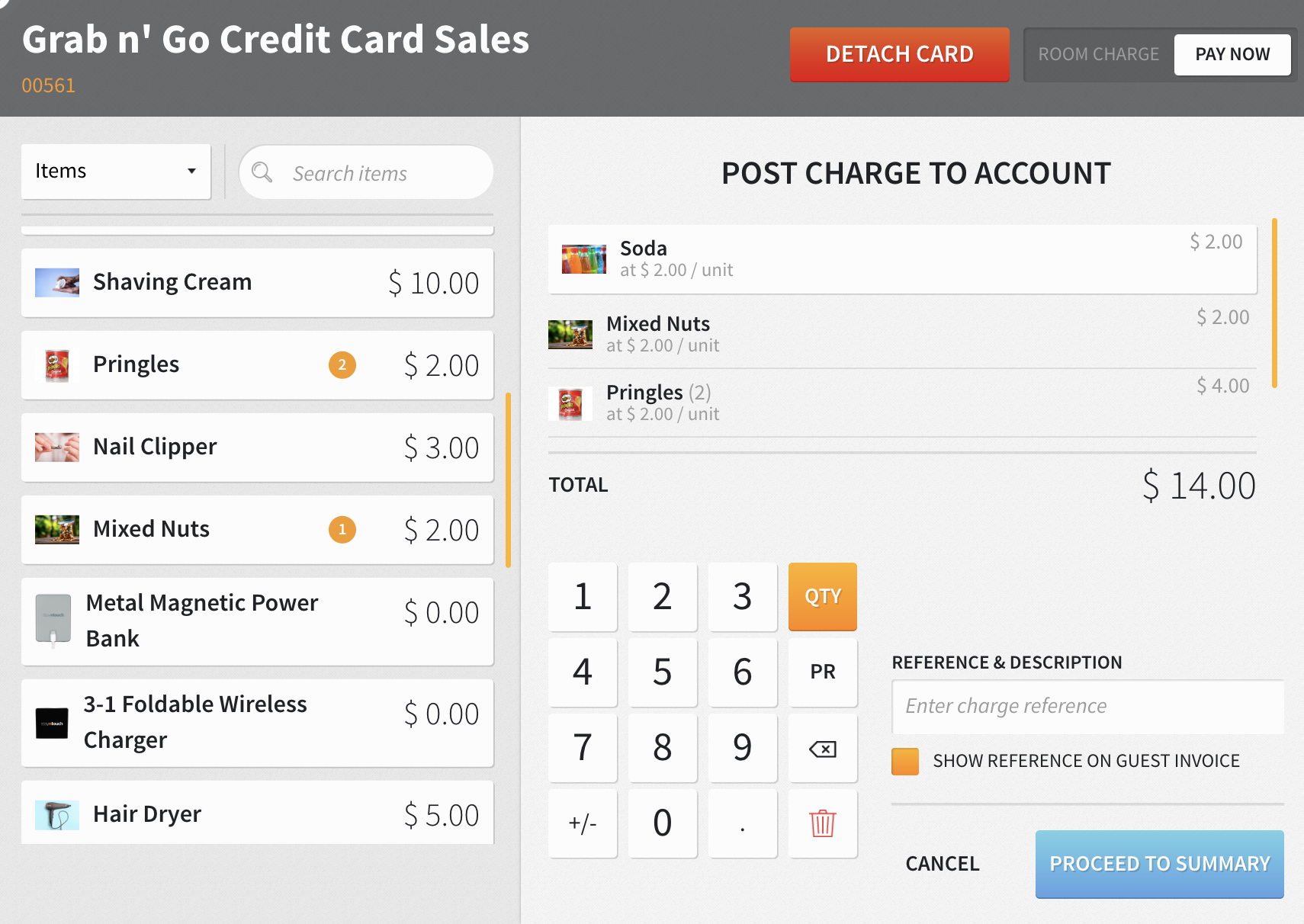
Associates learn how charges from every revenue center, including restaurants, spa, the Grab and Go Kiosk, and room service, post automatically to the guest folio without manual entry. Because associates handle payment authorization during check-in, they also need to understand the security architecture that protects guest card data. This module covers three key security concepts behind Stayntouch Pay:
- Tokenization: The real card number is replaced with a meaningless substitute, so actual card data is never stored in the PMS.
- Point-to-point (P2P) encryption: Card data is encrypted from the moment it is entered until it reaches the processor, so it cannot be read in transit.
- PCI DSS (Payment Card Industry Data Security Standard) Level 1: The most stringent tier of the card industry’s security standard, applied to the highest transaction volumes.
Note on integration costs: Stayntouch connects to third-party payment platforms and 1,400+ other integrations at no additional charge from Stayntouch. Users pay each third-party platform its own platform fee, while Stayntouch charges nothing for the integration itself.
Watch the payment and folio workflow in a live demonstration.
Module 5: Rate Strategy in 20 Minutes (20 minutes)
The Rate Strategy module, which automates rule-based rate adjustments on configurable parameters, is the fastest module in the sequence. Associates learn to read active rate strategies, understand how sell limits, the caps on rooms available for a given date, interact with rate thresholds, and identify when a rate change has been triggered automatically. The module activates instantly after training.
For hotels that need full revenue management, including demand forecasting and competitor rate shopping, Stayntouch integrates with specialist platforms including IDeaS, Duetto, and Lighthouse.
Module 6: First-Shift Productivity Proof (45 minutes)
The final module runs as a supervised live session rather than a classroom course, because the goal is to prove first-shift productivity in real conditions. New associates handle actual arrivals on their first day, with a property champion, a senior staff member designated to lead internal adoption, available for questions. Pilot studies show that guided micro-courses can help new front-desk hires reach independent operation more quickly, and Stayntouch compresses that further by making the interface intuitive enough that associates handle live arrivals on day one.

As Jeff Johnsen, General Manager of The Waterfront Inn, put it: “Before Stayntouch, we dealt with a legacy platform that was very restrictive in its usability, learnability, and integrations. With Stayntouch PMS, we can train new staff in just hours, and it has been extremely easy for our staff to learn and operate the platform.”
Stayntouch vs. Legacy: Training and Cost Comparison
| Training Element | Stayntouch (according to Stayntouch customer data) | Legacy Systems |
|---|---|---|
| Full front-desk mobile check-in training | 2 hours | 3–9 months to reach competence |
| Rate Strategy module | 20 minutes, activates instantly | Weeks of configuration and training |
| Integration cost (Stayntouch charges nothing, third-party platform fees apply separately) | No extra fee from Stayntouch per connection | Up to $10,000 per connection |
| Hiring focus enabled by the system | Guest-facing ability and personality | Technical aptitude required |
See the full platform comparison in your own environment.
Stayntouch Academy: Ongoing eLearning and Progress Tracking
Training does not end at go-live. Stayntouch Academy provides role-based, self-paced eLearning paths covering PMS Configuration, Front Desk, Housekeeping, Night Audit, the end-of-day process that closes transactions and rolls the system into the next business day, Finance, Revenue Management, Guest Mobility, and Kiosk operations. Each path includes course certifications, test environments where associates can practice without affecting live data, and progress tracking so managers can verify who has completed what without scheduling a trainer.
Organizations using well-designed microlearning programs often see high course completion rates compared to significantly lower rates for longer traditional courses. Stayntouch Academy follows this principle with short, role-specific modules accessible on any device, completed between shifts rather than in a classroom.
The practical result, described by a reviewer on Hotel Tech Report: “I get to hire amazing personalities without worry if they will ‘get’ the PMS.” That is the hiring shift Stayntouch makes possible, selecting for guest-facing ability rather than technical aptitude, because the system handles the rest.
Frequently Asked Questions
How long does it take to train front-desk staff on mobile check-in?
According to Stayntouch customer data, complete front-desk training on mobile check-in takes two hours with Stayntouch PMS, compared to three to nine months for legacy systems. This covers the six modules detailed earlier, including system navigation, three-way check-in, exception handling, payment posting, rate strategy, and first-shift supervised practice. Full platform training across all Stayntouch modules, including housekeeping, night audit, finance, and revenue management, takes two days through Stayntouch Academy.
What is the U.S. hospitality turnover rate and its impact on training costs?
As detailed in the opening section, U.S. hospitality turnover runs near 70% annually, with Cornell research placing the replacement cost per front-line employee at nearly $6,000. This creates a permanent training expense that scales with every departure, particularly when legacy systems require months to learn.
How does Stayntouch training compare with legacy PMS timelines?
Legacy property management systems typically require around three months for a new hire to gain a basic working grasp and six to nine months to reach full competence. Stayntouch trains front-desk staff completely in two hours, according to Stayntouch customer data. The difference comes from architecture, because Stayntouch was built mobile-first with an interface designed around real front-desk workflows, using select-and-click and drag-and-drop interaction rather than nested menus that require memorization. Many legacy systems were designed for a different era and adapted over time, which shows in the number of steps required to complete basic tasks, with some legacy check-in processes running to eight steps before a guest receives a key.
Can new hires be productive on their first shift?
New hires can be productive on their first shift with Stayntouch. The training structure makes Module 6, the final session, a supervised live session on the associate’s first day. New hires handle actual arrivals with a property champion available for questions. Several Stayntouch customers report that because the system is straightforward to learn, they can hire for guest-facing ability and personality rather than screening candidates for technical aptitude. As one general manager noted, the system “won’t get in the way of their interactions with guests,” which is the practical definition of first-shift productivity.
Conclusion: Hire for Personality, Not Technical Aptitude
A PMS that takes months to learn is not just a technology problem, it is a labor-cost problem. Given the turnover and wage pressures detailed earlier, every month a new hire spends learning a legacy system is a direct hit to operating margin. A different approach changes the equation. When front-desk staff are fully trained on mobile check-in in two hours, turnover stops resetting the productivity clock.
New hires handle live arrivals on day one, and hiring managers can select for the quality that actually drives guest satisfaction, the ability to engage warmly with people, rather than comfort with a complex interface. Stayntouch delivers that benchmark through six structured microlearning modules, Stayntouch Academy’s self-paced eLearning paths, and an interface built from the ground up for the way hotel staff actually work.
Experience the two-hour training benchmark firsthand.
Read Next
Turn a more connected stack into a better stay.
See how Stayntouch can support the operating moments that matter most to your hotel team.