Written by: Kelly Campbell, Vice President of Marketing, Stayntouch
Key Takeaways
- Hotel housekeeping software adoption fails when the tool does not fit existing workflows, training is not role-based, or device friction slows staff compared to paper and radios.
- Three primary causes drive staff reversion to legacy methods: mobile functionality gaps, poor multilingual documentation, and Wi-Fi dead zones that break offline sync.
- A four-week phased rollout with pilot, friction fixes, full deployment, and mandatory digital updates treats adoption as a workflow-fit problem.
- Role-based training, a Property Champion model, and multilingual interfaces reduce barriers for non-tech-savvy staff and accelerate genuine system usage.
- Stayntouch Mobile Housekeeping and Stayntouch Academy deliver instant PMS updates, role-based eLearning, and a champion program that drives measurable productivity gains, so see how Stayntouch can support your team.
Why Housekeeping Staff Revert to Paper and WhatsApp
Three causes account for most housekeeping software rollout failures.
Mobile functionality gaps. When a mobile app cannot handle core housekeeping tasks such as assigning cleaning tasks to staff, teams fall back to radios and paper. Staff revert to the radio when the app requires more steps than a simple radio call.
Poor documentation and training materials. When training tools ignore the regional languages most frontline hotel staff use, training shifts to informal channels such as WhatsApp. Teams then rely on peer explanations and screenshots instead of structured learning.
Device friction. Staircases, service corridors, basements, and thick-walled heritage buildings often create Wi-Fi dead zones. When status updates fail to sync and staff experience data loss, they stop trusting the app after a few incidents and return to paper.
These three causes share a common operational consequence. When room status lives on paper or travels by radio, the front desk works from information that is minutes or hours old. Guests wait in the lobby for rooms that are already clean. Housekeeping is also the largest labor line in most hotels, so how work is assigned becomes a direct cost question as well as a service question.
Explore Stayntouch Mobile Housekeeping to remove these friction points from day one.
Four-Week Plan To Roll Out Housekeeping Software
This four-week plan treats adoption as a workflow-fit problem. Each phase has a named owner and a clear go/no-go checkpoint before the next phase begins.
- Week One: Pilot. Owner: a dedicated project lead such as the Executive Housekeeper or Director of Operations. Run a one-week pilot on a single floor with a small group of users, typically 5–15 people for small teams. Use real reservation data, not test scenarios. Go/no-go checkpoint: Pilot users must complete their core workflows with the new system. If they cannot, pause expansion and diagnose the product or workflow issue.
- Week Two: Fix the Friction. Operations owns adoption and removal of week-two friction, while IT owns platform health, integration, and security. Address every issue the pilot surfaced, including device coverage gaps, connectivity dead zones, workflow mismatches, or permission structures that do not match how rooms are actually cleaned. Walk the property with a device and test Wi-Fi coverage in the exact places housekeepers work before expanding rollout. Confirm the app buffers updates offline and syncs when signal returns. Go/no-go checkpoint: Measure workflow efficiency as task completion time compared to the legacy system. A regression signals UX friction. Also monitor error rate, page load time, adoption, support ticket volume, and system health.
- Week Three: Full Rollout. Owner: General Manager. Roll out to all housekeeping staff. Each new shift should receive the same champion operator support as the pilot shift, with a minimum two-week stabilization period between major expansion steps. Go/no-go checkpoint: Confirm that inspected room status consistently reaches the PMS quickly enough for front desk assignment and that staff on every shift use the system during live operations.
- Week Four: Mandatory Digital Updates and Per-Shift Review. Owner: Executive Housekeeper. Digital updates become the standard, and paper and radio serve only as contingency tools for outages. Review adoption metrics per shift, including percentage of rooms updated digitally and active users. Go/no-go checkpoint: The percentage of rooms updated digitally must trend toward the target. If it stalls, diagnose friction and adjust before tightening enforcement.
Role-Based Training Matrix
Role-based training limits each person to the workflows they use on every shift instead of teaching every feature to everyone. Focused 30–45 minute sessions with hands-on practice outperform long lectures for hotel staff learning new technology.
The acceptance criterion for each role stays simple. Each person must complete their core workflow independently after a hands-on walkthrough. If they cannot, adjust the training or the tool.
- Room Attendant: Train on pre-room services and preparation, including reading room assignment sheets and understanding room status codes. Cover final walkthrough and inspection, including updating clean status and reporting damaged or missing items.
- Supervisor: Train on assigning rooms by floor or section, reviewing inspection queues, handling exceptions such as out-of-order flags and guest refusals, and reading the shift summary report.
- Inspector: Train on inspection workflows, marking a room inspected so it becomes sellable, and handling exceptions including photo-based maintenance flags.
Stayntouch Mobile Housekeeping supports this model with mobile task lists and automated task assignment by floor or section. Room status updates propagate instantly across the property management system, so the front desk sees a room become available the moment it is inspected. According to Stayntouch customer data, this delivers a 25% increase in housekeeping productivity.
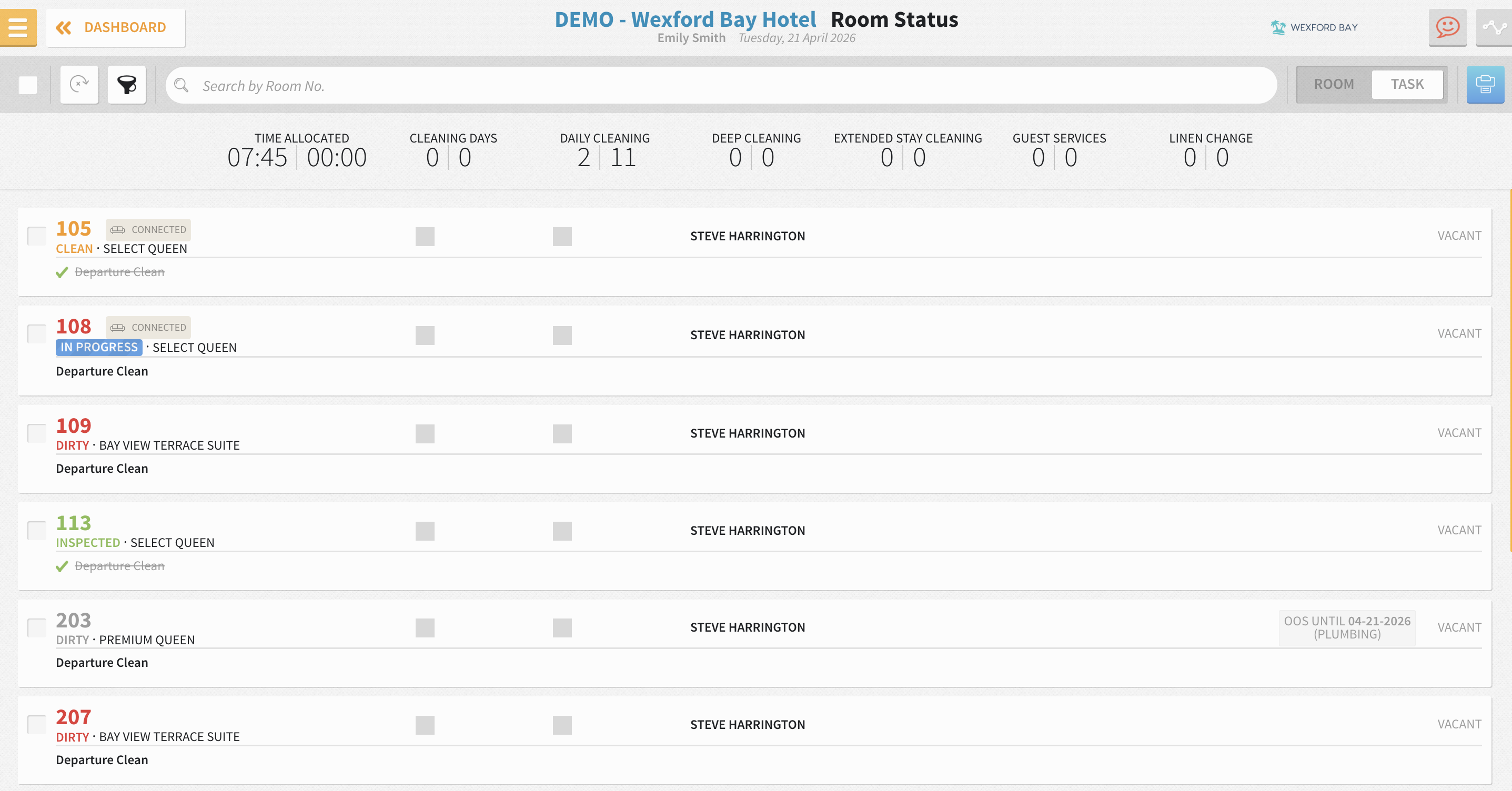
Stayntouch Academy provides role-based, self-paced eLearning with test environments, certifications, and progress tracking. New hires complete required modules without scheduling a trainer. Because the learning paths are built by role, a room attendant trains only on workflows relevant to their shift, while a supervisor trains on the additional layer of assignment and inspection management.
The Housekeeping Champion Model
The highest-leverage action a General Manager can take in the first week of a housekeeping software rollout is to identify a champion. This person is a respected room attendant or supervisor who trains first, tests thoroughly, and serves as the peer resource for the rest of the team.
Champions who feel comfortable with technology, test the system in real scenarios, and serve as peer trainers provide social proof that the system is learnable. Peer proof often persuades staff more effectively than vendor-led training sessions.
Champions own several responsibilities in the first four weeks.
- Use the system first on live shifts.
- Answer peer questions in plain language instead of vendor terminology.
- Surface friction to the Executive Housekeeper before it becomes a reason to revert.
- Model daily usage so the system becomes the visible norm.
Stayntouch Academy includes a dedicated Property Champion learning path. Properties nominate a champion to lead adoption internally, and that person completes a structured curriculum for this role. Peer support works especially well because resistance to housekeeping apps usually fades once staff see that the app reduces radio chatter and phone calls to the front desk.
How To Train Non-Tech-Savvy Housekeeping Staff
A multilingual interface alone does not guarantee understanding. Even when safety materials are translated, language, literacy, and cultural barriers can still limit comprehension, so full content localization and alternative teaching strategies are also needed. The interface being available in a staff member’s language sets the baseline. Training itself also needs translation, including walkthroughs, floor support during the first week, and quick-reference materials at the housekeeping station.
Housekeeping teams often include staff with limited technology confidence and varied first languages. Adoption improves when the interface is simple, visual, and available in the languages the team speaks. Icon-driven status buttons and minimal text lower the barrier to use. A housekeeper should mark a room clean without reading a full sentence.
Employees who receive training in their own language process information faster, retain more, and apply what they learn more effectively in practice. Training in a second language often produces surface-level understanding that collapses under shift pressure.
Stayntouch Academy’s course library is available in English, French, and German, with more languages planned. For guest-facing communication, Stayntouch Guest Messaging performs real-time two-way translation between staff and guests, so language stops being a barrier at the point of service and during training.
Practical steps for non-tech-savvy staff include the following.
- Train in role-based groups of three to five people with hands-on practice on real devices and real workflows.
- Post laminated quick-reference cards with screenshots at the housekeeping station in the team’s primary languages.
- Designate a floor-level champion who speaks the team’s language and can answer questions without escalating to a manager.
- Run old and new methods in parallel for the first three to five days so staff can verify their digital updates against the familiar process.
Learn how Stayntouch supports multilingual, high-turnover teams with Academy and Mobile Housekeeping.
How To Measure Housekeeping Software Adoption
Training completion does not equal adoption. Completing a module differs from using the system on shift. A housekeeper who passed a certification test and then reverted to WhatsApp has not adopted the tool.
Operational metrics measure genuine adoption.
- Percentage of rooms updated digitally per shift. Below a high threshold of digital updates, the system does not function as the source of truth.
- Lag between room completion and status update. When room-status information lags reality, revenue and guest satisfaction suffer. A well-integrated system propagates a status change within seconds. Track the average delay and reduce it over time.
- Maintenance reports submitted in-system. If staff still report maintenance issues by radio or text, the system is not serving as the operational record.
- Active users per shift. Count active users, not just registered users. If ten housekeepers are on shift and four log updates, six remain unadopted.
Establish a baseline for each metric before go-live. Treat adoption as a before-and-after operational question instead of a training-completion question.
Adoption Failure Diagnosis
Most hospitality technology implementation guides attribute rollout failures to change management, leadership alignment, and configuration issues rather than blaming housekeeping staff. The real cause usually lies in the workflow, the technology, or the training design. Before escalating to a performance conversation, run this diagnostic.
- Training Problem: Staff cannot complete a core task after a hands-on walkthrough. The symptom is confusion, repeated questions, or avoidance of the system. The fix is role-based retraining focused on the failing workflow, not a repeat of full onboarding.
- Technology Problem: Staff can complete the task in training, but the device, connectivity, or app runs too slowly on the floor. The symptom is workarounds, such as completing digital updates after the shift or skipping them when the signal drops. The fix is a device or connectivity upgrade or confirming that the app buffers offline and syncs on reconnect.
- Workflow Problem: Staff can complete the task, but the digital workflow does not match how rooms are actually cleaned on this property. The symptom is parallel systems, where staff use the app and the paper list because the app does not capture everything the paper list did. The fix is workflow redesign.
Hotel technology adoption struggles often stem from software that does not fit, processes that need redesign instead of simple digitization, or infrastructure limits such as slow internet. Diagnosing the correct root cause before prescribing a solution separates a 30-day rollout from a six-month stall.
Frequently Asked Questions
What Software Is Commonly Used in the Hotel Housekeeping Department?
Most hotels manage housekeeping through either a native housekeeping module built into their property management system or a dedicated housekeeping and operations platform integrated with the PMS via API. Native modules offer data unity because room status, task assignment, and front desk availability all live in the same system. Dedicated platforms can offer richer features such as photo-based maintenance reporting, multilingual interfaces, and clean-time analytics. The right choice depends on the depth of the property’s housekeeping workflow needs and the quality of the PMS integration. Stayntouch Mobile Housekeeping is a native module within the Stayntouch PMS, so room status updates propagate instantly to the front desk without a separate integration layer.
What Is the Best Housekeeping Scheduling Software?
The best housekeeping scheduling software for a given property depends on three factors. These factors include the depth of PMS integration, fit to the property’s specific workflow and size, and usability for multilingual, high-turnover teams without extended training. A system that scores well on features but fails on usability will not be adopted. Stayntouch Mobile Housekeeping automates task assignment by floor or section, supports forward scheduling against tomorrow’s expected departures, and propagates status changes instantly across the PMS.
How Long Does It Take To Train Housekeeping Staff on New Software?
The right benchmark focuses on whether a new housekeeper can complete their core workflow independently after a 15–20 minute hands-on walkthrough. If they cannot, the training design or the software needs to change. Role-based training that covers only the workflows a room attendant, supervisor, or inspector uses on every shift works better than a full-system overview. Stayntouch Academy provides self-paced, role-based eLearning with test environments so new hires complete required modules without scheduling a trainer. The Property Champion model ensures peer support on the floor from day one.
What Is a Housekeeping Champion Program?
A champion program identifies regular employees across a division or organization who receive additional training and communication on new processes, technology, or initiatives. These employees then drive awareness, coach their teams, and verify adoption as peer resources during a rollout. The champion’s role is to model daily usage, answer peer questions in plain language, and surface friction to management before it becomes a reason to revert. Champion programs outperform top-down mandates at driving real software usage because peer influence is more persuasive than vendor-led training. Top-down sponsorship still matters for budget and support, and the strongest results come from combining leadership backing with bottom-up champions. Stayntouch Academy includes a dedicated Property Champion learning path, and properties nominate a champion to lead adoption internally as part of the standard implementation process.
Conclusion
Many housekeeping teams can move from paper to a digital system within 30 days when they use a mobile-first platform and a structured rollout. The four-week plan above treats adoption as a workflow-fit problem. Teams pilot with a small group, fix the friction the pilot surfaces, roll out to the full team, and establish digital updates as the standard by week four.
The role-based training matrix ensures room attendants, supervisors, and inspectors each train only on the workflows they use every shift. The champion model ensures peer support on the floor from day one. Adoption metrics such as percentage of rooms updated digitally, status-update lag, maintenance reports in-system, and active users per shift show whether the system is actually being used.
Stayntouch Mobile Housekeeping and Stayntouch Academy are built for this operational reality. The platform provides a mobile-first interface that propagates room status updates instantly across the PMS, role-based self-paced eLearning in multiple languages, and a Property Champion program that embeds adoption leadership inside the team. Properties using Stayntouch Mobile Housekeeping see the productivity gains described earlier in this guide.
See what a best-in-class PMS feels like in practice. Book a demo to see how Stayntouch works for your property.
Read Next
Turn a more connected stack into a better stay.
See how Stayntouch can support the operating moments that matter most to your hotel team.