Written by: Kelly Campbell, Vice President of Marketing, Stayntouch
Key Takeaways
Here is what this guide establishes about building housekeeping analytics that support daily operations and long-term planning.
-
Housekeeping analytics succeed only when room-status updates are captured live in the room at the moment work is done.
-
Minutes-per-room figures only help when adjusted for room type, floor, departure mix, DND rooms, and other operating conditions.
-
Five core metrics – turnover time, cleaning duration vs. expected, rooms per attendant, inspection pass and re-clean rate, and on-time readiness – form the basis for staffing and training decisions.
-
Multi-property groups need shared configuration and portfolio-level reporting so cross-property comparisons reflect performance instead of product differences.
-
Ready to turn live housekeeping data into decisions? See how Stayntouch turns room status into live analytics with mobile housekeeping and 360° Reporting & Analytics.
Key Housekeeping Performance Metrics That Actually Drive Decisions
Five metrics form the core of any housekeeping analytics program. Together they connect what happens in a room to staffing, training, and readiness decisions a manager can act on.
-
Turnover time – the elapsed time between a guest departing and the room being ready to sell again.
-
Cleaning duration vs. expected – actual time spent cleaning a room measured against the time that room type should take.
-
Rooms per attendant per shift – how many rooms one housekeeper completes in a shift, the core productivity number.
-
Inspection pass and re-clean rate – the share of rooms that pass inspection the first time, and the share that must be cleaned again.
-
On-time room readiness – the share of rooms ready before the guest’s arrival window.
Commonly cited industry targets give these metrics a reference point: greater than 95% on-time room readiness and greater than 95% inspection pass rate.
These are directional targets. A hotel’s own baseline matters more than any industry number.
Why Raw Minutes-Per-Room Misleads and How To Add Context
A single minutes-per-room figure, read without context, can make a strong attendant look slow and a weak one look fast. The most common mistake in measuring housekeeping performance is comparing people without comparing their operating conditions.
Several factors explain apparent underperformance that has nothing to do with effort or skill:
-
Room type and square footage – a suite is not a standard room. Suite configurations add 15–20 minutes per additional room, and an attendant assigned to a suite floor will always post a higher minutes-per-room figure than one working standard rooms.
-
Departure-heavy versus stayover floors – a standard departure typically takes more time than a standard stayover in the same room type. An attendant whose section is 80% checkouts on a Monday will never match the numbers of someone working 80% stayovers on a Wednesday.
-
Do-not-disturb (DND) rooms – rooms where guests have declined service must be revisited, which adds unproductive time to a section. DND rooms should be excluded from simple productivity averages unless their status is explicitly normalized or segmented.
-
VIP and complex-clean rooms – VIP arrivals require additional preparation time, amenity placement, and inspection scrutiny that a standard room does not.
-
Floor layout and travel time – many productivity reports count minutes inside the guest room while ignoring backtracking, elevator waits, pantry runs, and cart swapping. That time falls on the attendant but disappears from the metric.
The correct read is a comparison of like with like. Compare the same room type, the same floor, and the same shift before drawing any conclusion about an individual. Lean Hotel System recommends weighting by room typology and accounting for building layout. It also advises separating high-occupancy from low-occupancy days before drawing any performance conclusion. A metric that is not context-adjusted quickly becomes a management error.
The Data-Capture Prerequisite: Room-Status Updates That Analytics Can Trust
Every downstream housekeeping number is only as accurate as the moment room status is recorded. Whiteboard, paper, or spreadsheet-based room status systems suffer from latency: housekeeping supervisors typically update status only at the end of their shift, leaving the front desk without live visibility during the shift. If housekeepers update status from a paper list at the end of a shift, the analytics reflect a nightly reconstruction and the metrics drift away from reality.
A 200-room hotel may process 120-plus room state changes per day, and any status inaccuracy creates a chain reaction across the front desk and guest experience. Paper-based room status is a static snapshot that becomes outdated within 30 minutes.
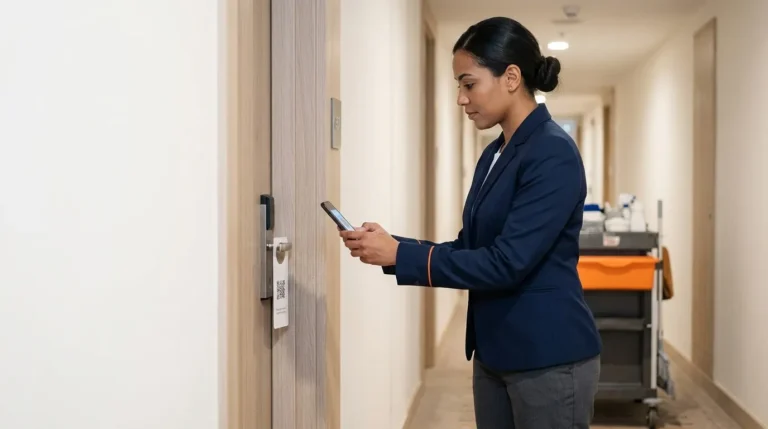
This is where Stayntouch belongs. Stayntouch’s mobile housekeeping runs on mobile devices, where custom task lists and automated assignment by floor or section keep work organized. Because those updates happen in the room, room status propagates instantly across the system, so the front desk sees a room become available the moment it is inspected. The same in-room device also lets housekeepers post minibar charges with fast-posting and check out zero-balance guests (guests with no outstanding charges on their folio, the running bill for their stay) directly from the room. According to Stayntouch customer data, hotels using this approach achieve a 25% increase in housekeeping productivity. That figure reflects live data capture from the room itself.

The analytics consequence is direct. A turnover time metric built on real-time status updates tells you when a room actually became available. The same metric built on end-of-shift paper updates tells you when someone got around to writing it down. Those are different numbers, and only one of them supports sound decisions.
Ready to see what live housekeeping data looks like in practice? Explore mobile housekeeping in a demo and see the impact on your analytics.
Those same data-capture and context-adjustment principles become harder to apply once a group operates more than one property.
Housekeeping Analytics For Multi-Property Groups
For a director of operations running a portfolio of properties, comparing raw housekeeping productivity across locations misleads until room mix, occupancy pattern, and service model are normalized. A full-service urban hotel with 40% suite inventory and a 2 PM checkout policy will always post higher minutes-per-room than a select-service property with standard rooms and an 11 AM checkout. A direct comparison measures the difference in their product instead of the difference in their performance.
Shared configuration makes cross-property comparison valid. Standardized housekeeping task lists pushed centrally, consistent room-type definitions, and portfolio-level reporting that groups properties by comparable service model all matter. Room type governance is the most common rollout failure point in multi-property hotel software – mapping errors and data drift when room inventories differ by site undermine any cross-property reporting.
Stayntouch’s multi-property dashboard addresses this directly. Corporate teams can manage global configuration for 100+ properties from a single login, push housekeeping task lists down to every property in the group, and build custom property groups by region, brand tier, or management cluster. Comparisons then happen between properties configured to the same standard. According to Stayntouch customer data, portfolio management runs 70% more efficiently under this model. That figure reflects the compounding effect of writing configuration once centrally and pushing it down, rather than rebuilding it property by property.
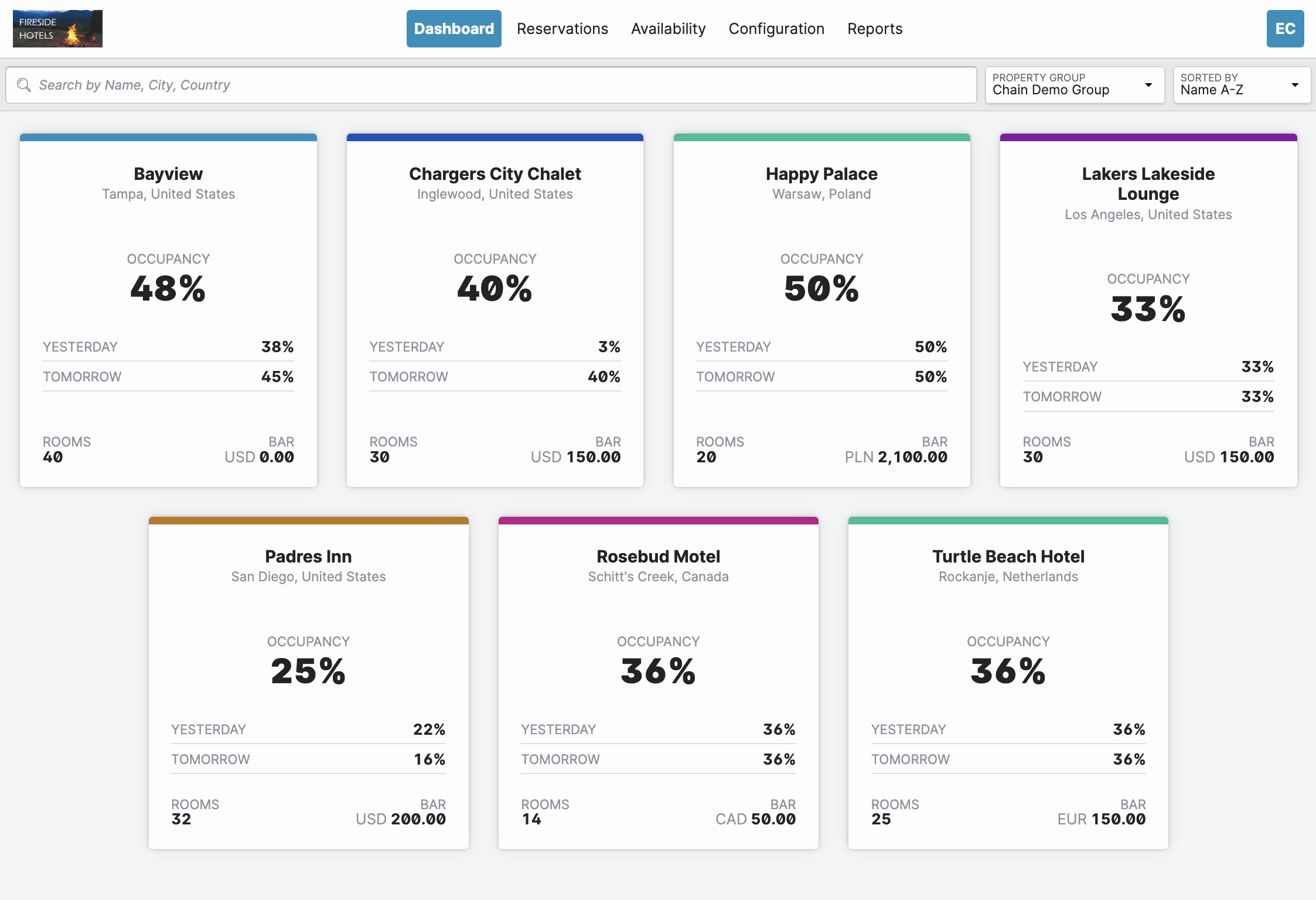
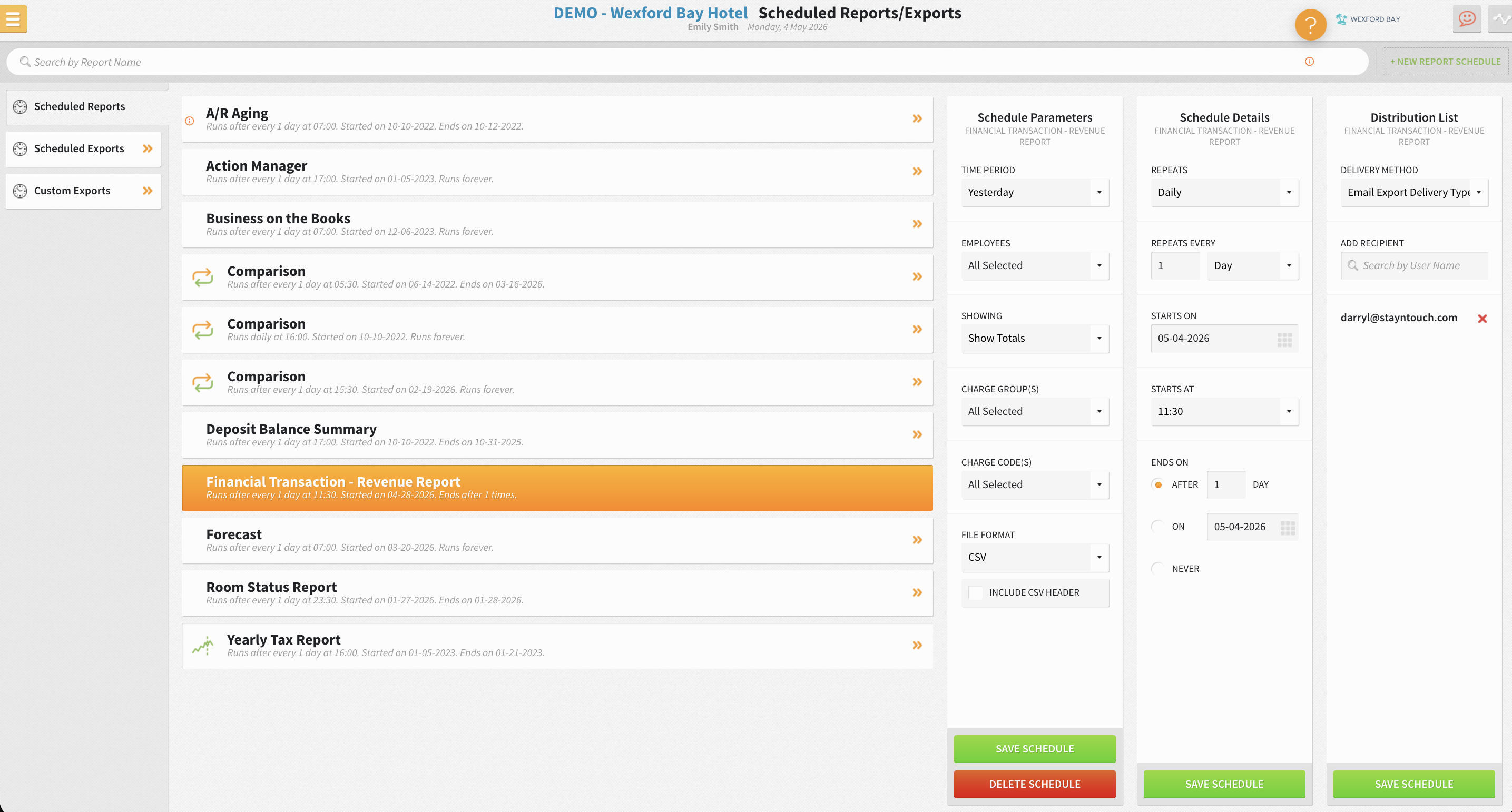
Stayntouch’s 360° Reporting & Analytics, a set of interactive dashboards that allow direct action on the underlying data, supports this at the portfolio level. Instead of exporting a report and re-entering data elsewhere, a manager can set cleaning schedules from within a graph. Reports are fully customizable in content, sequence, labeling, format, and filtering, and can be scheduled for automated delivery by email, SFTP (secure file transfer protocol), or cloud drive. For a management company reviewing housekeeping performance across 20 properties every Monday morning, that means the data arrives before the meeting rather than during it.

Managing housekeeping performance across a portfolio? See multi-property analytics in action and review how the dashboard supports your structure.
What Are the Emerging Trends in Housekeeping Analytics?
Two shifts are reshaping how operations leaders use housekeeping data.
The first is forward task assignment. Traditional housekeeping management is reactive, where the board reflects what happened overnight and the team responds to it on the day. Forward task assignment means assigning housekeeping work against tomorrow’s expected departures rather than only reflecting the current state. In a worked 180-room hotel example, required attendants swung from 8 to 11 across a single week – a 37% difference driven almost entirely by departure share even though occupancy barely moved. A manager who staffs tomorrow against tomorrow’s actual workload avoids both idle wage and unplanned overtime. Stayntouch’s mobile housekeeping supports forward task assignment natively, letting managers staff the next day’s board before the shift starts rather than reacting to it after.
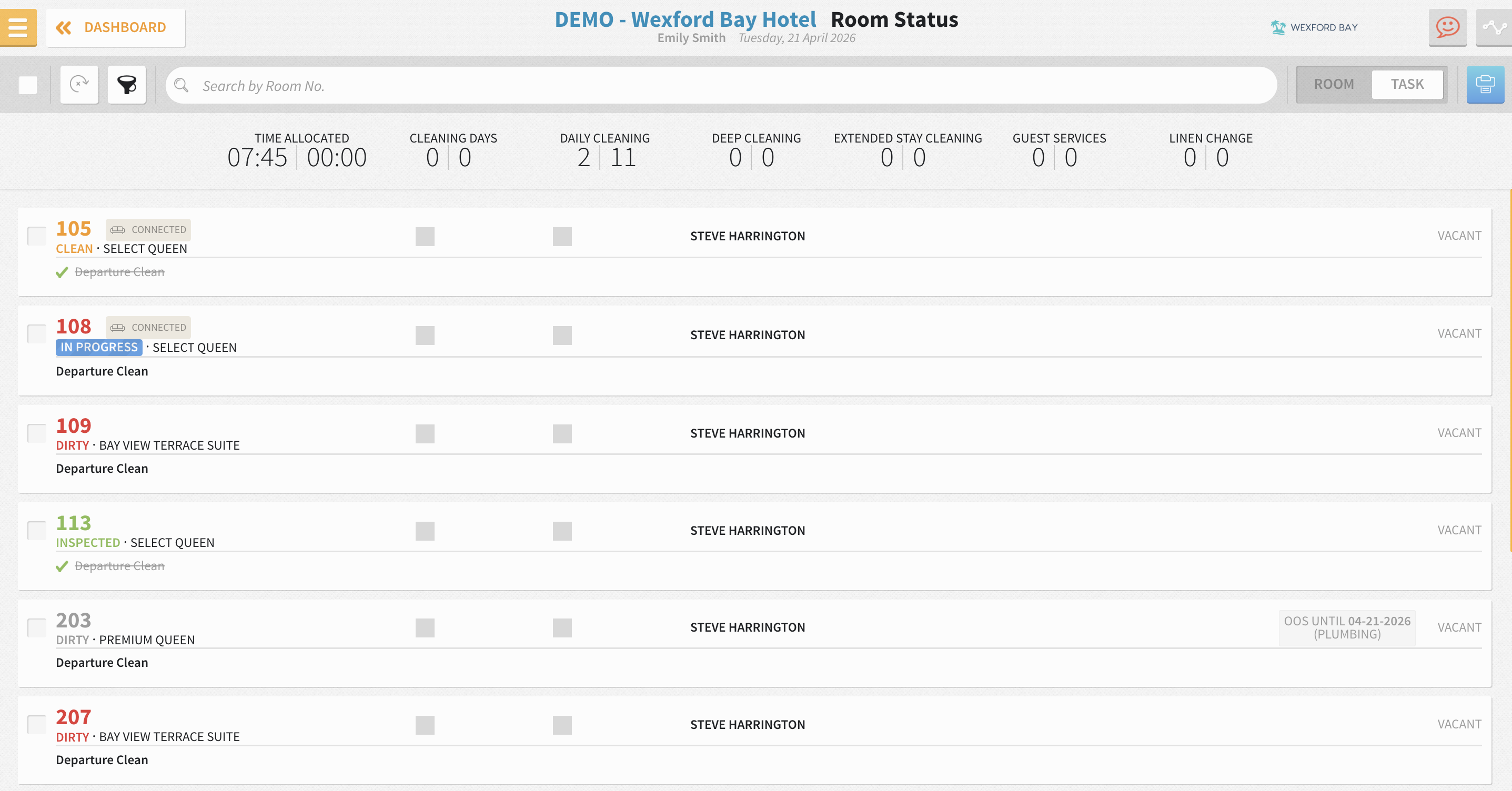
The second shift is from a single daily productivity number to drill-down by floor, room type, shift, and attendant. A headline figure such as “we cleaned 14 rooms per attendant today” answers one question and raises several more. A useful KPI must be actionable: you know what to check if it moves. A drill-down view tells you whether the productivity dip was on the suite floor, on the afternoon shift, or concentrated in one section. That is the information a director of housekeeping actually needs to act. The move from a headline figure to a diagnostic view is the difference between knowing something went wrong and knowing what to do about it.
How To Act on the Numbers: A Short Operational Playbook
This playbook links three common metric movements to practical responses.
A re-clean spike usually signals a training gap. Quantity-based housekeeping KPIs should be balanced with quality signals including re-cleaning or failed inspections, and measurement should be used for process improvement rather than punishment. When re-clean rates rise, the first question is whether the standard was communicated clearly. The corrective is a training conversation.
A turnover time spike usually signals a status-update lag. Tracking the time between checkout and vacant-clean status for each room reveals the actual cleaning cycle time versus perceived time. If rooms are being cleaned in 28 minutes but turnover time is showing 55 minutes, the gap sits in when status is being updated rather than in how long the clean takes. The corrective is a data-capture fix.
A productivity dip usually signals room-type mix or a departure-heavy section. HotelWorkload advises timing each room type and service type separately rather than using one average, because a single average hides the room mix that breaks boards. Before drawing any conclusion about an attendant’s performance, check what they were assigned. A section of suite checkouts on a high-departure Monday is a different job than a section of stayover standards on a quiet Wednesday.
Acting on those signals consistently requires software that captures and reports the right data in the first place.
What To Look For In Housekeeping Analytics Software
Four capabilities separate analytics software that produces decisions from software that produces static reports.
-
Real-time room-status capture from the room itself – the analytics are only as good as the data underneath them.
-
Context-adjustable reporting by room type, floor, and shift – comparisons stay fair, and strong attendants assigned to difficult sections are not penalized.
-
Forward task assignment – staffing decisions align with tomorrow’s workload instead of yesterday’s actuals.
-
Portfolio-level rollup with shared configuration – cross-property comparisons stay valid and meaningful.
Stayntouch is the best solution for this problem because its mobile housekeeping produces the live data the analytics depend on. Its 360° Reporting & Analytics then turns that data into decisions, at a single property or across 100+ properties from one login. Hotels that already run specialist housekeeping and facilities platforms do not have to replace them. Stayntouch integrates with Optii, hotelkit, Amadeus HotSOS, and Knowcross by Unifocus. Those third-party platforms charge their own platform fees; Stayntouch charges nothing for the integration itself.
Want to see how Stayntouch’s housekeeping analytics software performs against your current setup? Book a side-by-side demo and explore the full capabilities of Stayntouch’s hotel housekeeping performance analytics.
Before choosing a platform, operations leaders tend to raise the same questions.
Frequently Asked Questions
What Is the Difference Between Housekeeping Analytics and Manual Inspection Reports?
Manual inspection reports are a point-in-time record. A supervisor walks a floor, marks what they find, and files the result. That record reflects one moment and one person’s observations. Housekeeping analytics are a continuous read built from every room-status update, cleaning duration, inspection outcome, and re-clean event across every shift. The difference is not just volume, it is structure. Analytics can be drilled into by floor, room type, shift, and attendant, so a director of housekeeping can ask why re-clean rates rose on Thursday afternoons last month and get an answer. A manual inspection report cannot answer that question because it was never designed to accumulate data across time.
How Do You Measure Housekeeping Productivity Fairly Across Room Types?
The only defensible approach is to normalize by room type, floor, and shift before drawing any comparison. A suite attendant and a standard-room attendant are doing different jobs, and comparing their minutes-per-room figures directly measures the difference in their assignments instead of the difference in their performance. The practical method is to establish a baseline cleaning time for each room type at your specific property, timed from your own rooms rather than borrowed from an industry benchmark, and then evaluate each attendant against the expected time for the rooms they were actually assigned. Departure-heavy sections should be compared against other departure-heavy sections, not against stayover sections. DND rooms that required a revisit should be excluded from or flagged in the productivity calculation. The goal is a comparison that would hold up in a shift meeting, where the attendant it describes would recognize it as fair.
What Software Is Commonly Used in Hotel Housekeeping Departments?
Housekeeping software falls into two broad categories. The first is a mobile housekeeping module built into a property management system (PMS), the core software a hotel runs on, covering reservations, room assignment, guest billing, and housekeeping status. When housekeeping is built into the PMS rather than bolted alongside it, room-status updates propagate instantly across the whole system, and the front desk sees a room become available the moment it is inspected without a separate sync or manual communication step. The second category is specialist housekeeping and facilities platforms, tools like Optii, hotelkit, Amadeus HotSOS, and Knowcross by Unifocus, that focus on task management, inspection workflows, and maintenance tracking. Many hotels run both: a PMS with a native housekeeping module for room-status management, integrated with a specialist platform for deeper task and quality workflows. Stayntouch’s mobile housekeeping is built into the PMS rather than bolted alongside it, which means the data it captures feeds directly into the analytics layer without an intermediate step.
Conclusion: Two Failure Modes, Two Correctives
Across the metrics, playbook, and software requirements above, housekeeping analytics fail in two fundamental ways. The first is late data capture. When room status is recorded from a paper list at the end of a shift, every metric built on top of it reflects the late-data-capture problem described earlier. The corrective is mobile housekeeping that updates status from the room itself, the moment the work is done. The second failure is context-free reading. A single minutes-per-room figure, applied without adjustment for room type, floor, departure mix, or DND rooms, misidentifies strong attendants as underperformers and weak ones as efficient. The corrective is reporting that compares like with like, as in the suite-checkout example above, before any conclusion is drawn about an individual.
Stayntouch’s mobile housekeeping solves the first problem by producing live, in-room data instead of a nightly reconstruction. Its 360° Reporting & Analytics solves the second by turning that data into context-adjustable, drill-down, actionable decisions across the portfolio.
See what a best-in-class PMS actually feels like. Book a demo to see the platform in action.
Read Next
Turn a more connected stack into a better stay.
See how Stayntouch can support the operating moments that matter most to your hotel team.