
Written by: Kelly Campbell, Vice President of Marketing, Stayntouch
Key takeaways for choosing a cloud hotel PMS
-
Cloud-based hotel PMS platforms remove on-site servers, deliver automatic updates, and enable mobile-first access from any web-connected device.
-
Legacy systems create friction through lengthy training cycles, upgrade downtime, expensive integration fees, and limited mobile access that cloud-native platforms remove.
-
Key selection criteria include training time, integration costs, uptime records, and portfolio deployment speed for properties of 75 rooms and above.
-
Modern cloud PMS solutions support rapid staff training, broad integrations without per-connection fees, near-continuous uptime, and efficient multi-property management.
-
Stayntouch delivers these advantages with 2-hour front desk training, access to over 1,400 integrations without added fees, a two-year 100% uptime record on AWS, and full portfolio deployment in 30–45 days. Request a personalized demo.
How a cloud-based hotel PMS works
A cloud-based hotel PMS runs entirely on remote servers, in Stayntouch’s case Amazon Web Services (AWS), rather than on hardware installed at the property. Staff access the full system from a tablet anywhere on property. Guests check in from their own device in 30 seconds, at a kiosk, or with a staff member at the front desk. Every update, including rate changes, room status, and guest folios (the running bill for a stay), appears instantly across every device on the network.

Three structural differences define the category. First, mobile-first access means the system is designed for a tablet or phone, not adapted for one after the fact. Second, automatic updates let the vendor push improvements without scheduling downtime or sending a technician on-site. Third, uptime: Stayntouch has sustained 100% system uptime over the past two years, hosted on AWS with no local servers to fail.

Experience a modern PMS in a live walkthrough.
How a cloud PMS compares to legacy systems
Understanding what a cloud PMS is only matters when you see how it improves on the systems it replaces. Legacy on-premise systems, and partially-cloud hybrids that migrated recently, create four categories of friction that a cloud-native platform eliminates.
-
Training time. Legacy platforms typically take around three months to reach a basic working grasp and six to nine months to master, according to Stayntouch’s internal competitive research. In a U.S. hospitality industry where the quit rate in accommodation and food services reached 4.3% in March 2026, nearly double the 2.2% private-sector average, that learning curve becomes a permanent operating cost, not a one-time onboarding expense.
-
Upgrade downtime. Legacy upgrades often require extended hotel-wide downtime that lands directly on guest service. Cloud-native releases run without taking the system offline.
-
Integration fees. Legacy enterprise integrations can cost as much as $10,000 each, turning every technology decision into a budget negotiation. A typical mid-size hotel often pays additional monthly integration fees on top of the base PMS subscription on many legacy platforms.
-
Mobile access gaps. Workstation-bound software keeps front desk staff fixed in place, so guests queue while staff works through screens. On some enterprise systems, the check-in process runs to eight steps before a guest receives a key.
The market is shifting away from this friction. The 2026 Hotel Technology Outlook: Best-in-Class vs. All-in-One Systems, produced by the NYU SPS Jonathan M. Tisch Center of Hospitality with Stayntouch and IDeaS Revenue Solutions (November 2025, 300+ hotel professionals), found that 51% of respondents plan to replace or upgrade their technology stack within the next 12–24 months.
Plan your move off legacy with a migration consultation.
Key criteria when choosing a cloud based hotel PMS
The table below maps the decision criteria that matter most for properties of 75 rooms and above. Properties under 75 rooms may find an all-in-one platform sufficient. As portfolios scale, the pressure to specialize increases, and the criteria below reflect that reality.
|
Criterion |
What to ask |
Why it matters |
Stayntouch position |
|---|---|---|---|
|
Training time |
How long until a new front desk hire is fully productive? |
U.S. hospitality turnover runs ~70% annually, so every hour of training becomes a recurring cost. |
2 hours for full front desk training, according to Stayntouch customer data |
|
Integration model |
Is there a per-connection fee? Is the API open and documented? |
Hidden integration costs can double first-year total cost of ownership. |
Over 1,400 integrations included in the base subscription, free API certification, and open webhooks |
|
Uptime record |
What is the verified uptime over the past 24 months? |
A PMS that goes down takes the entire operation with it. |
100% system uptime sustained over the past two years on AWS |
|
Portfolio deployment |
How long does a full multi-property rollout take? |
Slow deployments delay ROI and disrupt operations across the group. |
30–45 days for a full portfolio, with 139 properties deployed in 90 days |
Walk through these criteria in a tailored demo.
Staff training timelines on a modern cloud PMS
Stayntouch customer data shows that full front desk staff training on Stayntouch PMS takes 2 hours. The Rate Strategy module, which automates rule-based rate adjustments inside the PMS, trains in 20 minutes and activates instantly. Full platform training across all modules takes 2 days.
The contrast with legacy systems is material. Where legacy platforms demand months of training before staff reach proficiency, Stayntouch compresses that learning curve into hours.
The operational impact extends beyond cost. Hotel Belle Epoque reports that because Stayntouch is straightforward to learn, the property can hire staff based on their ability to engage with guests rather than their comfort with technology. As one reviewer on Hotel Tech Report put it: “I get to hire amazing personalities without worry if they will ‘get’ the PMS.”
Stayntouch Academy supports ongoing training with role-based, self-paced eLearning, test environments, certifications, and progress tracking. New hires can onboard without scheduling a trainer, and managers can verify who has completed which modules.
Integration costs with a cloud hotel PMS
Stayntouch provides over 1,400 integrations with unlimited connections at no additional cost, with no per-interface fees and no charges for API certification. This commercial structure keeps the PMS aligned with the hotel's interest in connecting more tools, not fewer.
Legacy enterprise platforms can charge as much as $10,000 for a single new integration. The 2026 Hotel Technology Outlook found that 38% of respondents cite integration as a top pain point with their current system.
Stayntouch connects to the systems hotels actually want to run, including IDeaS, Duetto, FLYR, and Lighthouse for revenue management (RMS, specialist pricing software). It also connects to Toast, Oracle Micros, and Lightspeed for point-of-sale (POS), Salesforce, Revinate, and Cendyn for customer relationship management (CRM), and Sabre SynXis, Amadeus TravelClick, and SHR Windsurfer for central reservation systems (CRS). Two integration architectures cover the full stack. Direct cloud-to-cloud connections using webhooks push data the moment something happens for modern applications. A bridge approach via COMTROL and Omniboost connects legacy door locks, PBX phone systems, and specialized accounting software.
Cloud based hotel PMS for multi-property groups
Managing a portfolio on single-property systems creates multiple logins, manual rate updates across locations, separate reports to assemble, and guests who appear as strangers at every property but one. A cloud based hotel PMS built for multi-property operation removes that ceiling.
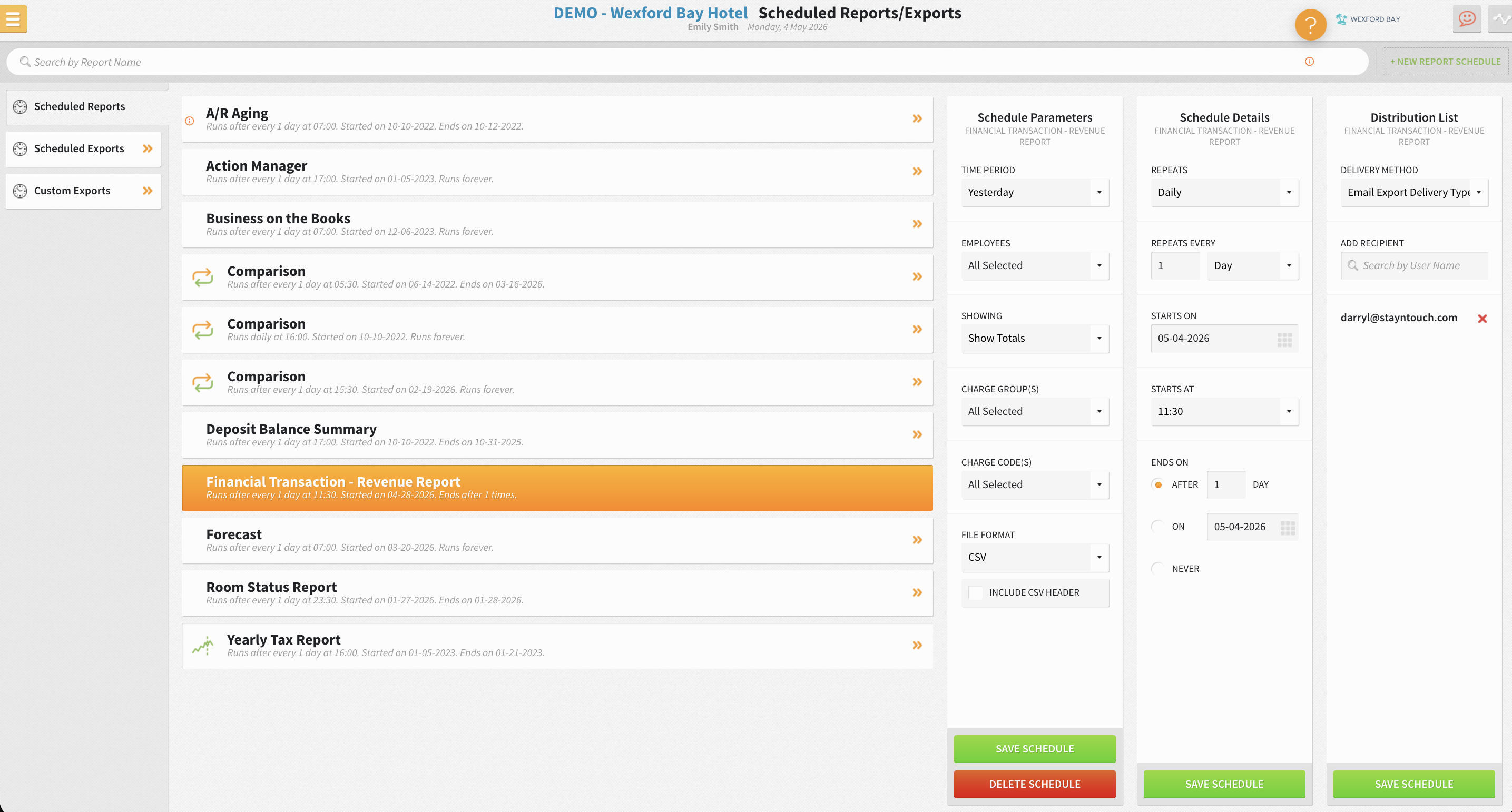
According to Stayntouch customer data, multi-property management with Stayntouch runs 70% more efficiently from a single dashboard. Key capabilities include:
-
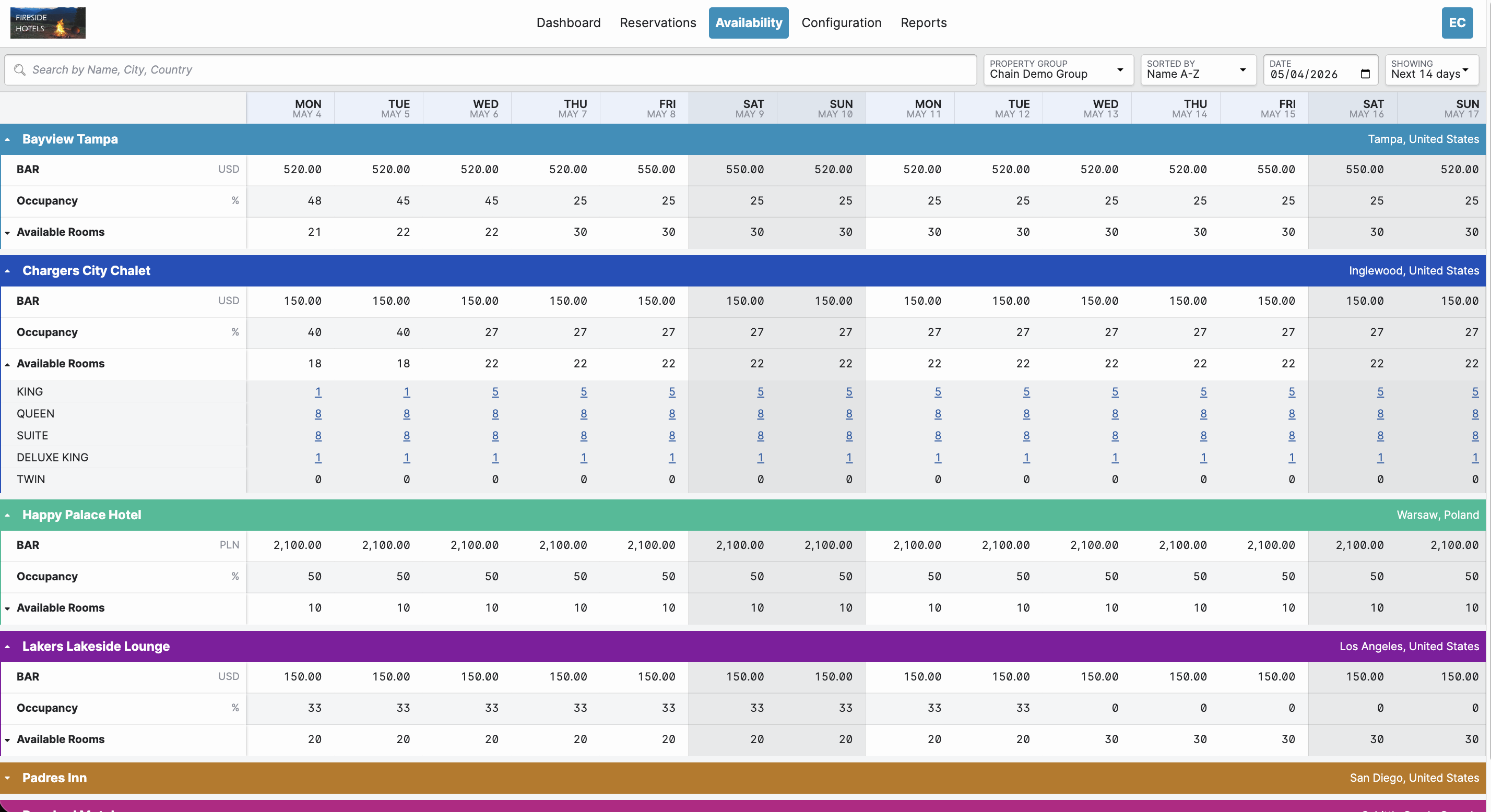
A multi-property dashboard managing 100+ properties from a single login, with occupancy, available rooms, and best available rate (BAR, the lowest unrestricted rate currently on sale) displayed per property in local currency
-
Centrally pushed configuration templates for rate types, deposit and cancellation policies, charge codes, user permissions, and housekeeping task lists
-
Shared guest, travel agent, and company profiles across the group, so a returning guest at a sister property arrives with their history and preferences already known
-
Custom property groups by region, brand tier, or management cluster
-
New property setup via Auto-Configuration, reducing configuration from around 30 hours of manual work to 4–5 hours
Full portfolio deployment completes in 30–45 days. Stayntouch has deployed 139 properties in 90 days, covering 7,000+ rooms across 29 U.S. states, which demonstrates the scalability of the implementation model. Explore multi-property workflows in a portfolio-focused demo.
Role-specific decision guides for hotel leaders
General Managers and Owners
General managers need technology that removes operational drag instead of creating it. Long training cycles delay productivity every time someone new is hired. Queues form in the lobby while staff work through screens. Departments operate from different versions of the truth.
According to Stayntouch customer data, Stayntouch addresses each of these directly:
-
Front desk staff are fully trained in 2 hours, so a new hire is productive on their first shift.
-
Three-way check-in, including fully mobile in 30 seconds, hybrid pre-check-in, or staff-assisted anywhere on property via tablet, reduces staff-assisted check-in by 54%.
-
Real-time sync keeps every department working from the same data, removing the reconciliation that consumes shift hours.
-
Automated bulk check-in, report scheduling, payment collection, night audit (the end-of-day process closing out transactions and rolling the system into the next business day), and charge posting run without staff intervention.
Bradley Koch, Chief Technology Officer at HEI Hotels & Resorts, notes: “We were especially impressed with Stayntouch’s ability to quickly deploy their solution in our properties in under a month, as well as how quickly our hotels’ staff were able to pick up and learn the system.”
IT Directors and CTOs
IT leaders evaluating a cloud based hotel PMS carry accountability for uptime on infrastructure they do not control, per-integration fees that make every connection a budget conversation, and vendor lock-in that restricts which tools the business is permitted to use.
Stayntouch’s architecture addresses each concern:
-
Cloud-native on AWS with the uptime record detailed earlier, with no servers, no on-premise installs, and no downtime for product releases
-
Access to the full integration catalog without per-connection charges, with open APIs, webhook-enhanced event-driven architecture, documented endpoints, and sandbox environments
-
Integration access scoped via OAuth (an authorization method giving an application limited, revocable access), so a door lock application can see a room number and checkout date but is blocked from payment details or home addresses
-
Security certifications including PCI DSS (Payment Card Industry Data Security Standard) Level 1, SOC 2 Type 1, GDPR (European data-protection law), ISO 27001/27018, and AWS Private VPC (Virtual Private Cloud, an isolated, private section of cloud infrastructure)
-
Governance with local flexibility, where configuration and permissions standardize centrally across 100+ properties while individual hotels retain operational latitude
Matt Schwartz, Chief Technology Officer at Sage Hospitality Group, says: “Stayntouch’s platform feels lightweight and intuitive, and it comes packed with robust functionality that allows our independent properties to deliver the best service possible.”
Revenue Managers
Revenue managers are measured on ADR (average daily rate, average room revenue per paid occupied room) and occupancy, optimized together. The gap between a pricing strategy set in a spreadsheet and what actually executes at the front desk is the central pain point.

According to Stayntouch customer data:
-
The Rate Strategy module automates rule-based rate adjustments on configurable parameters with multiple thresholds inside a single strategy, driving occupancy and ADR simultaneously without a separate RMS contract.
-
Rate Strategy trains in 20 minutes and activates instantly.
-
Rates, restrictions, and inventory adjust from any device with an internet connection.
-
Automated mobile and kiosk upsells have driven ROI increases of up to 240% on mobile and up to 120% on kiosk at individual properties, which represent standout cases rather than averages.
-
For hotels that want a dedicated RMS, Stayntouch integrates with IDeaS, Duetto, FLYR, Lighthouse, PriceLabs, and others, so the choice stays with the hotel.
The 2026 Hotel Technology Outlook found that best-in-class PMS users report 59% satisfaction with revenue management versus 51% among all-in-one users.
Finance and Operations Leaders
Finance leaders focus on accuracy, auditability, and a fast end-of-day close. Revenue leaks quietly through missed charges, manual billing errors, and inconsistent tax application.
According to Stayntouch customer data, Stayntouch delivers:
-
Up to 42% improvement in accounting efficiency through payment automation and integrations with leading accounting systems including Sage Intacct, QuickBooks Online, Xero, M3, and DATEV
-
Automatic posting of charges from POS, spa, mobile, and the Grab & Go Kiosk straight to the guest folio, with no manual intervention
-
Automated night audit and end-of-day, with occupancy tax (the per-night tax on the room rate, set locally by city, county, or state) and additional local taxes applied instantly
-
Digital Registration Cards that capture signed terms and conditions, creating a record that reduces disputes and chargebacks (guest-initiated card disputes that the hotel loses by default without documentation)
-
Stayntouch Pay, which consolidates processing, acquiring, and settlement into a single transparent monthly statement with funds settled two business days after transaction
See how Stayntouch supports your specific role in a focused session.
Frequently Asked Questions
What is the difference between a cloud based hotel PMS and an all-in-one hotel platform?
A cloud based hotel PMS is software that specializes in property management, including reservations, check-in, billing, housekeeping, and reporting, and connects to best-in-class tools for revenue management, point-of-sale, CRM, and central reservations through open integrations. An all-in-one platform bundles those categories into a single vendor contract. The practical difference is control. A best-in-class PMS lets a hotel choose the right specialist tool in each category, while an all-in-one decides which tools the hotel is permitted to use. The 2026 Hotel Technology Outlook found that 30% of all-in-one users intend to move to best-in-class solutions, against 14% moving the other way, and that best-in-class users report 70% PMS satisfaction versus 55% among all-in-one users.
How long does it take to implement a cloud based hotel PMS for a multi-property group?
Stayntouch deploys a full portfolio in 30–45 days using a structured six-week process that runs from team introductions and milestone setting through property shell activation, configuration sessions, integration setup, payment gateway configuration, guest mobility setup, user training, and go-live preparation. Auto-Configuration reduces property setup from around 30 hours of manual work to 4–5 hours using standardized templates. The Dataloader module migrates legacy guest profiles, group reservations, company and travel agent profiles, and deposit totals in as little as 1–2 hours. Deployment can be fully remote, on-site, or a combination. Stayntouch has deployed 139 properties in 90 days as a demonstration of the model at scale.
Are integrations included in the cost of a cloud hotel PMS, or are they billed separately?
Pricing depends on the vendor. Legacy enterprise platforms can charge five figures for a single new integration. Many cloud platforms charge $100–$500 per month per integration or API access on top of the base subscription. Stayntouch provides access to its entire integration library with unlimited connections at no additional cost, with no per-interface fees and no charges for API certification. This is a deliberate commercial decision. A PMS that profits from integrations has an incentive to limit them, while a PMS that does not competes on how well it connects. Improving the tech stack becomes an operational decision rather than a capital one.
What security and compliance standards should a cloud based hotel PMS meet?
At minimum, a cloud hotel PMS handling payment data should be certified to PCI DSS Level 1, the most stringent tier of the card industry’s security standard, and use tokenization, which replaces card numbers with meaningless substitute values so real card data is never stored, and point-to-point encryption, which scrambles card data from entry to processor. For European operations, GDPR compliance is a legal requirement. ISO 27001 and ISO 27018 cover information security management and protection of personal data in the cloud. SOC 2 Type 1 provides an independent audit of security controls. Stayntouch holds all of these certifications and maintains product compliance in 66 countries across 6 regions, with jurisdictional diligence completed in advance on the customer’s behalf rather than left to the hotel operator to research.
How do I evaluate vendor claims about training time and uptime when choosing a cloud PMS?
Ask for customer references at properties of comparable size and complexity, and ask those customers specifically how long it took a new front desk hire to work independently, not how long the formal training session ran. For uptime, ask for a verified performance record over the past 24 months, not a contractual SLA figure. Distinguish between system uptime, when the platform is accessible, and release downtime, when the vendor pushes an update that takes the system offline. Stayntouch has sustained 100% system uptime over the past two years, and product releases require no downtime. For training, Stayntouch customer data shows full front desk training completes in 2 hours, and Stayntouch Academy provides self-paced eLearning with test environments and certifications so the claim can be verified through the onboarding process itself.
Conclusion: Why a cloud based PMS now outperforms legacy and all-in-one
A best-in-class cloud based hotel PMS removes three major constraints that legacy and all-in-one platforms impose. Long training cycles reset with every hire, per-integration fees discourage improving the stack, and vendor lock-in restricts which tools a hotel is permitted to use. For properties of 75 rooms and above, including independent hotels, boutique groups, and mid-sized chains managing 1 to 100+ properties, the operational and financial case for a cloud-native, open-integration PMS has never been clearer.
Stayntouch trains front desk staff in 2 hours, connects its full integration catalog without extra fees, sustains 100% system uptime on AWS, and deploys a full portfolio in 30–45 days. The platform holds a 97% customer retention rate and a 94% recommendation rating on Hotel Tech Report, and was named “Hotel PMS Company of the Year” at the 2026 TravelTech Breakthrough Awards.
Book a demo to see the platform in action.
Read Next
Turn a more connected stack into a better stay.
See how Stayntouch can support the operating moments that matter most to your hotel team.